
Knob-and-Tube Wiring and Homeowners Insurance: What an Inspection Report Can and Cannot Do
A request from a homeowners insurer can be as brief as “Provide an electrical report” or as specific as “Confirm that no active knob-and-tube wiring remains.” Those are different assignments. Before scheduling an electrician, obtain the request in writing and ask whether the carrier has a required form, photo list, testing standard, deadline, or contractor qualification.
An electrician can inspect accessible wiring, trace selected circuits, test representative devices, photograph observed conditions, and describe work recommended for safety or reliability. The report records what was found and what could not be seen. It does not bind an insurance company or guarantee a policy. Without access, it cannot prove the condition of concealed wiring.
That distinction protects the homeowner as much as the contractor. A narrowly worded “certification” may sound stronger, yet fail to answer the underwriter’s actual question or overstate what a non-destructive inspection can establish.
Why knob-and-tube wiring draws scrutiny
Knob-and-tube is an early wiring method. Separate insulated conductors run in open air, supported on porcelain knobs and protected by porcelain tubes where they pass through wood framing. It did not include an equipment grounding conductor in the way modern branch-circuit cable does.
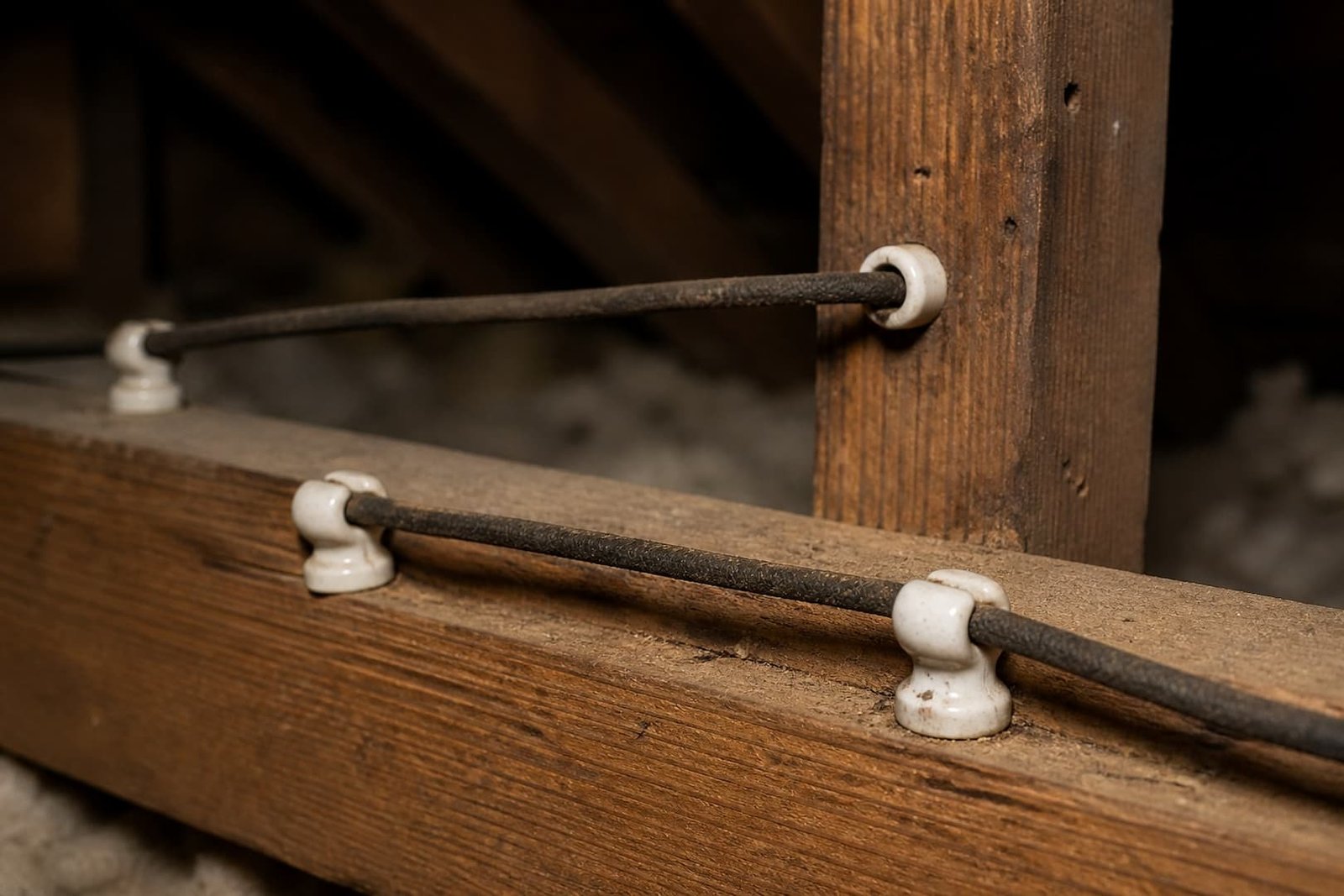
The wiring method’s age is only part of the concern. A century of renovations may have added concealed splices, oversized protection, damaged insulation, or grounded receptacles without a grounding path. Thermal insulation may also surround conductors designed to dissipate heat in open air. The U.S. Consumer Product Safety Commission’s report on residential electrical distribution fires notes that covering older open wiring with thermal insulation can raise conductor temperature and shorten insulation life.
None of that means every visible porcelain knob proves an immediate failure. Some hardware is abandoned. Some circuits have been partly replaced. The condition, use, alterations, overcurrent protection, and environment have to be examined together.
What an insurer may be trying to learn
- Whether active knob-and-tube wiring is present
- Which rooms or circuits it appears to serve
- Whether the observed insulation is intact or visibly deteriorated
- Whether thermal insulation contacts accessible runs
- Whether improper alterations or open splices are visible
- Whether overcurrent protection appears appropriate for the observed conductors
- Whether three-slot receptacles are actually grounded
- Whether replacement has been completed under permit
- What corrective work the electrician recommends
Some carriers will consider a condition report. Others require replacement of active knob-and-tube wiring before binding or renewing a policy. Underwriting standards differ by company, property, policy, and market conditions. An electrician can provide electrical facts; the carrier decides how it treats those facts.
Three common requests—and why the wording matters
| Request | Reasonable electrical scope | Limit to state |
|---|---|---|
| “Inspect the knob-and-tube wiring” | Accessible visual inspection, representative testing, circuit observations, photos | Concealed areas and untraced branches remain outside the observation |
| “Confirm wiring is in good condition” | Describe observed condition and test results using specific language | “Good” is undefined; no non-destructive visit predicts future failure |
| “Confirm no active knob-and-tube remains” | Records review, panel and circuit tracing, accessible area inspection, targeted openings if authorized | High confidence may require broader access than a standard inspection |
If the underwriter asks for a signed form, send it before the visit. The electrician may find that a checkbox requires testing or access not included in the initial appointment. It is better to revise the scope than to force a yes-or-no answer unsupported by the evidence.
What a useful inspection includes
Document review and owner interview
Permit history, prior electrical invoices, remodeling plans, and panel directories provide leads. The owner should identify dead outlets, warm devices, recurring trips, flicker, previous insulation work, and rooms renovated at different times. Records help focus the inspection; they do not replace field verification.
Service and panel observations
The electrician records accessible service and panel ratings, overcurrent devices, visible conductor types, directory condition, grounding and bonding observations, and signs of heat, corrosion, or unapproved additions. De-energization may be needed before covers are removed safely.
Accessible attics, basements, crawlspaces, and utility areas
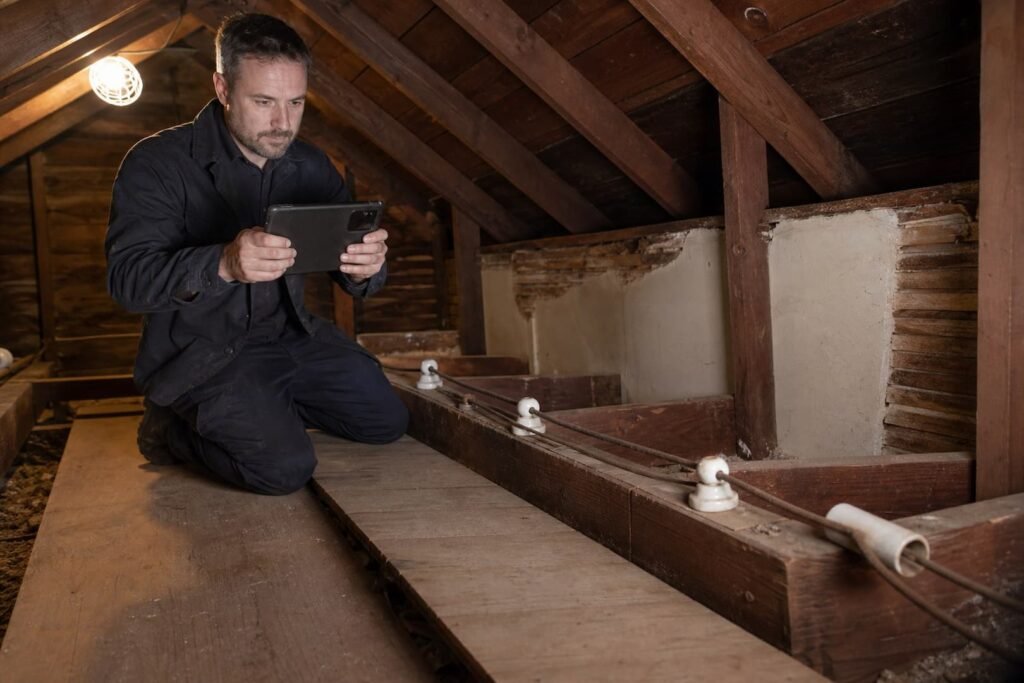
These areas often show the best evidence of original wiring and later alterations. The report should identify access conditions, visible conductor insulation, porcelain supports, contact with thermal insulation, junction methods, abandoned wiring, and transitions to newer cable. Storage, unsafe framing, vermiculite, pests, or low clearance can limit access.
Representative device and circuit testing
Receptacle tests can reveal polarity and the presence or absence of an equipment grounding path at the tested location. Circuit tracing can connect rooms or devices to panel protection. Neither method alone identifies every concealed conductor. Report GFCI protection separately from equipment grounding, even when the device has three slots.
Photographic record
Photos should show context, not only close-ups. A useful sequence includes the panel, route area, representative supports and insulation, observed splices or transitions, contact with building insulation, tested devices, and any area that could not be entered. Captions need locations and observations rather than alarmist labels.

What the written report should say
- Property address, inspection date, requesting party, and inspector identity
- Purpose and exact requested questions
- Areas and equipment accessed
- Inspection and testing methods used
- Observed active, inactive, or indeterminate knob-and-tube components
- Representative circuit and device findings
- Observed defects or conditions requiring correction
- Photos tied to room or area names
- Access limitations and concealed conditions
- Recommended next steps, separated by urgency and purpose
Precise wording is stronger than a blanket conclusion. “Cloth insulation was intact at the three accessible attic locations shown in Photos 4–6” is verifiable. “All wiring is safe” exceeds what those observations establish.
What the report cannot establish without more work
- The condition of conductors concealed behind intact finishes
- The absence of hidden splices or abandoned energized segments
- The history of every alteration
- Future performance or remaining insulation life
- Compliance with every provision of the current code in an older installation
- Insurance eligibility, premium, renewal, or claim outcome
- Complete absence of active knob-and-tube wiring when tracing and access were limited
Targeted openings, additional tracing, temporary disconnection, or replacement may be needed to answer a stricter question. The owner should approve destructive access and finish responsibility before it occurs.
Conditions that usually move the conversation toward replacement
- Brittle, cracked, missing, or heat-damaged conductor insulation
- Open, taped, or otherwise improper alterations
- Thermal insulation covering active conductors
- Overfusing or oversized breaker protection
- Ungrounded circuits serving equipment that needs a grounding path
- Recurring trips, flicker, odor, arcing, shocks, or warm devices
- Broad remodel work that already exposes walls and ceilings
- An insurer’s written requirement to remove active knob-and-tube wiring
ESFI recommends an electrical inspection for a home 40 years old or more and lists damaged insulation, frequent trips, flicker, buzzing, heat, and shocks among warning signs. Its home wiring safety guidance is a useful homeowner reference, but urgent symptoms should be evaluated directly rather than documented for insurance first.
How to prepare for the inspection
- Forward the insurer’s complete written request and form.
- Collect prior permits, invoices, panel schedules, and rewiring records.
- Clear safe access to panels, attic entries, basements, crawlspaces, and representative devices.
- List electrical symptoms and rooms remodeled at different times.
- Ask whether the inspection may require de-energization or targeted openings.
- Confirm the report recipient, deadline, and preferred file format.
- Send the finished report to the carrier for its own determination.
Do not change the visible wiring or make cosmetic repairs solely to improve photographs. The purpose is to establish an accurate condition and a defensible next step.
If the insurer asks for proof of replacement
Clarify whether the carrier wants a paid invoice, contractor letter, permit record, final inspection, photos, updated panel directory, or a statement that no active knob-and-tube remains. Retain all of them when replacement is performed. The proof should match the actual scope: partial replacement must not be described as whole-house removal.
Use the comparison in Partial vs. Full Knob-and-Tube Replacement to understand when a limited scope can be defined and when a comprehensive rewire is more credible.
Frequently asked questions
Will an electrician’s report guarantee insurance approval?
No. The report supplies electrical observations and recommendations. The insurer applies its underwriting rules and decides whether to issue, renew, limit, or price coverage.
Can a home inspection report be used instead?
Only if the insurer accepts it and it answers the requested electrical questions. A general home inspection commonly has a different scope from circuit tracing and a licensed electrician’s written findings.
Can an electrician certify that all knob-and-tube wiring is inactive?
Sometimes, after sufficient records review, tracing, access, disconnection, and testing. A standard visual inspection may not support that conclusion when conductors disappear behind finishes.
Does GFCI protection make knob-and-tube wiring grounded?
No. GFCI protection can reduce shock risk under an approved arrangement, but it does not create an equipment grounding conductor. The device, labeling, equipment needs, and circuit condition must be evaluated separately.
Should I call the insurer before replacing wiring?
Yes. Get its requirement in writing so the electrical scope and final documentation address the real underwriting question. Safety defects still deserve prompt correction regardless of a paperwork deadline.
Request a defined inspection and report
Max Electric provides knob-and-tube inspection and insurance reports in San Francisco with accessible circuit observations, photographs, findings, and written limits. Send the carrier’s request before scheduling or call (415) 867-7006.
For policy-shopping and complaint resources, consult the California Department of Insurance’s current homeowners insurance guide.
Last reviewed August 2026. This article provides general electrical information and does not interpret an insurance policy or offer legal advice.