
Water Leak Detection in San Francisco
A stain tells you where water became visible, not necessarily where it started. We work from fixtures, meters, pressure behavior, moisture patterns and accessible piping to narrow the source before recommending openings or repair.
Leak detection is a sequence of evidence, not one magic device
Thermal imaging may show temperature differences, but those patterns are not proof of water by themselves. Moisture meters identify damp materials, not the exact failed fitting. Acoustic tools depend on pressure, material and background noise. Reliable diagnosis combines methods and verifies the most likely source.
We also rule out non-plumbing sources where practical: condensation, failed caulking, appliance discharge, roof or exterior entry and drainage backups can imitate supply leaks. The result should state findings, limitations and the recommended access or next test.

A concealed leak is narrowed in layers
No single device finds every leak. The sequence changes with the symptom, but each step should either eliminate a source or make the search area smaller.
Connect moisture to time and use
Does the stain grow with constant pressure, only during drainage, after a shower, or after weather? The pattern separates systems.
Inspect fixtures, valves and visible routes
Start where confirmation is cheap. A loose trap hidden by stored items does not need an acoustic survey.
Test branches or fixtures where controls allow
Meter movement, pressure behavior and controlled fixture use can show whether the source belongs to a pressurized or drain-side system.
Use the method that fits the material and access
Acoustic listening, moisture mapping, thermal patterns or tracing can support the diagnosis, but each has limitations.
Open only when the evidence supports the location
A small inspection opening or direct observation should confirm the repair target before a wider scope is approved.
Moisture patterns that call for source isolation
Meter moves with fixtures off
Isolate branches, fixtures and equipment to determine whether pressurized water loss is likely.
Ceiling or wall stain
Map moisture and inspect plumbing above, behind or nearby without assuming a straight vertical path.
Unexplained water bill increase
Check continuous-use fixtures, irrigation or equipment where relevant before pursuing concealed piping.
Intermittent moisture
Compare timing with showers, drains, appliances, weather and occupancy.
Warm area on floor or wall
Use temperature and moisture evidence together; heat patterns alone do not prove a hot-water leak.
Multifamily source unclear
Coordinate unit access and shared piping so water travel between floors or walls is not misattributed.
Evidence we compare before recommending an opening
- Customer timeline and water-use changes
- Fixture, valve and appliance checks
- Meter observation when accessible and appropriate
- Moisture mapping across affected finishes
- Pressure or zone isolation when suitable
- Acoustic or thermal observations with stated limitations
- Accessible cavity or camera inspection where justified
- Recommended repair access or further investigation
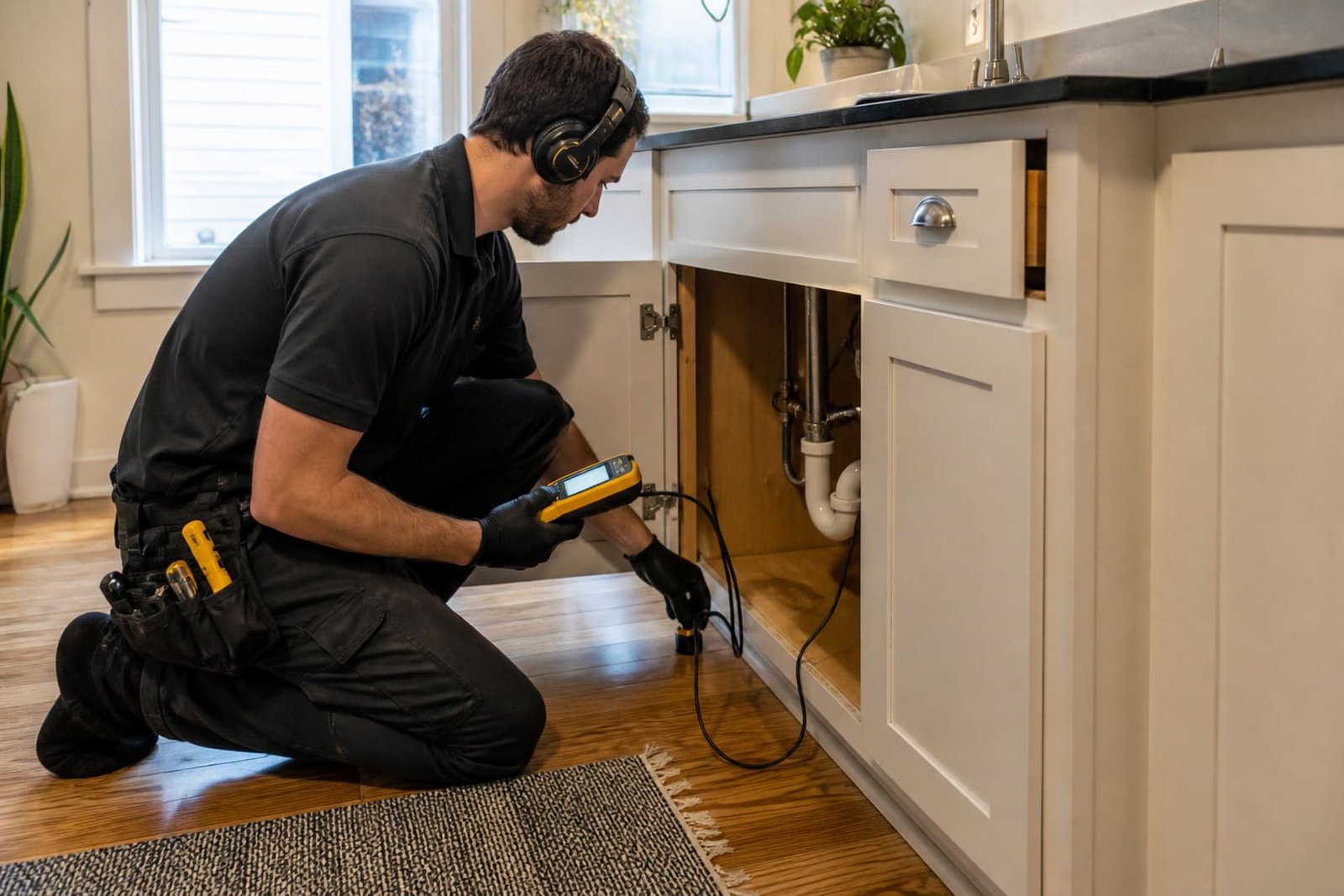
Repair, monitor or continue testing based on confidence
| Finding or need | Practical direction |
|---|---|
| Source confirmed at an accessible component | Move to a focused leak repair scope. |
| Evidence narrows a concealed location | Plan the smallest practical access that can confirm and repair the source. |
| No active plumbing leak is verified | Document findings and consider drainage, exterior, condensation or intermittent-use causes. |
| Multiple failures or degraded material appear | Review whether pipe repair or repiping is the better next decision. |
What different clues can—and cannot—tell us
Instrumentation is useful when its result is interpreted with the building and the symptom. A colored thermal image or a loud point on a line is not a complete conclusion by itself.
| Clue or method | Useful for | Common limitation |
|---|---|---|
| Moisture readings | Mapping damp material and comparing affected areas | Shows where moisture is present, not necessarily where it entered |
| Thermal pattern | Finding temperature differences that may guide closer inspection | Sun, HVAC, insulation and old moisture can create similar patterns |
| Acoustic listening | Narrowing some pressurized leaks that produce usable sound | Pipe material, background noise and small leaks can weaken or shift the signal |
| Pressure or meter observation | Showing whether a closed system may be losing water | Does not locate the loss and depends on correct isolation |
| Controlled fixture testing | Linking drainage, enclosure or supply symptoms to a repeatable action | Intermittent leaks may not reproduce during a short visit |
Confidence grows when several independent clues point to the same place. When they do not, the report should say what remains uncertain.
Narrow the system, the route and finally the access area
Build a symptom and timing history
Check accessible fixtures and likely sources
Map moisture and isolate the plumbing system
Correlate findings instead of relying on one tool
Explain confidence, limitations and the next action
What happens after the likely source is narrowed
Detection has value only if the next person can act on the finding.
The source is accessible and confirmed
A repair can be scoped against the visible failed component, followed by an operating test.
The source is concealed but the area is well supported
Define the smallest practical access opening and who will handle finish removal and restoration.
Evidence points to a drain or enclosure instead of a supply pipe
Route the work to drain repair, fixture sealing, waterproofing or another appropriate specialty rather than forcing a pipe repair.
The evidence remains mixed
Record the tests, limits and next isolation step. Another controlled test may be better than opening a large area on low confidence.
Leak Detection Services in San Francisco FAQ
Can leak detection guarantee no wall opening?
No. The goal is to narrow and justify access. Some concealed conditions can only be confirmed through a controlled opening.
Is thermal imaging enough to locate a leak?
No. It shows surface temperature patterns. Moisture readings, plumbing checks and other evidence are needed to interpret the pattern.
Can you find an intermittent leak?
Sometimes, but the source may need to be active or reproduced safely. Timing, fixture use, weather and photos are especially helpful.
What do I receive after the assessment?
You should receive a plain-language explanation of findings, limitations and the recommended repair access or next diagnostic step.
Describe the timing, location and recent changes
Include the address, property type, affected fixture or equipment, when the issue began, whether water or sewage is active, and any safe-to-take photos. You do not need to diagnose it first.