
Water Heater Repair in San Francisco
Repair begins with the whole operating system: water, energy source, controls, venting where applicable, temperature delivery and the condition of the vessel or heat exchanger.
“No hot water” can begin at the heater—or somewhere around it
An electric tank may lose one heating element and still produce a short amount of warm water. A gas unit may have fuel available but fail to ignite or prove flame. A tankless heater can show an error because of flow, scale, venting, gas supply or a control fault. Even a working heater can seem inadequate when a mixing valve, recirculation loop or changed household demand affects delivery.
We start with the model, energy source and actual complaint. Then we check the inputs, controls and operating sequence that apply to that unit. The repair decision should identify the failed part and confirm that the rest of the appliance can be returned to safe, useful service. Swapping parts by symptom is slower—and often more expensive—than tracing the sequence.
A repair is worthwhile when it restores a safe, serviceable system
No hot water may come from a control, heating element, burner, ignition, power, gas supply, flow sensor or safety device. Poor recovery can reflect demand, temperature setting, sediment, component wear or a system that was never sized for current use.
We identify the failure and also note conditions that would undermine the repair: a leaking tank body, severe corrosion, unsafe venting, unavailable parts or a unit whose age and condition make repeated work poor value. The recommendation should explain both paths.
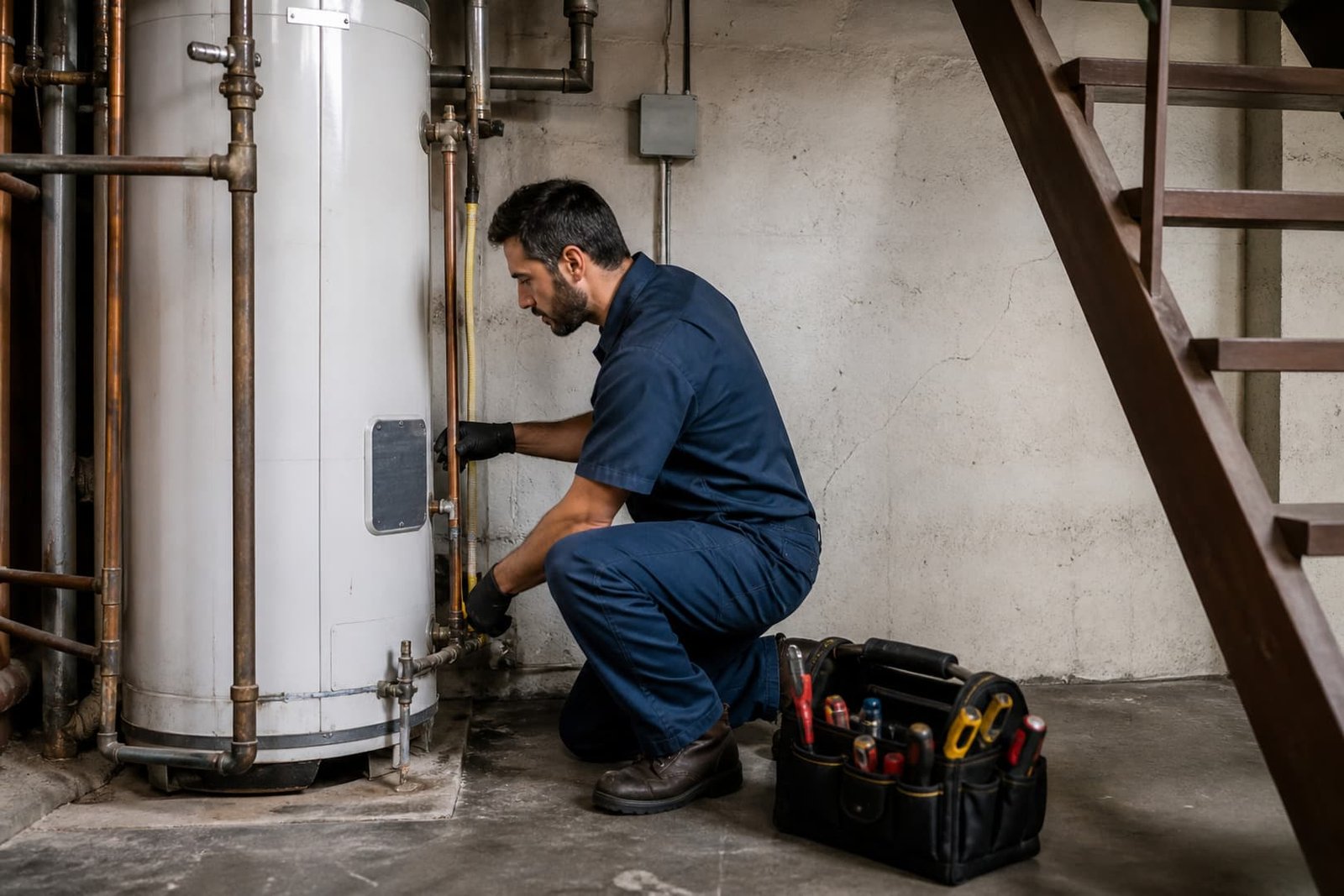
Some performance problems are repairable failures; others are design limits
A repair can restore the unit to its intended output. It cannot create storage volume, fuel input or electrical capacity the system was never designed to provide.
| Complaint | Possible repair-side checks | Possible system-side question |
|---|---|---|
| No hot water at all | Power or gas supply, ignition, controls, thermostats and heating components | Is another control or mixing device interrupting delivery? |
| Hot water runs out quickly | Failed lower element, thermostat, sediment effects or burner performance | Has demand increased beyond the tank’s usable storage and recovery? |
| Temperature swings | Controls, scale, flow sensing or unstable combustion | Are fixtures, crossover or recirculation affecting delivered temperature? |
| Water takes too long to arrive | Recirculation controls and check valves when present | Is the distribution route long and unserved by a recirculation design? |
| Leak near the heater | Valves, unions, drain and relief discharge source | Is the tank or heat exchanger itself leaking and no longer repairable? |
When the appliance works as designed but no longer meets the property’s use, replacement or system redesign is a different conversation from component repair.
Operating symptoms that change the diagnostic sequence
No hot water
Check energy source, controls, heating components, safety devices and system status.
Temperature swings
Review controls, mixing, crossover, flow and demand pattern.
Water not hot enough
Check setpoint, heating performance, scale or sediment, delivery and actual household demand.
Tankless error code
Use the code as a starting point, then verify flow, combustion or power, venting and maintenance condition.
Noise or slow recovery
Inspect sediment, scale, burner or element operation and whether demand exceeds capacity.
Leak at the unit
Determine whether it is a serviceable connection or valve versus the tank or heat exchanger itself.
Inputs, controls and components checked for this heater
- Equipment type, fuel, age and model
- Water connections, valves and visible leakage
- Power, gas or other energy supply
- Controls, codes and safety devices
- Venting and combustion air where applicable
- Heating and recovery performance
- Temperature delivery and mixing
- Repair value versus replacement condition
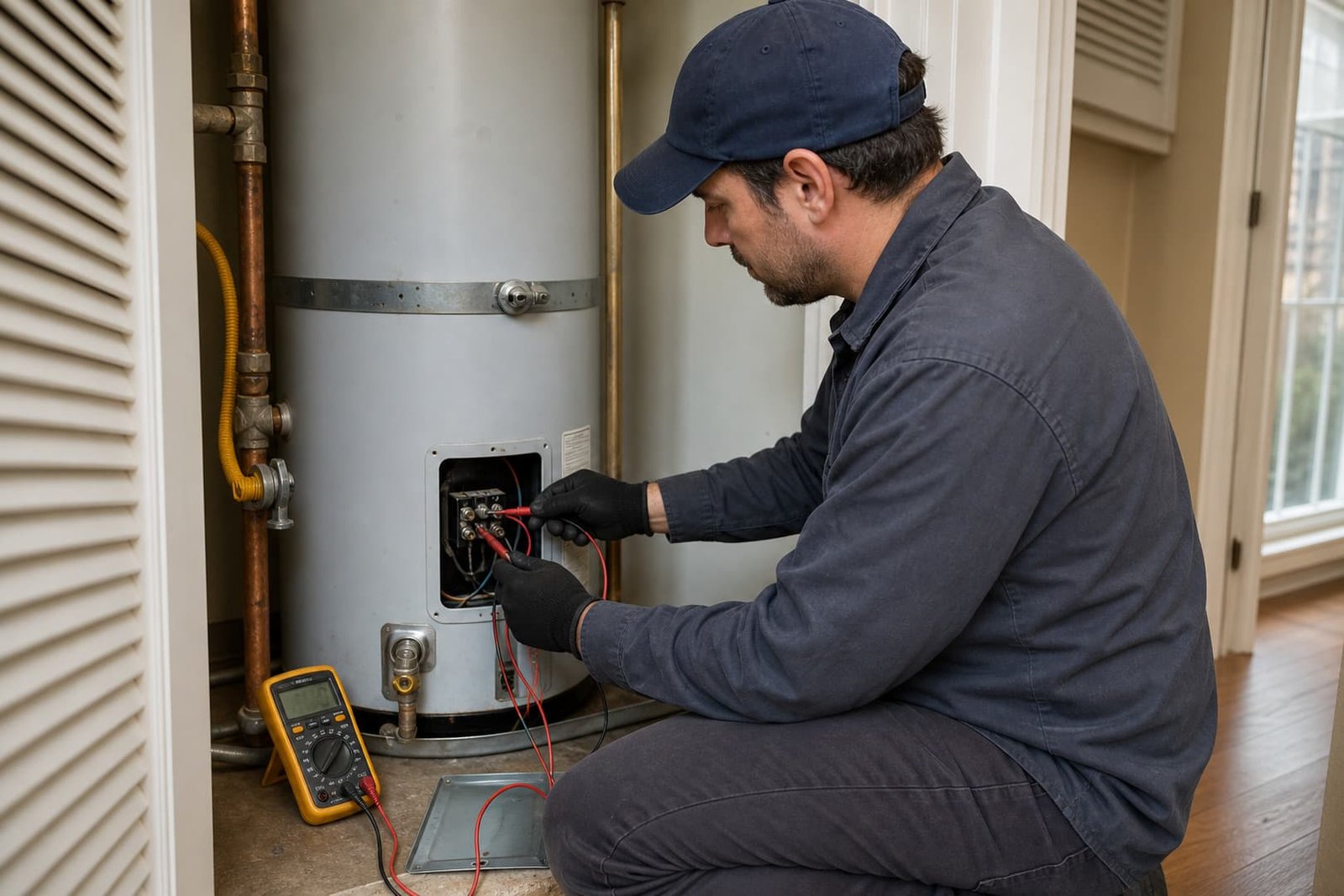
Repair the fault or identify why replacement is the better value
| Finding or need | Practical direction |
|---|---|
| Repair | For a clearly failed serviceable component in an otherwise suitable unit. |
| Maintenance plus repair | When scale, sediment or overdue service contributes and the equipment supports corrective maintenance. |
| Replacement | When the vessel leaks, safety cannot be restored economically or condition predicts poor repair value. |
| Installation review | When original sizing, venting, gas, electrical or piping design is the root problem. |
Trace the operating sequence and test the repair under demand
Collect model, age, symptoms and codes
Test water, energy and control conditions
Identify the failed component and contributing factors
Explain repair value and alternatives
Repair, operate and verify safe performance
A repair should end with an operating sequence, not a power-on moment
The technician needs enough run time to see the unit respond under the condition that previously failed.
- Start
- Confirm the call for heat and the expected ignition or electrical sequence without repeated fault resets.
- Heat
- Observe temperature response, burner or element operation and any manufacturer controls relevant to the repair.
- Deliver
- Run a suitable fixture to confirm hot-water delivery and stable operation under flow.
- Inspect
- Check accessible water connections, relief discharge, venting or electrical covers disturbed during service.
- Record
- Note the failed component, correction, remaining condition and any maintenance or replacement issue that is separate from the repair.
Water Heater Repair in San Francisco FAQ
Do you repair tankless units?
Yes. Model information and error codes help prepare, but diagnosis still checks flow, power or gas, venting, scale and controls.
Is a leaking water heater repairable?
Connections, valves and some components may be. A leaking tank body generally is not a component repair and usually points to replacement.
How do I choose repair or replacement?
Consider the failed part, unit condition, age, safety, parts availability, efficiency, prior repairs and installation quality—not age alone.
Can maintenance fix a no-hot-water problem?
Sometimes maintenance contributes to recovery, but a failed component or supply problem needs direct diagnosis.
Send the model, energy source and exact hot-water symptom
Include the address, property type, affected fixture or equipment, when the issue began, whether water or sewage is active, and any safe-to-take photos. You do not need to diagnose it first.