
Tankless Water Heater Installation in San Francisco
Tankless equipment is sized for simultaneous flow and temperature rise—not storage gallons. A successful conversion depends on the utility infrastructure and distribution system as much as the wall-mounted unit.
Confirm the infrastructure before choosing the model
For gas equipment, available gas capacity, pipe route, venting and combustion requirements can drive the project. Electric tankless equipment can require substantial electrical capacity. Condensing units also need a suitable condensate route. We check those constraints before treating a brochure rating as an installation plan.
Long pipe runs can still create a wait for hot water. A compatible recirculation approach, insulated distribution and fixture use may matter more to comfort than the equipment’s headline flow rate.
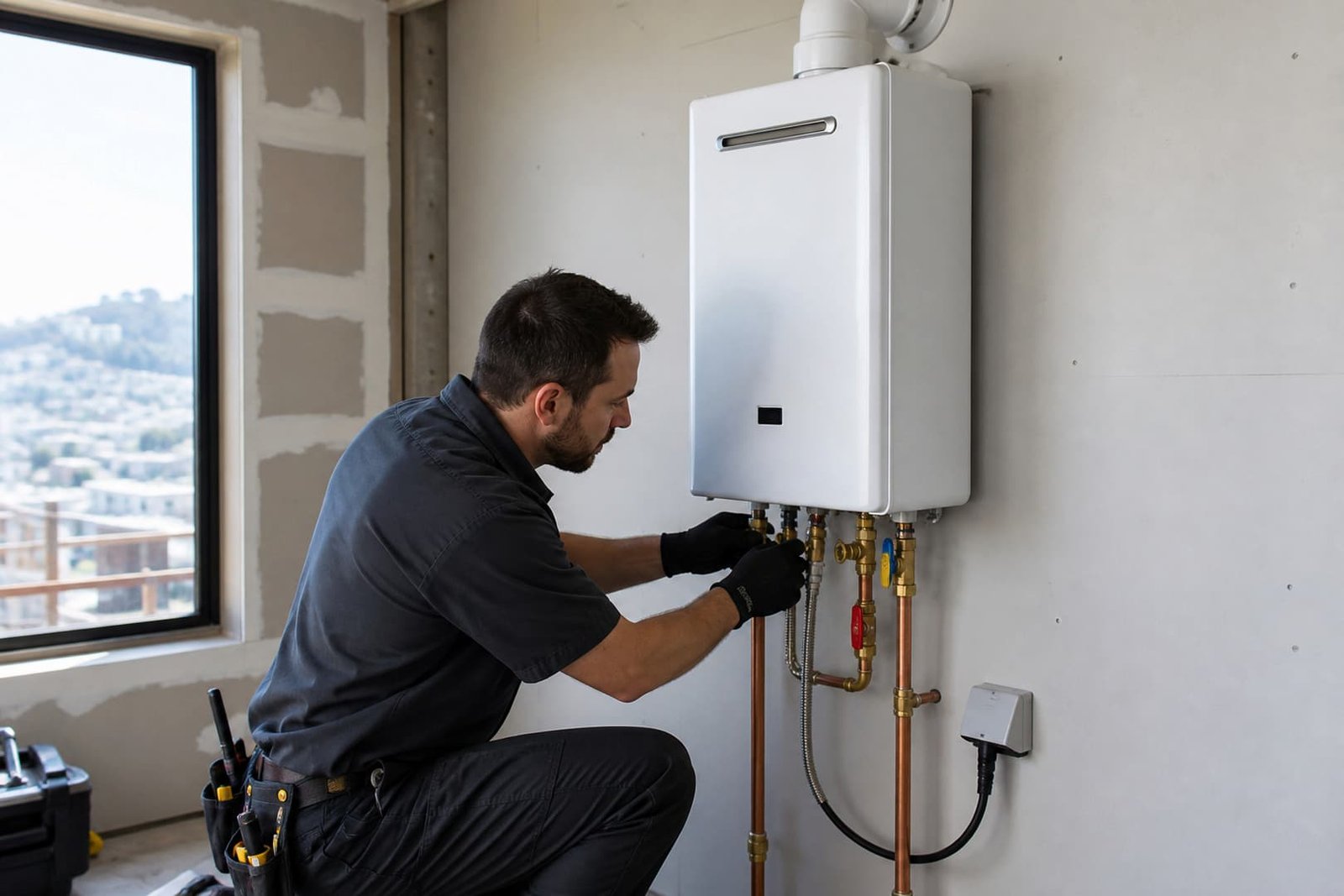
A tankless heater saves storage space, but it asks more from the infrastructure while running
The right question is not whether tankless technology is “better.” It is whether the property can support the required flow, temperature rise, energy input, venting or electrical load, condensate handling and maintenance access.
| Fit factor | What we evaluate | Why it matters |
|---|---|---|
| Simultaneous flow | Showers, faucets and appliances likely to run together | The unit must heat the combined flow at the required temperature rise |
| Incoming water temperature | Seasonal supply temperature and desired delivery temperature | A larger temperature rise reduces the flow one unit can deliver |
| Gas or electrical capacity | Gas meter and piping path, or electrical service, panel and circuit demand | Tankless equipment often has a high instantaneous input |
| Venting or exhaust | Approved route, termination, intake and material for the selected model | A tank vent usually cannot be assumed suitable for a tankless unit |
| Condensate and drainage | Whether the selected equipment condenses and where drainage can run | The route may need treatment, protection and service access |
| Water quality and isolation | Scale potential, service valves and flushing access | Maintenance is easier when the system can be isolated and circulated properly |
| Distribution and recirculation | Distance to fixtures and any existing return loop | Tankless does not by itself eliminate the wait for hot water at a remote fixture |
Equipment selection should follow these findings. Choosing a model first can force an expensive utility or venting change—or leave the home with disappointing flow.
Goals that may—or may not—fit a tankless conversion
Tank-to-tankless conversion
Review peak flow, location, gas or electrical capacity, venting, condensate and removal scope.
New ADU or compact space
Coordinate equipment, utility load and short distribution routes early in design.
Multiple simultaneous showers
Calculate temperature rise and realistic combined flow before model selection.
Long wait at distant fixtures
Review distribution and supported recirculation options; tankless alone does not shorten the pipe.
Outdoor versus indoor location
Compare exposure, venting, access, clearances, condensate and maintenance needs.
Commercial point or central use
Size from actual operating profile, redundancy needs and peak demand.
Verify the load and infrastructure before selecting the unit
| Path | When it fits |
|---|---|
| Gas tankless | Requires verified gas delivery, compatible venting, combustion conditions and condensate planning for condensing models. |
| Electric tankless | Requires careful electrical load and circuit review; large whole-home units can be demanding. |
| Recirculation | Useful in some layouts when equipment and controls support a properly designed return or crossover strategy. |
| Multiple units or zoning | May suit larger or separated demand, but adds controls, maintenance and infrastructure that must be planned. |
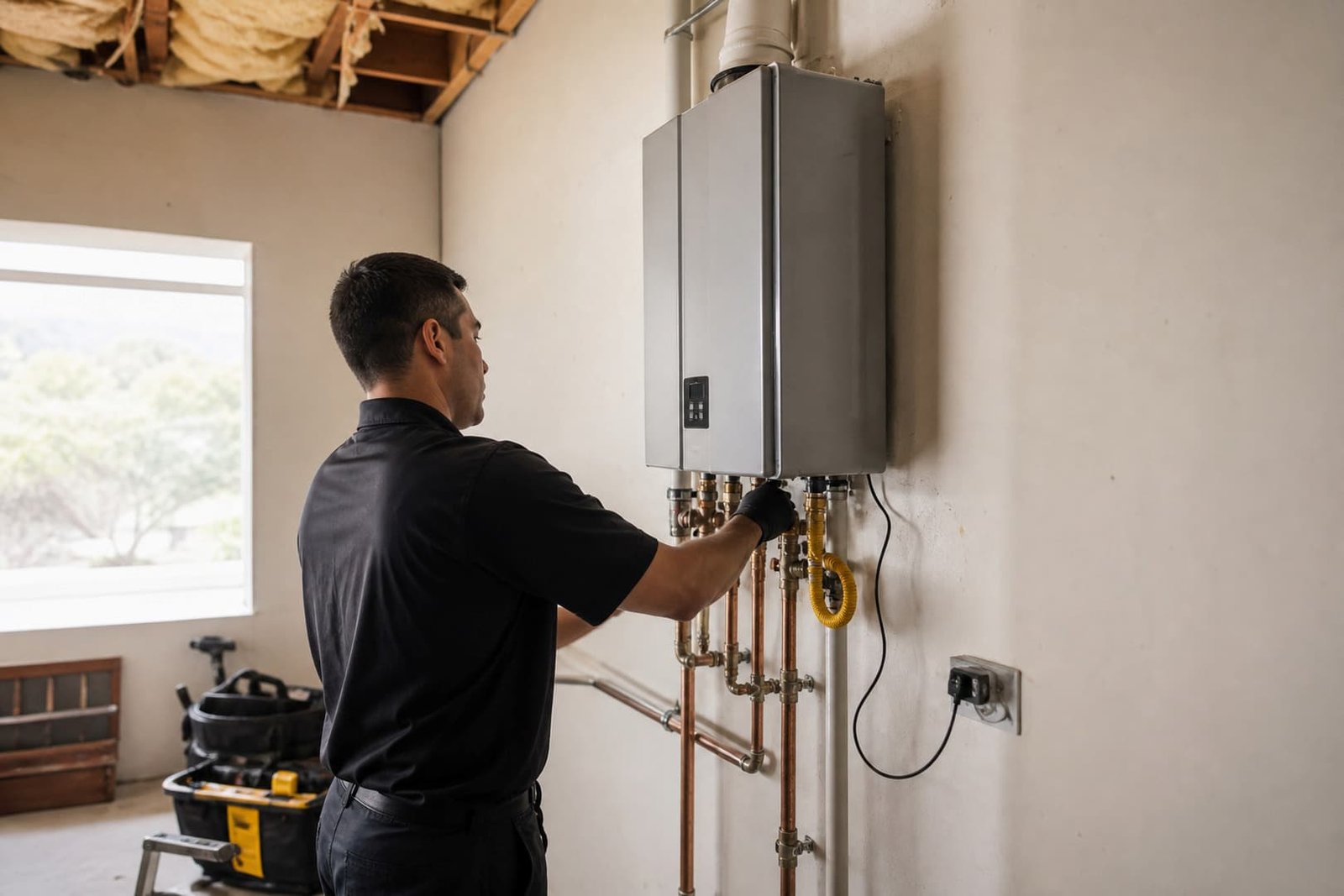
Tankless capacity changes with the water entering the unit
Tankless heaters are rated by how much temperature they can add at a given flow. If incoming water is colder or several fixtures run at once, the unit must work harder. That is why a single headline flow number is incomplete. We build a realistic demand case from the fixtures and use pattern, then compare it with the selected model’s performance data.
Oversizing has limits too. A larger gas unit may need more fuel delivery and different venting; a larger electric unit may exceed available service capacity. Staging two units, keeping a tank, changing fixtures or managing simultaneous use may be more practical in some properties. The answer comes from the load and the building, not from the technology label.
Size the demand, prepare the site and test real fixture flow
Calculate peak flow and temperature rise
Verify gas or electrical capacity and location
Plan venting, condensate, water and recirculation
Install, permit and complete required inspections
Commission flow, temperature, combustion or electrical operation
The conversion should be planned as more than an appliance swap
Several trades or inspection steps may touch the project, depending on the selected equipment and site.
Measure the hot-water demand
List simultaneous fixtures, target temperature and any recirculation requirement.
Check energy, venting, drainage and wall space
Confirm what can be reused, what must change and how the unit will remain serviceable.
Choose equipment from the verified constraints
Match performance data and installation requirements to the property rather than relying on a generic size label.
Complete infrastructure and mounting work
Install approved water connections, isolation valves, energy supply, exhaust or circuits and condensate path as applicable.
Purge, start and test under real flow
Run representative fixtures, check temperature stability, inspect connections and review controls.
Leave service access and a maintenance plan
The owner should know how to isolate the unit, when scale service may be needed and where filters or drains are located.
A different system can be a better fit
Tankless technology solves specific problems. It does not need to win every comparison.
The required utility upgrade is disproportionate
A right-sized storage or heat-pump system may meet demand without the same instantaneous gas or electrical load.
The household relies on high simultaneous flow
One unit may not deliver the expected temperature rise without staging, fixture changes or use management.
There is no practical vent or condensate route
For combustion equipment, difficult terminations can outweigh the space saved by removing a tank.
Maintenance access would be poor
A compact installation is not useful if isolation valves, filters and service points cannot be reached later.
The real complaint is remote delivery time
Fix the distribution or recirculation problem rather than expecting the heating technology to shorten the pipe.
Tankless Water Heater Installation in San Francisco FAQ
Will tankless give instant hot water at the tap?
Not by itself. Water already sitting in the pipe must move first. Distribution distance and recirculation determine wait time.
Can every home convert to tankless?
Not without review. Gas delivery, electrical capacity, venting, condensate, location, flow and temperature rise may make the conversion simple, extensive or impractical.
Does tankless need maintenance?
Yes. Maintenance depends on the equipment and water conditions and may include periodic flushing or descaling and system checks.
Can one unit serve several bathrooms?
Possibly, if its rated performance at the required temperature rise covers realistic simultaneous flow and the infrastructure supports it.
Share simultaneous use, current equipment and available utilities
Include the address, property type, affected fixture or equipment, when the issue began, whether water or sewage is active, and any safe-to-take photos. You do not need to diagnose it first.