
Water Heater Replacement in San Francisco
Replacement is the right moment to correct poor access, venting, drainage, shutoffs, seismic restraint, capacity or energy-source limitations instead of copying every detail of the old installation.
A failed heater creates a choice that did not exist during normal service
Many properties need a straightforward replacement in the existing location. Others have outgrown the capacity, changed energy plans or inherited an installation whose venting, drainage or access should not be repeated.
Like-for-like replacement
The existing type, capacity and location still fit the property, and the surrounding infrastructure can support a compliant new unit with defined corrections.
- Hot-water demand has not materially changed
- Fuel or electrical supply remains suitable
- Venting, drain path and service access are workable
- The goal is a direct, low-disruption changeout
Redesign or conversion
The property needs different capacity, efficiency, energy source, location or distribution behavior. This becomes an installation project, not just a swap.
- ADU, added bath or occupancy changes demand
- Gas-to-electric or tank-to-tankless conversion is planned
- Existing location lacks access or suitable infrastructure
- Recirculation or long delivery time needs attention
“Same size” is not the same as “same fit”
New equipment dimensions, connections, venting, electrical needs and efficiency can differ even when nominal capacity is similar. We review household demand, available space, route, fuel or circuit capacity, condensate or drain needs and the work required to remove the old unit.
A like-for-like replacement may be straightforward. A switch to heat-pump, electric or tankless equipment can involve panel capacity, gas sizing, venting, air volume, condensate and other trades. Those changes should be visible in the proposal before the old heater is removed.
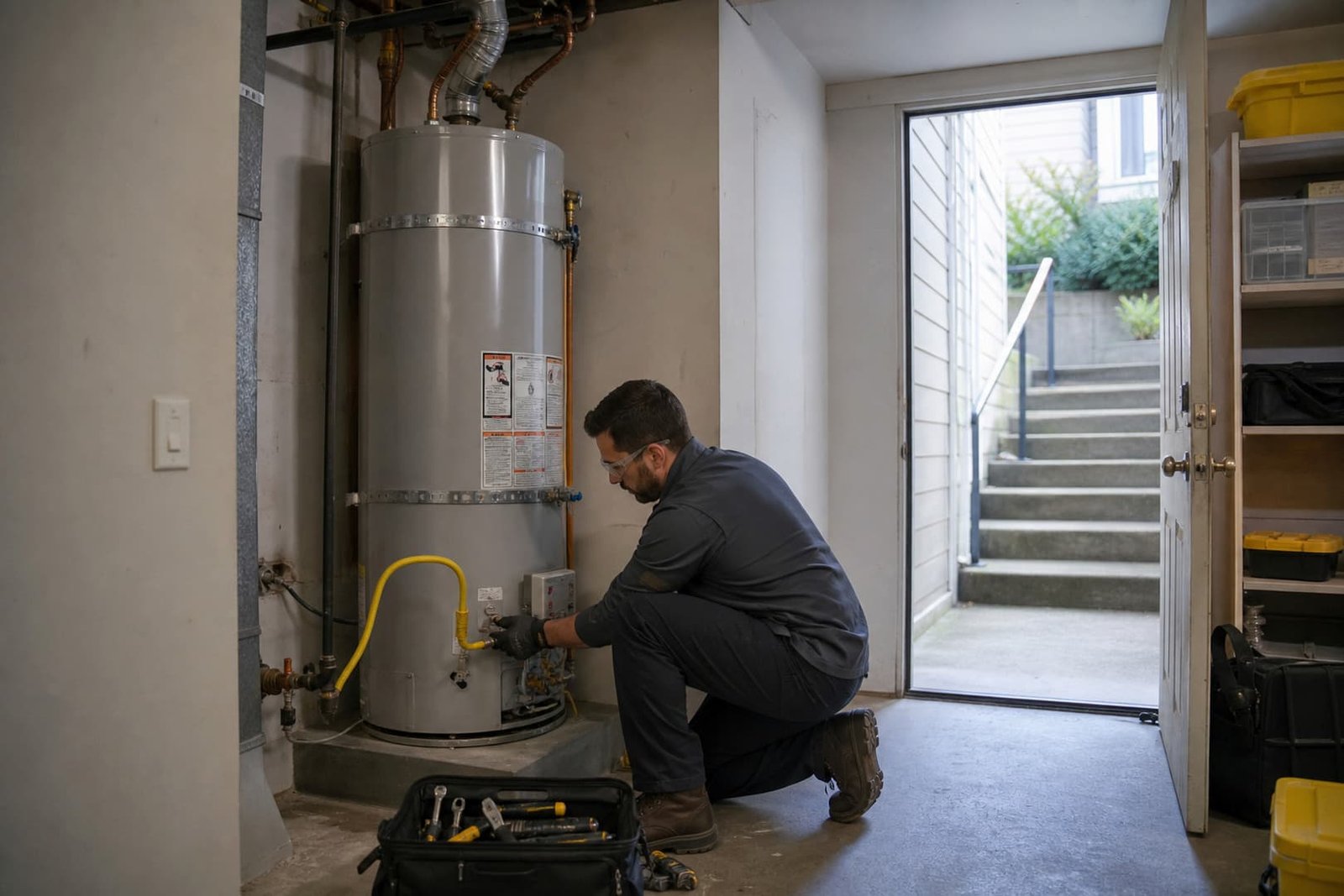
Conditions that make a changeout straightforward—or not
Tank is leaking
Plan safe isolation, removal, replacement fit and restoration of hot water.
Repeated repair costs
Compare remaining unit condition and installation quality with the total replacement scope.
Capacity no longer matches use
Size from actual simultaneous demand and recovery expectations.
Fuel or technology change
Evaluate electrical, gas, venting, condensate, air and space impacts.
Tight closet or garage location
Measure equipment, service clearances and removal route before ordering.
Multifamily replacement
Coordinate units, central or individual equipment, shutdowns, access and notices.
Define equipment, infrastructure corrections and removal together
| Path | When it fits |
|---|---|
| Storage tank | Familiar operation and recovery; size, fuel, venting, drainage and footprint still matter. |
| Heat-pump water heater | Requires suitable electrical capacity, air volume, condensate and operating-location review. |
| Tankless | Requires peak-flow sizing and infrastructure review; use the dedicated tankless page for conversion details. |
| Like-for-like replacement | Can reduce scope when the existing installation is compliant, serviceable in layout and appropriately sized. |
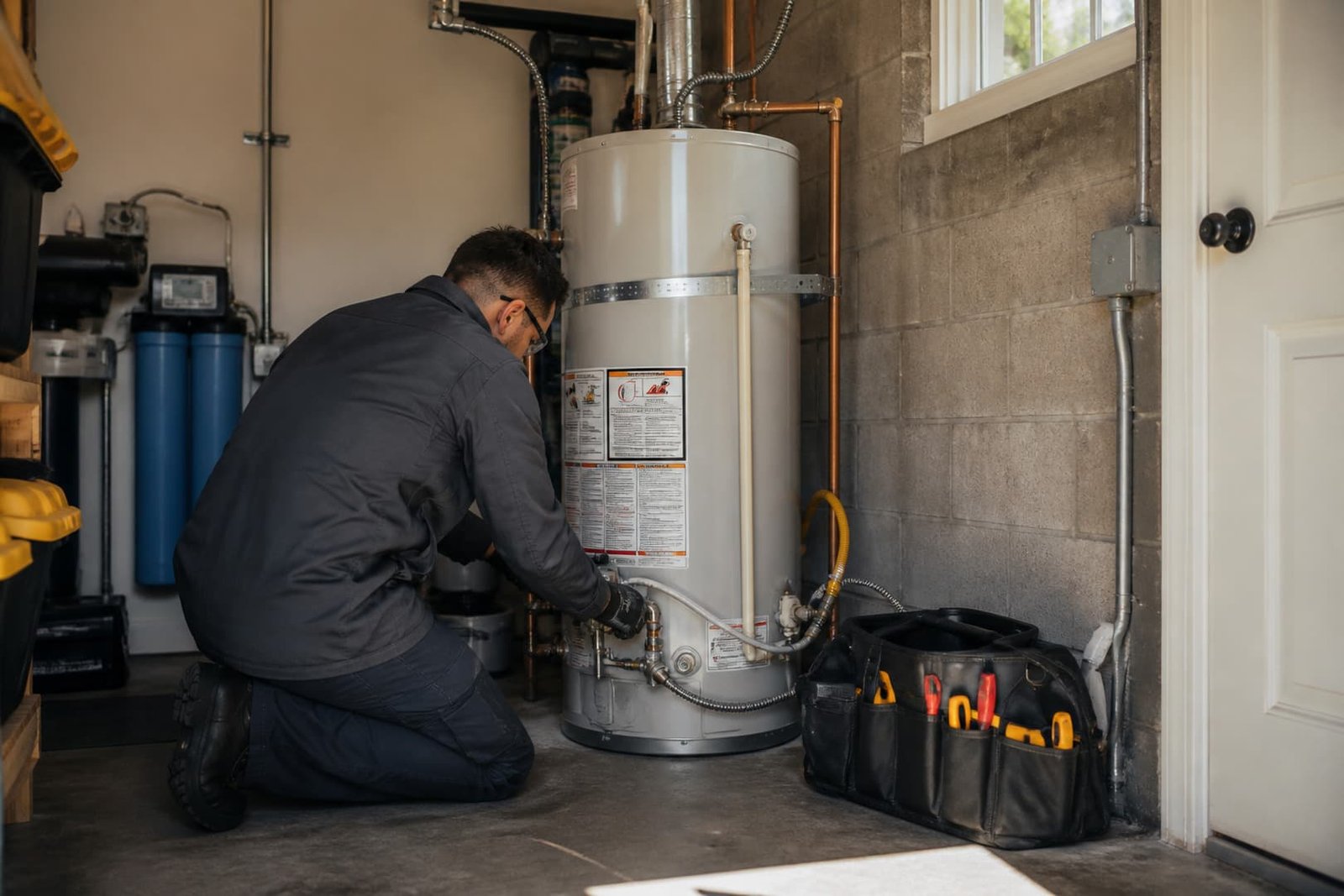
The replacement model must fit the site as well as the hot-water load
A catalog match based on tank gallons or input alone can miss the conditions that determine whether the new unit can be installed and serviced properly.
| Site item | What gets checked | Why it can change the scope |
|---|---|---|
| Space and access | Dimensions, door path, clear working area and removal route | A unit that fits on paper may not pass through the building or allow service |
| Energy supply | Gas piping and controls, or circuit, voltage and available electrical capacity | A different input or technology may need infrastructure work |
| Venting or heat-pump airflow | Existing vent route and condition, or air volume and condensate needs | The new technology may not use the old pathway |
| Water and drain connections | Shutoffs, flex or hard connections, drain pan, relief and condensate route | Old leaking valves or missing drainage can expand the installation |
| Restraint and protection | Seismic bracing, physical protection and local site conditions | The replacement must be secured and protected for its location |
| Distribution | Recirculation, mixing, pipe runs and fixtures served | Delivery complaints may remain even with a new heater if distribution is unchanged |
Share the existing model label and wide photos before equipment is ordered. They do not replace a site check, but they can expose an obvious mismatch early.
Survey the site, replace the unit and commission hot-water service
Measure space and document existing connections
Review demand, energy source and equipment options
Define permit, removal and infrastructure scope
Install, connect, restrain and complete inspections
Start up, verify temperature and explain operation
From failed unit to tested hot-water service
The exact sequence changes by equipment and permit path, but the handoffs should remain clear.
Set the replacement criteria
Capacity, energy source, location, household demand and any conversion decision are agreed before ordering.
Plan shutdown, access and protection
Coordinate occupants, drain-down, removal route and any related electrical, gas, vent or finish work.
Disconnect and take out the old unit
The area is inspected for leaking valves, damaged connections or site conditions hidden by the old heater.
Set, connect and secure the replacement
Complete the approved water, energy, venting, drainage and restraint scope.
Fill, purge, start and test
Check connections, controls, delivered temperature and normal operating sequence before handoff.
Document equipment and owner controls
Record model information, isolation points, maintenance items and any inspection follow-up.
Water Heater Replacement in San Francisco FAQ
Can I replace a gas heater with electric or heat pump?
Possibly. Electrical capacity, circuit, space, air, condensate and operating needs must be evaluated as part of the conversion.
Will the old unit be removed?
Removal and disposal should be explicit in the approved proposal. Access and unusual handling conditions may affect scope.
Do replacements require permits?
Requirements depend on equipment and scope. When required, permit and inspection steps should be included in the plan.
How long will hot water be off?
Timing depends on equipment availability, access, corrections, permits and inspections. A project-specific schedule is more reliable than a generic promise.
Share the existing model and what you want the replacement to improve
Include the address, property type, affected fixture or equipment, when the issue began, whether water or sewage is active, and any safe-to-take photos. You do not need to diagnose it first.