
Pipe Repair & Repiping in San Francisco
One failed fitting may need one repair. Repeated pinholes, corrosion, poor flow and mixed aging materials call for a broader decision. We define the evidence, access and remaining system before recommending the scope.
The right scope sits between “patch everything” and “replace everything”
We review pipe material, visible condition, failure locations, pressure, flow complaints, prior alterations and access. A spot repair makes sense when surrounding pipe is serviceable. A partial repipe can isolate one failed zone. A whole-property plan becomes more reasonable when risk and performance problems are distributed.
Routing matters as much as material. Basements, garages, crawlspaces, shafts, closets and open remodel walls may reduce finish disruption. The proposal should identify shutoffs, penetrations, fixture connections, insulation or protection where relevant, testing and who closes finishes.

A spot repair and a repipe solve different risk horizons
One accessible failure does not make every pipe defective. Repeated leaks across the same aging system, however, can make another patch a poor use of access and finish work.
A section repair can be reasonable
The failure has a clear local cause, surrounding material is sound and the connection points are serviceable.
- Damage from a fastener or isolated impact
- One failed valve or exposed fitting
- A short corroded section with good pipe beyond it
- Remodel work already provides clean access to a defined branch
A broader repipe deserves comparison
Failures appear in different rooms, the same material is deteriorating or the system no longer delivers acceptable service.
- Several pinhole leaks over a short period
- Widespread corrosion or restricted galvanized piping
- Poor pressure balance across multiple fixtures
- Many concealed transitions and undocumented prior patches
Failure patterns that change the replacement boundary
One isolated damaged section
Repair back to sound material and test the affected area.
Several pinhole leaks
Map failure pattern and compare continued spot work with a defined repipe zone.
Galvanized piping and poor flow
Assess internal restriction, accessible condition and fixture demand before choosing replacement extent.
Mixed old and new materials
Identify transitions and prioritize the sections carrying the highest failure or performance risk.
Remodel with walls open
Coordinate new routing and future fixture needs while access is available.
Whole-house or multifamily planning
Sequence shutoffs, occupied areas, risers, branches, common piping and closeout.
Compare one more repair with a planned repipe
| Path | When it fits |
|---|---|
| Spot repair | Best when damage is localized and adjacent pipe provides a dependable connection. |
| Partial repipe | Useful for a failing riser, branch, floor, unit or material zone with clear boundaries. |
| Whole-property repipe | Consider when failures, corrosion or performance problems are widespread and access can be planned coherently. |
| Monitor and plan | Reasonable when no active failure exists and observations do not justify immediate replacement. |
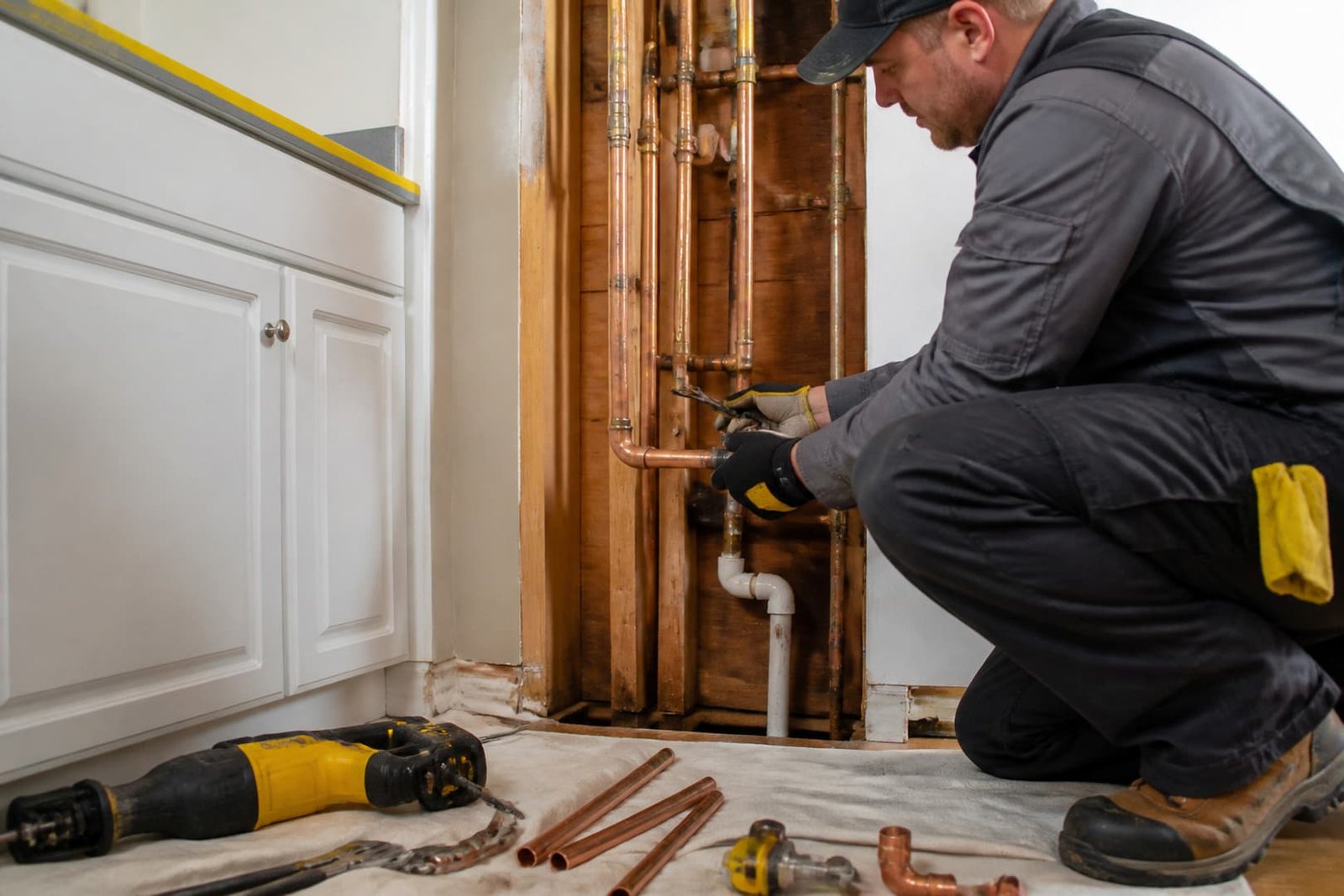
Compare pipe options in the context of the building
Copper and approved flexible supply piping can both be appropriate in residential work. The route, exposure, connection details, local project requirements and the owner’s priorities usually matter more than a blanket claim that one material is always best.
| Planning factor | Questions for copper | Questions for flexible supply piping |
|---|---|---|
| Route and access | Can rigid lengths and fittings reach the route without excessive opening? | Can the tubing be routed and supported without sharp bends or vulnerable exposure? |
| Existing connections | Where will new copper meet valves, fixtures and remaining materials? | Which transition fittings and manifolds fit the selected system? |
| Exposure and protection | Does the route face corrosion, contact or damage concerns? | Does the route need sleeves, nail protection or shielding from light and heat? |
| Future service | Will shutoffs and branches remain identifiable and accessible? | Will a manifold or home-run layout simplify isolation, or add unnecessary complexity? |
| Project logistics | How will soldering or press work be managed in occupied finishes? | How will long pulls, supports and manufacturer requirements shape the openings? |
The specification should name the system, connection method, replacement limits and any pipe that remains. “Repipe house” is too vague to compare proposals fairly.
Map, route, stage and test the new piping
Document materials, failures and performance
Map shutoffs, fixtures, routes and access
Compare repair and repipe boundaries
Complete the approved work in planned zones
Pressure-test, flush, label and review closeout
A repipe is also an access and water-service project
Good sequencing keeps an occupied property usable while walls and ceilings are open.
Confirm fixtures, branches and shutoffs
Walk the property, note special equipment and decide what stays, what moves and what will be abandoned.
Choose openings before cutting
Use closets, utility paths and existing access where practical. Finish responsibility should be agreed upon now.
Plan shutdowns by area
In an occupied home or multifamily building, phase work so the right people know when water will be off and when it returns.
Replace to defined endpoints
Label valves and protect concealed piping at framing penetrations before surfaces close.
Flush, operate and observe
Check connections, fixture flow, pressure behavior and hot-water delivery; then document the concealed route while it is still visible.
Pipe Repair and Repiping in San Francisco FAQ
Does one pinhole leak mean I need a full repipe?
No. One leak is evidence about one location. Material, age, failure history, water conditions, access and the rest of the system determine whether broader work is justified.
Copper or PEX—which is better?
Both can be appropriate when properly selected and installed. Routing, exposure, connections, local requirements, owner preferences and the project scope influence the choice.
Can a repipe be done in stages?
Often. A useful phased plan defines logical zones and avoids creating unnecessary future rework at transitions.
Who repairs drywall or plaster?
Finish responsibility should be explicit in the proposal. Plumbing access and finish restoration may be performed by different trades.
Share the leak history, pipe material and affected rooms
Include the address, property type, affected fixture or equipment, when the issue began, whether water or sewage is active, and any safe-to-take photos. You do not need to diagnose it first.