

AFCI vs. GFCI: What’s the Difference, and Do You Need Both?
AFCI protection helps prevent fires caused by dangerous electrical arcing. GFCI protection helps prevent severe electric shock from current escaping its intended path. One does not replace the other. A circuit may need both, and a dual-function AFCI/GFCI device can provide both kinds of protection.
The names can make shopping for protection confusing. An outlet with TEST and RESET buttons is not necessarily a GFCI, and “combination AFCI” on a breaker does not mean it includes GFCI protection. To choose correctly, you need to know what is already installed, which part of the circuit it covers, and what work you plan to do.
AFCI vs. GFCI vs. a standard circuit breaker
Everyday conversations often call all three “safety breakers,” but they respond to different conditions. ESFI’s comparison of AFCIs and GFCIs separates arc faults, which can ignite nearby materials, from ground faults, which can expose a person to dangerous current.
| Protection | What it detects | Main purpose | What it does not establish |
|---|---|---|---|
| Standard circuit breaker | Overloads and short circuits | Protect circuit conductors from excessive current | It does not provide AFCI or personnel GFCI protection unless specifically marked. |
| AFCI | Electrical patterns associated with hazardous arcing | Reduce the risk of electrical fires | An AFCI label alone does not establish GFCI shock protection. |
| GFCI | An imbalance between outgoing and returning current | Reduce the risk of severe shock from ground faults | It does not provide AFCI protection or create an equipment ground. |
| Dual-function AFCI/GFCI | Both arc-fault and ground-fault conditions | Provide both protective functions in one device | Its coverage still depends on where and how it is installed. |
AFCI, GFCI, and dual-function circuit breakers also provide the breaker’s overcurrent protection. Receptacle versions still need the circuit’s correctly rated breaker or fuse. Schneider Electric explains these breaker functions separately; adding electronics to detect a fault does not remove the need to protect the wiring against overloads.
What an AFCI protects against
A lamp cord pinched under furniture or a wire damaged by a nail can become an arc-fault hazard. At a damaged conductor or poor connection, electricity may arc and produce enough heat to ignite nearby material. The problem can develop in a room where nothing seems to be drawing unusually high power.
A conventional breaker may not trip promptly when an arc draws less current than the breaker’s overload threshold. AFCI circuitry looks for characteristics of dangerous arcing. The CPSC’s AFCI fact sheet explains why ordinary breakers and fuses alone may miss early arcing conditions and recommends considering AFCI protection in existing homes as well as new construction.
Damaged cords and loose connections still need repair, even on an AFCI-protected circuit. The device can interrupt dangerous arcing; it cannot restore deteriorated wiring or eliminate every fire hazard.

What a GFCI protects against
A GFCI monitors current leaving and returning through the circuit. If some current takes another path, possibly through a person, it disconnects power. That is why ground-fault protection is especially associated with bathrooms, outdoor equipment, and other places where water or grounded surfaces increase shock exposure.
A ground fault can happen in a dry room, too. A defective appliance may expose energized parts even when there is no water nearby. The CPSC’s GFCI fact sheet explains the current imbalance that triggers protection. You may also hear this protection called GFI, a common abbreviation for the same function.
A GFCI cannot prevent every form of electric shock. For example, simultaneous contact with hot and neutral can leave current balanced while it flows through a person. Never treat a protected outlet as permission to handle exposed conductors or use wet electrical equipment.
“Combination AFCI” and “dual function” mean different things
A combination-type AFCI addresses both series and parallel arcing. Series arcing occurs along a conductor’s current path, such as at a damaged connection. Parallel arcing occurs between conductors at different electrical potentials. The word “combination” refers to those arc-fault categories.
A dual-function AFCI/GFCI includes arc-fault protection and personnel ground-fault protection. Leviton’s terminology guide makes this distinction explicit. If a project needs both, “combination AFCI” on its own is not enough information to select the product.
How to tell which protection you already have
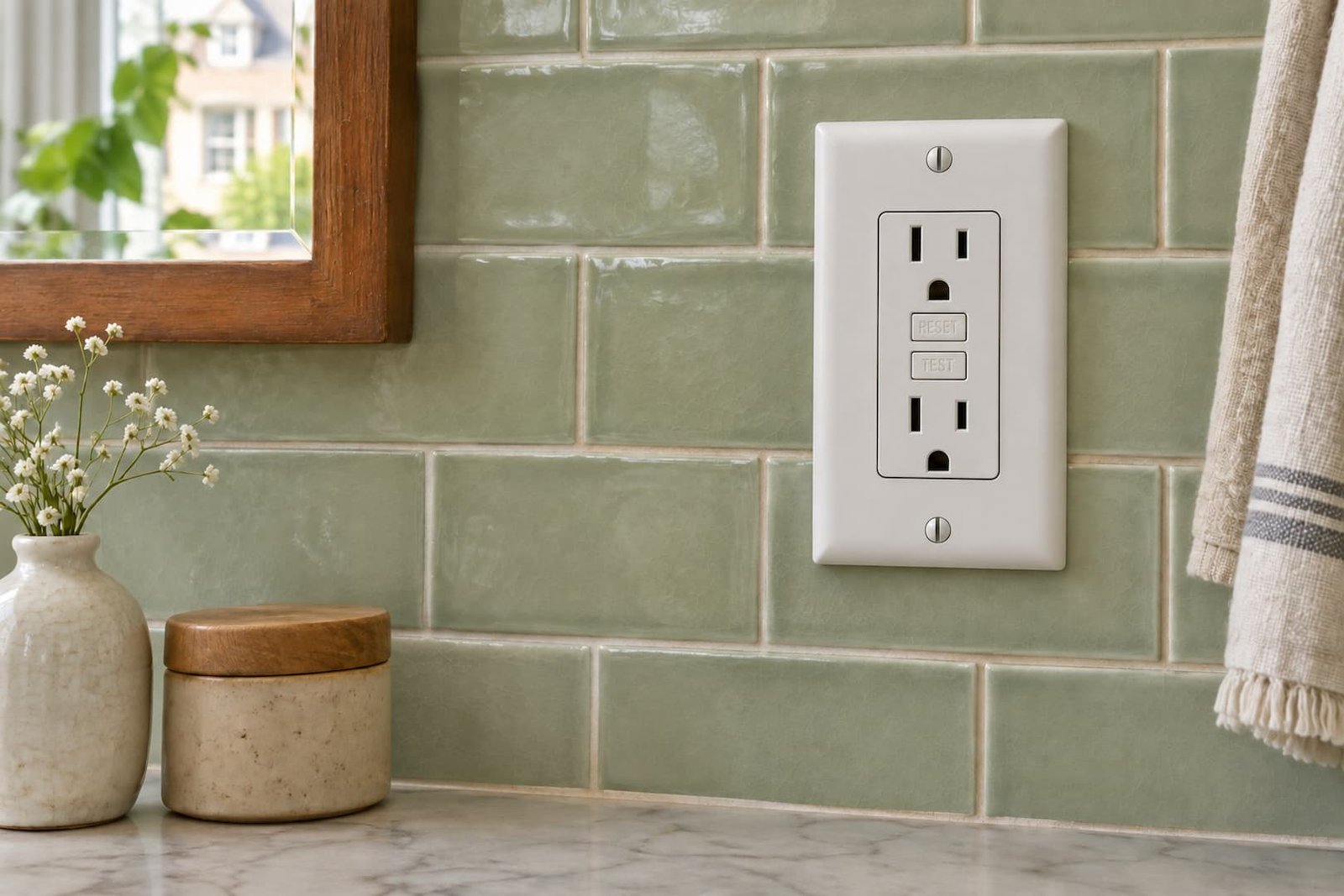
Look at accessible device markings and the manufacturer’s information for the exact model. AFCI, GFCI, and dual-function products can all have a TEST button. Button color and faceplate appearance are not universal identification systems.
The UL circuit-breaker marking guide describes distinct identifiers and test functions for these products. Some identifying information is only accessible to an electrician. Do not remove the panel’s dead-front cover or pull an outlet out of the wall to read a label.
An ordinary-looking receptacle may already receive protection from a breaker or another receptacle upstream. Conversely, a TEST button in one room does not prove that every outlet in that room is protected. Ask the electrician to identify the protective device and document which outlets and loads it covers.
Breaker or receptacle: where protection starts matters
A protective breaker operates at the circuit’s origin in the panel. A protective receptacle operates at its position along the circuit. A GFCI receptacle can protect its own face and correctly connected downstream loads, but it does not add GFCI protection to wiring or outlets upstream.
Outlet branch-circuit AFCIs have their own installation rules. For an arrangement that requires the first outlet, “first” means electrically first after the panel, not the receptacle nearest the panel on a floor plan. An electrician must also check the permitted wiring method and any requirements for the section between the panel and that outlet. Installing an AFCI receptacle at an arbitrary location is not a universal substitute for an AFCI breaker.
In some arrangements, the breaker and receptacle work as a tested pair. Eaton’s system combination-type AFCI is one example. The listing applies to the specified components, so an installer cannot substitute an arbitrary breaker or receptacle and assume the same coverage.
Panel compatibility matters too. The breaker must be approved for that exact panel and application. Eaton’s guidance on classified breakers explains that approved replacements are tested for specified loadcenters. Matching dimensions or an ampere rating is not sufficient.

Do you need both AFCI and GFCI in your home?
You need both wherever the rules applicable to the work require both protections. Their purposes can overlap in the same room: kitchen and laundry projects are common examples. A dry bedroom can still have an arc-fault hazard, while a bathroom GFCI does not establish arc-fault protection elsewhere on its circuit.
For a specific property, the answer depends on the locally adopted electrical code, circuit characteristics, equipment served, and scope of work. San Francisco’s electrical-code preface identifies the California Electrical Code together with local amendments. A national room-by-room chart cannot settle every local installation question.
New circuits, remodeling, and replacement outlets
Replacing a worn outlet is a different job from adding a kitchen circuit or extending wiring into a new room. Protection requirements can change with that scope. Leviton describes dual-function applications for new construction, circuit modifications, and replacement receptacles. Have the electrician check which arrangement the applicable local rules permit for your actual project.
An existing home with no electrical work planned
Do not assume that a new code edition means every untouched circuit must immediately be retrofitted. Whether an existing circuit needs alteration depends on the applicable rules and the condition of the installation. An inspection can separate repairs needed now from voluntary upgrades and changes required for a remodel.
Can separate AFCI and GFCI devices share a circuit?
Yes. A permitted arrangement can use an AFCI breaker with GFCI receptacle protection where needed, or a compatible dual-function breaker can provide both functions. Receptacle-based options may also be suitable when their installation conditions are met. Leviton’s dual-function FAQ confirms that separate AFCI and GFCI receptacles can coexist on a circuit.
Ask where each function will apply. An AFCI breaker with one GFCI receptacle may provide arc-fault protection across the branch circuit while ground-fault protection starts at that receptacle. Other outlets on the branch may need their own GFCI coverage. The electrician should also consider test access, the panel model, existing wiring, and any shared neutral before selecting devices.
Neither protection creates an equipment ground
A GFCI can operate without an equipment grounding conductor. That does not turn an ungrounded circuit into a grounded one. Leviton discusses GFCI protection for older two-slot outlets, but required labeling and equipment suitability still need professional review. A three-slot replacement faceplate is not evidence of a grounding path.
Testing, tripping, and planning an upgrade
Follow the device’s testing instructions. ESFI recommends monthly testing of AFCIs and GFCIs. Tell other occupants before interrupting power, and account for equipment that must remain powered. If the prescribed test fails, stop using the affected circuit and arrange service.
After a trip, record which device operated and what was running. Do not repeatedly reset it, bypass it, or move a suspect appliance to an unprotected outlet. Burning smells, scorching, buzzing, shocks, or moisture call for prompt professional help; smoke or active fire means leave and call 911. For a RESET button that will not stay in, see our guide to a GFCI outlet that won’t reset.

Before approving an upgrade, ask which hazards it addresses, where coverage starts, which outlets remain outside that coverage, and how you will test it. Request clear circuit labels and the instructions for the installed models when the work is complete. If a future trip turns off several rooms, knowing which device supplies them will save confusion. Those details belong in the handover just as much as the product names do.
Max Electric offers electrical safety inspections in San Francisco and outlet installation and replacement. For an older home or a planned remodel, ask for an assessment of the existing circuit protection and the options appropriate to your wiring and project.