
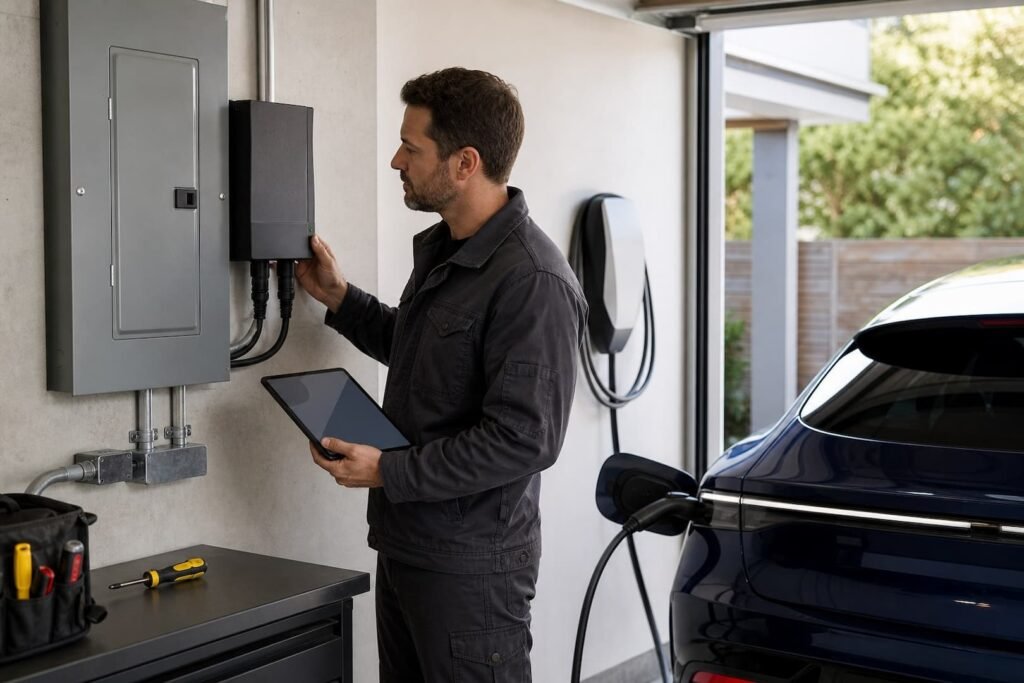
Dynamic Load Management for EV Charging: When It Can Avoid a Panel Upgrade
A home does not use every electrical load at full power all day. Dynamic load management takes advantage of that fact. A compatible system monitors demand at the service or feeder and adjusts EV charging so the total stays below a configured limit.
When the range, water heater, dryer, or heat pump raises household demand, the charger slows or pauses. As those loads fall, charging power returns. The car remains plugged in; the control happens automatically. For the right home and driving pattern, this can add useful Level 2 charging without increasing the utility service.
It is not a universal substitute for a panel or service upgrade. The existing equipment must be in suitable condition, and the proposed system must be listed and compatible. The branch circuit still needs proper sizing. The complete design has to meet the adopted electrical code and local permit requirements.
Dynamic load management in one example
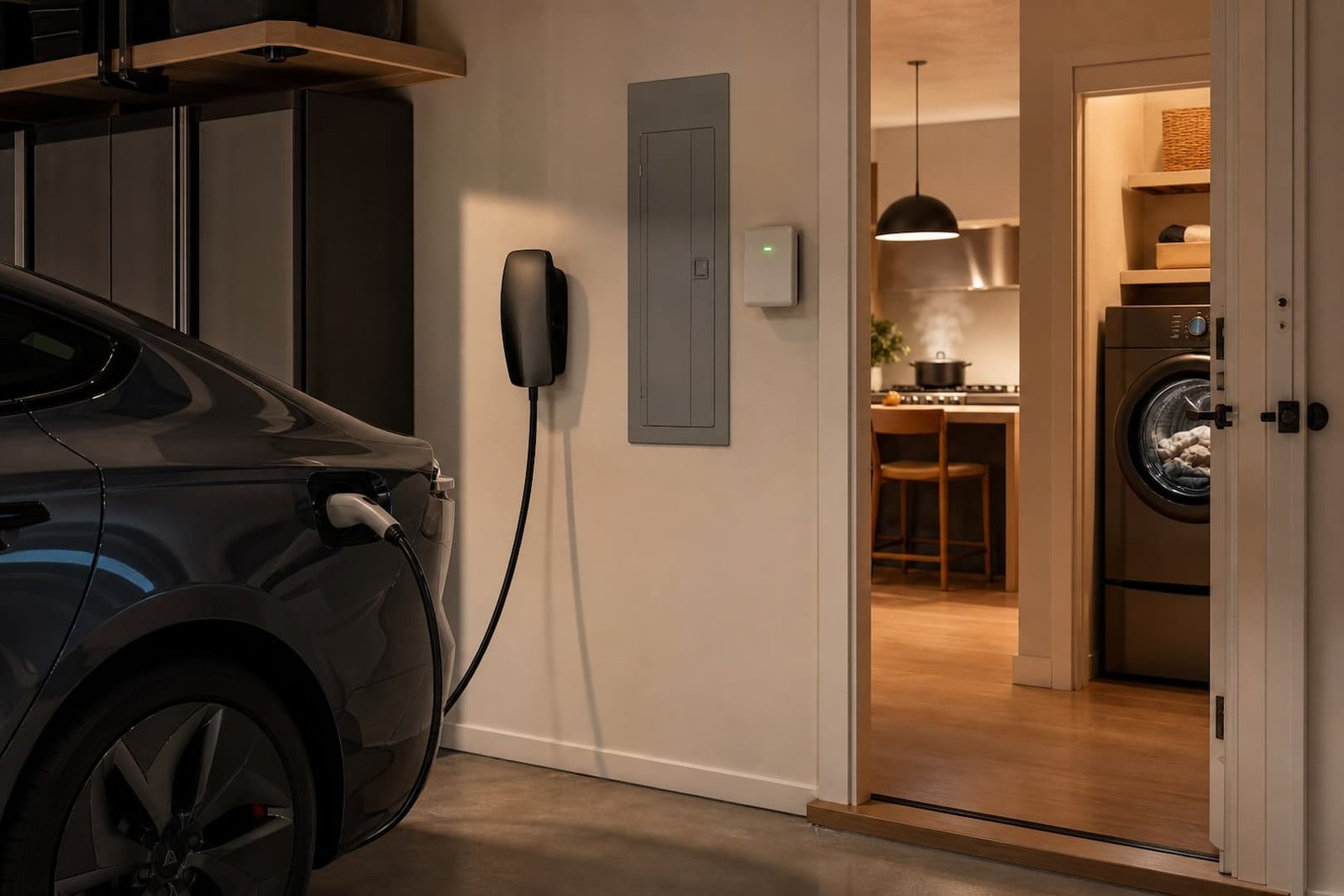
Suppose a home has a service limit selected by the system designer and a 40-amp EV charging setting. Late at night, the house is using little power, so the charger can deliver its configured output. The electric dryer starts. The controller sees the total approaching its limit and reduces the charger to 18 amps. The dryer finishes, and the charger rises again. The service never has to support the charger’s maximum on top of every coincident load.
The example explains the behavior, not a design value. The actual setpoint comes from the service and feeder ratings, load calculation, equipment instructions, and approved configuration. It should not be guessed from a utility bill or copied from another home.
Four controls that are often confused
| Control method | What it responds to | What it can solve |
|---|---|---|
| Charging schedule | Clock or utility-rate period | Moves charging to preferred hours; does not measure live home demand |
| Fixed charger setting | Installer-set maximum current | Reduces the continuous charging load at all times |
| Group power sharing | Demand from a group of compatible chargers | Splits one allocation among two or more vehicles |
| Dynamic home or building load management | Measured demand at a service, feeder, or panel | Adjusts charging to protect a defined upstream capacity limit |
A charger can support more than one method. Two chargers may share a circuit while the group also responds to whole-home demand. The drawings and commissioning record should make clear which limit controls which equipment. Field labels preserve that distinction at the panel.
The hardware behind the control
Current measurement
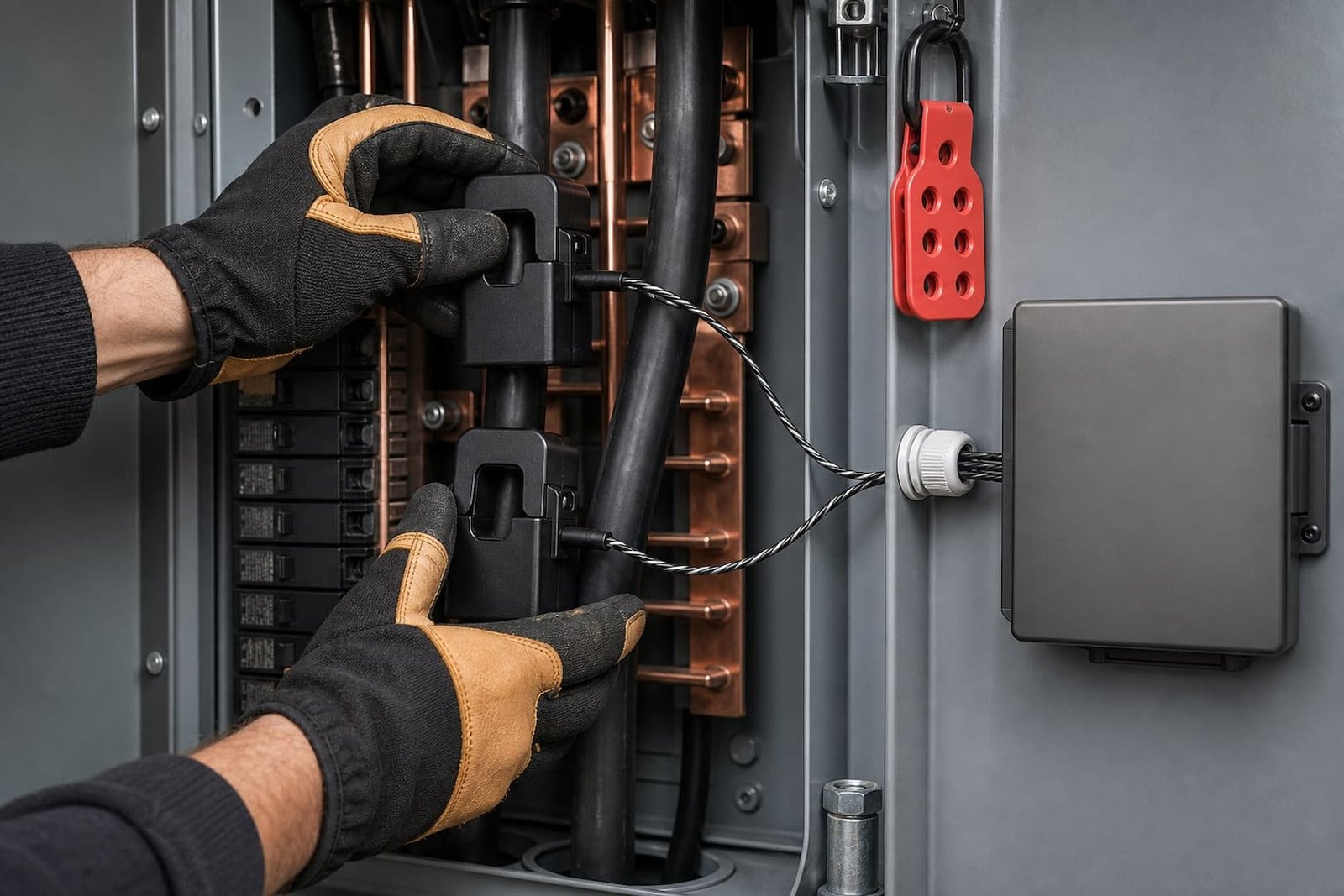
Current transformers or another approved metering method measure the conductors serving the monitored point. Sensor location matters. Sensors at a subpanel cannot infer loads that bypass that subpanel. Direction, phase assignment, conductor placement, and the system’s calibration all affect the reading.
A controller with an enforceable limit
The controller compares measured demand with a configured setpoint and sends a command to reduce or suspend charging. A phone notification is not load management. The equipment itself has to control the load quickly and predictably enough for its listed function.
Compatible EVSE
The charger must accept the controller’s commands through the manufacturer’s supported connection. A brand’s ordinary Wi-Fi scheduling feature does not establish compatibility with a third-party energy-management product. Use the exact model numbers and current installation manuals.
A correctly sized branch circuit
Dynamic control protects the specified upstream limit; it does not permit undersized branch-circuit conductors or an unsuitable breaker. The EV circuit is designed for its configured maximum, connection method, route, temperature conditions, and applicable continuous-load rules.
Why listing and failure behavior matter
UL describes a power control system as a type of energy-management system that limits current or power to prevent overload of distribution equipment or controlled conductors. Its Article 130 overview notes that a system must transition to a defined controlled state when the control function fails. The approved installation also needs the markings and documentation associated with that function.
Ask three plain questions:
- What happens to charging if the sensor cable is damaged?
- What happens if local communications or internet service fails?
- Who can change the service limit after commissioning?
The safe answer varies by system, but it must be in the manufacturer’s documentation. A cloud dashboard that merely reports yesterday’s peak is useful monitoring; it is not the same control function.
When dynamic management is a strong fit
- The service is constrained only during occasional coincident peaks.
- The driver parks long enough for variable charging to replenish daily use.
- The panel and service equipment are serviceable and have a viable circuit path.
- A compatible listed system supports the selected charger and installation.
- A utility service upgrade would add substantial construction or delay.
- The home’s future loads are understood and included in the plan.
The U.S. Department of Energy describes managed charging as adaptive charging that considers vehicle needs and control objectives. It can reduce equipment upgrades and energy costs. Residential code compliance depends on the specific listed system and local design; the federal overview is not an installation instruction.
When it is the wrong shortcut
- The panel is damaged or obsolete. Software cannot repair corrosion, heat damage, poor connections, or unavailable replacement components.
- The service is already overloaded. A new controllable load does not correct an existing deficiency.
- The driver needs guaranteed high output in a short window. Load shedding during household peaks may conflict with the use case.
- Several large loads are coming. An EV, ADU, heat pumps, electric water heating, and cooking should be planned together.
- The charger is incompatible. A field-made combination without manufacturer support is not a design strategy.
- The panel lacks physical space or a safe route. Load control does not create breaker positions, wall area, or conduit pathways.
Where the underlying distribution equipment needs replacement, compare a conventional panel, a purpose-built control device, and a SPAN smart panel installation on their actual functions and lifetime costs.
Dynamic management versus a service upgrade
| Question | Dynamic load management | Service upgrade |
|---|---|---|
| Changes utility service capacity | No | Yes |
| Can reduce EV output during peaks | Yes | Usually unnecessary for capacity, though scheduling may still help |
| Addresses damaged panel equipment | No | Only if the equipment is included in the upgrade scope |
| Supports future uncontrolled loads | Only when those loads are part of a compatible control design | Provides added capacity up to the new service rating |
| Utility coordination | Often limited, subject to project specifics | Normally required |
| Dependence on controls | Yes | No for basic service capacity |
A service upgrade may be the durable answer for a major electrification plan. Dynamic management may be the precise answer for one flexible load. The contractor should show why the selected path meets the present use and what happens when the next large appliance is added.
San Francisco permit and plan implications
Adding load-management hardware does not remove the EV circuit from permit review. San Francisco DBI asks for the existing load, service and equipment details, a load calculation, panel schedule, manufacturer specifications, and the relevant wiring diagram for most new EVSE installations. The submittal should show the monitored point, sensors, controller, charger, maximum branch-circuit rating, and the limit the control system enforces.
Keep the approved model numbers and settings with the panel records. A later homeowner or electrician should be able to recognize that available EV charging power depends on a control function. If the charger, controller, sensors, service rating, or managed loads change, the original calculation and commissioning assumptions need review.
How to compare installed cost
Compare complete scopes rather than the controller price. A managed-charging proposal should include sensing hardware, approved communications components, conductor and raceway work, permits, configuration, functional testing, owner handoff, and any recurring service. A service-upgrade proposal should identify utility work, meter and main equipment, grounding, panel changes, permits, finish repair, and schedule risk.
Also price the future. If a second EV, heat-pump water heater, or ADU will arrive soon, ask whether the controller can manage it and whether the existing distribution has physical space. The lowest-cost solution for one charger can become the most expensive first phase when it has to be replaced during the next project.
Commissioning checklist
- Record service, feeder, panel, breaker, conductor, and EVSE ratings.
- Confirm sensor placement and phase mapping.
- Enter the approved control setpoint and lock installer-only values.
- Simulate higher household demand and observe charging reduction.
- Confirm charging restores after demand falls.
- Test the documented communications-loss behavior.
- Label controlled equipment as required.
- Give the owner the one-line diagram, model numbers, settings, and operating instructions.
Frequently asked questions
Will load management make charging too slow?
It reduces charging only when the monitored demand approaches the set limit. The result depends on household peaks, charger setting, arrival time, and energy needed by departure. Review miles driven and parking duration instead of assuming maximum output is required all night.
Does it work without internet?
Some systems make control decisions locally; others rely on particular communication paths. The manufacturer’s current documentation must state the behavior. Do not infer it from the presence of an app.
Can two EV chargers share available capacity?
Yes, with compatible equipment designed for group power sharing or a broader managed-charging system. The approved upstream limit still governs how much power the group can receive.
Is load management cheaper than upgrading the service?
It often has a smaller construction scope, but compare installed equipment, permitting, communications, future compatibility, and maintenance. A service upgrade may still be better when several new uncontrolled loads are planned.
Have the capacity question answered before buying hardware
Max Electric can assess the panel, complete the load calculation, review charger compatibility, and compare a fixed lower setting, dynamic management, panel work, or a service increase. Visit our EV charger installation page or call (415) 867-7006.
Last reviewed August 2026. Product compatibility, listings, adopted codes, and manufacturer control functions can change.