
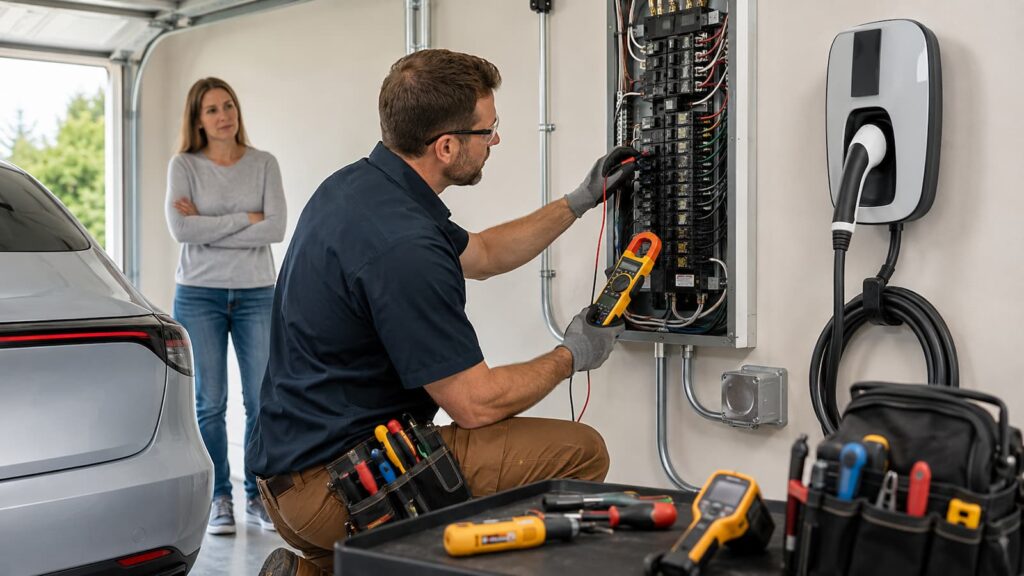
EV Charger Keeps Tripping the Breaker: Common Causes and Safe Fixes
If your EV charger keeps tripping the breaker, the problem is more than an inconvenience. A breaker that trips repeatedly is trying to tell you something: the circuit may be overloaded, the charger may be configured incorrectly, the breaker may be reacting to a ground fault, the outlet or wiring may be overheating, or the electrical panel may not be ready for the charging load you are asking it to handle.
That does not automatically mean your charger is defective. In fact, many “EV charger problems” are really circuit design problems, panel capacity problems, connection quality problems, or protection devices doing their job. EV charging is a high-current load that can run for hours at a time, so weak spots in an electrical system often show up quickly once home charging begins.
This guide explains why an EV charger trips the breaker, what you can safely check, what you should never do, and when the right fix is a dedicated circuit, a different breaker type, a hardwired charger, a NEMA 14-50 correction, load management, or an electrical panel upgrade.
If you want a licensed electrician to inspect the charger circuit, verify breaker sizing, check panel capacity, and install a safe long-term solution, MaxElectric can help with EV charger installation in San Francisco.
Safety first: do not keep resetting the breaker
Before getting into causes and fixes, it is important to start with safety. If your EV charger trips the breaker once, it may be a temporary condition. If it trips repeatedly, especially during charging, you should not treat it as a normal annoyance.
A circuit breaker is a safety device. It is designed to interrupt power when it detects a condition that could damage wiring, equipment, or people. Repeated tripping can indicate overload, heat, short circuit, ground fault, nuisance tripping, or a mismatch between the charger and the electrical circuit.
Stop charging and call a licensed electrician if you notice any of the following:
- A burning smell near the panel, outlet, plug, or EV charger
- A breaker that feels hot to the touch
- A NEMA 14-50 outlet or EV plug that feels hot, loose, or discolored
- Buzzing, crackling, popping, or arcing sounds
- Melted plastic around the outlet, plug, breaker, or charger
- The breaker trips immediately every time charging starts
- The breaker will not reset or trips even with the charger unplugged
- Visible scorch marks inside or around the panel
What you should not do:
- Do not replace the breaker with a larger one to “stop the tripping.”
- Do not keep resetting the breaker over and over.
- Do not open the electrical panel to tighten wires yourself.
- Do not use extension cords or adapters to bypass the problem.
- Do not ignore a warm outlet, warm plug, or warm breaker.
- Do not assume the charger is safe just because it worked for a few weeks.
Breaker tripping is a symptom. The right fix depends on the cause.
Quick answer: why does an EV charger trip the breaker?
An EV charger usually trips the breaker because the circuit is drawing more current than it can safely support, the charger is configured for the wrong amperage, a GFCI breaker is detecting leakage current, a connection is overheating, the outlet is worn or low quality, the breaker is failing, or the electrical panel is overloaded.
The most common causes include:
- Charger amperage is too high for the breaker size.
- The EV charger is not on a properly dedicated circuit.
- The circuit is overloaded because other loads are sharing it.
- A GFCI breaker is tripping due to ground-fault detection or nuisance trips.
- A plug-in outlet, especially NEMA 14-50, is overheating or loose.
- Wire size, breaker size, or charger settings do not match.
- The breaker is old, weak, defective, or wrong for the application.
- The electrical panel is at capacity or has existing issues.
- The charger, vehicle, or charging cable has an internal fault.
- Long wire runs or voltage drop are causing instability under load.
The timing of the trip matters. A breaker that trips immediately points to a different set of causes than a breaker that trips after 20 minutes, two hours, or only when other appliances are running.
First clue: when does the breaker trip?
Before assuming anything, pay attention to the pattern. Electricians use timing as a clue because different electrical problems behave differently under load.
| When the Breaker Trips | Possible Cause | What It Often Means |
|---|---|---|
| Immediately when charging starts | Short circuit, ground fault, wrong wiring, defective charger, GFCI trip | Stop using the charger and get the circuit checked |
| After a few minutes | Overload, wrong amperage setting, bad breaker, heating connection | The circuit may not be designed for the configured charging load |
| After 30–90 minutes | Heat buildup at outlet, plug, breaker, or terminal | Very common with weak connections or low-quality receptacles |
| Only at higher charging amps | Charger set too high, undersized circuit, marginal breaker | Lower current may work temporarily, but the circuit needs evaluation |
| Only when other appliances run | Panel capacity issue or shared circuit problem | The home may need load calculation or load management |
| Randomly overnight | GFCI nuisance trip, heat, utility voltage fluctuation, charger fault | Requires diagnosis rather than guessing |
If the breaker trips immediately, do not keep testing it repeatedly. If it trips after a while, heat may be building up somewhere. That can be just as serious because the problem only appears after the circuit has carried charging current long enough to warm a weak connection.
Cause #1: the charger amperage is too high for the breaker
This is one of the most common and most important causes. EV charging is considered a continuous load, meaning the circuit is expected to carry current for a long period. For that reason, the charging output is typically limited to 80% of the circuit rating.
That means a charger pulling 40 amps should not be on a 40-amp breaker. A 40-amp charging output usually requires a 50-amp circuit. A 48-amp charging output usually requires a 60-amp circuit. If the charger is configured too high for the circuit, the breaker may trip because it is doing exactly what it is supposed to do.
| Charger Output | Typical Circuit Rating | Common Mistake |
|---|---|---|
| 16A | 20A circuit | Assuming a 15A circuit is enough |
| 24A | 30A circuit | Setting charger higher after installation |
| 32A | 40A circuit | Using a circuit that was not designed for EV load |
| 40A | 50A circuit | Installing on a 40A breaker |
| 48A | 60A circuit | Using a NEMA 14-50 setup instead of a proper hardwired circuit |
The charger, breaker, wire, installation method, and panel capacity must all match. You cannot solve this by simply upsizing the breaker. The wire must also be correctly sized, the charger must be configured correctly, and the panel must be able to handle the load.
Safe fix
The safe fix is to verify the circuit rating and configure the charger to the correct output. If the circuit is too small for the desired charging speed, the solution may be a new dedicated circuit, different charger setting, hardwired installation, or panel upgrade. A licensed electrician should confirm the breaker size, conductor size, charger setting, and panel capacity before increasing charging current.
Cause #2: the EV charger is not on a dedicated circuit
A Level 2 EV charger should be supplied by a properly dedicated circuit. This matters because EV charging is not a small occasional load. If the charger shares a circuit with another appliance, outlet, garage load, dryer, or workshop equipment, the combined load can exceed what the breaker can handle.
For example, a homeowner may try to use an existing 240V dryer outlet, a garage circuit, or an old receptacle that was never intended for continuous EV charging. Even if the plug physically fits with an adapter, that does not mean the circuit is safe or compliant for EV charging.
Warning signs of a shared or improper circuit include:
- The breaker trips when another appliance starts.
- The EV charger works only when other equipment is off.
- The circuit was originally installed for a dryer, welder, range, or garage tool.
- The outlet is not located where a dedicated EV circuit would normally be installed.
- The panel label is unclear or inaccurate.
- The charger is connected through adapters or extension cords.
Safe fix
The safe fix is a properly installed dedicated EV charging circuit sized for the charger’s output. If you want a plug-in Level 2 setup, the outlet should be installed for EV charging rather than reused casually. If you want a permanent and often cleaner setup, a hardwired charger may be a better choice.
If your current setup uses an old or questionable receptacle, MaxElectric can help with professional NEMA 14-50 outlet installation in San Francisco for a safer plug-in EV charging configuration.
Cause #3: the breaker is tripping because of heat, not just current
A breaker can trip because current is too high, but heat is often part of the story. EV charging runs long enough for weak connections to warm up. A loose termination, worn receptacle, poor contact pressure, damaged conductor, or old breaker can heat gradually until the breaker trips.
This is why some EV charger breaker trips happen after 30 minutes, one hour, or several hours instead of immediately. The circuit may look fine at first, but heat builds as charging continues.
Common heat-related failure points include:
- Loose breaker terminal
- Loose receptacle terminal
- Worn NEMA 14-50 receptacle contacts
- Low-quality outlet not designed for repeated EV load
- Undersized conductors
- Damaged insulation
- Improper torque on terminals
- Corroded panel bus or breaker connection
- Old breaker that heats under normal load
A plug or outlet that feels hot is a major warning sign. Slight warmth may happen under load, but a hot plug, burning smell, discoloration, or softened plastic is not normal.
Safe fix
The safe fix is to shut down charging and have the circuit inspected. An electrician may check terminal torque, receptacle condition, breaker condition, conductor sizing, heat marks, voltage drop, and thermal behavior under load. In many cases, the best fix is replacing a weak receptacle with a high-quality EV-rated installation or converting to a hardwired charger.
Cause #4: GFCI breaker trips during EV charging
Many plug-in EV charging circuits require GFCI protection. A GFCI breaker is designed to detect current leakage and shut off power to reduce shock risk. This is especially important in garages, outdoor areas, and EV charging setups where equipment may be exposed to moisture, cords, plugs, and vehicle connections.
However, GFCI trips can be frustrating because they do not always feel like a normal overload. A GFCI breaker may trip even when the charging current is below the breaker’s rating. This can happen because of a real ground fault, moisture intrusion, damaged equipment, charger leakage current, wiring issues, or nuisance interaction between the EVSE and GFCI protection.
Common GFCI-related causes include:
- Moisture in the receptacle, plug, junction box, or charger
- Damaged EV charging cable
- Ground fault inside the charger
- Improper neutral/ground relationship
- Incorrect wiring of a NEMA 14-50 receptacle
- Incompatible or overly sensitive GFCI breaker
- Outdoor charger not properly sealed
- Internal vehicle or EVSE fault
One important point: bypassing GFCI protection is not the safe fix. If GFCI protection is required for your installation, it exists for a reason. The correct approach is to identify why it is tripping and design the system properly.
Safe fix
An electrician should verify whether the trip is an overload trip or a GFCI trip, then inspect the wiring, receptacle, charger, breaker type, moisture exposure, and manufacturer requirements. In some cases, a hardwired EV charger may be a better long-term solution than a plug-in receptacle setup, especially if nuisance GFCI trips continue.
Cause #5: the NEMA 14-50 outlet is not suitable for EV charging
NEMA 14-50 outlets are common for plug-in Level 2 charging, but not every 14-50 installation is equal. Some outlets were installed for ranges, RVs, welders, or general 240V use. Some were installed with low-cost receptacles that may not hold up well under repeated EV charging. Some have loose terminals or worn contacts. Some are connected to circuits that were never designed for continuous charging.
A weak NEMA 14-50 outlet can cause breaker trips because of heat buildup. It can also cause the charger or vehicle to reduce charging speed or stop charging.
Signs that the receptacle may be the problem:
- The plug feels loose in the outlet.
- The outlet face is warm or hot after charging.
- The plug blades show discoloration.
- The breaker trips after the charger has been running for a while.
- Charging is stable at lower amps but trips at higher amps.
- The outlet was not installed specifically for EV charging.
- The charger works normally on another circuit.
Because EV charging is a sustained load, small contact problems matter. A receptacle that might survive occasional appliance use can fail under nightly EV charging.
Safe fix
The safe fix may involve replacing the receptacle with a higher-quality device, correcting wire terminations, verifying conductor size, installing the correct breaker, improving the box or cover, or converting the setup to a hardwired charger. If the receptacle shows heat damage, stop using it until it is inspected.
Cause #6: the breaker is old, weak, or wrong for the charger circuit
Breakers can fail. They can also become more sensitive with age, heat damage, poor contact with the panel bus, or repeated tripping. Sometimes the circuit is properly sized, the charger is correctly configured, and the problem is the breaker itself.
That said, you should not assume the breaker is bad just because it trips. A tripping breaker may be correctly responding to a real problem. Replacing it without diagnosing the cause can hide a dangerous condition.
Breaker-related problems may include:
- Breaker is not compatible with the panel.
- Breaker has been damaged by repeated overloads.
- Breaker terminals were not torqued properly.
- Breaker is overheating at the bus connection.
- Breaker is the wrong type for the circuit.
- GFCI breaker is nuisance-tripping or incompatible with the EVSE.
- Breaker was reused from an old installation.
Safe fix
The electrician should confirm the breaker is listed for the panel, sized for the conductors and charger, and appropriate for the installation. If the breaker is defective, it can be replaced with the correct type. If the breaker is tripping due to overload or heat, replacing it alone will not fix the real issue.
Cause #7: the wire size does not match the breaker and charger output
The breaker protects the wire. This is one of the most important ideas in electrical safety. A breaker is not chosen only based on what the charger wants. It must be matched to the conductor size, wiring method, temperature ratings, installation conditions, and equipment requirements.
If a charger is set for a high output but the wire is too small, the breaker may trip or the wiring may overheat. If someone tries to stop the tripping by installing a larger breaker, the wire may no longer be properly protected. That creates a fire risk.
Common mismatch examples include:
- Charger configured for 40A on a circuit not designed for 40A continuous output
- Breaker upsized without changing wire
- Old 240V circuit reused without confirming conductor size
- Long wire run not evaluated for voltage drop
- Aluminum and copper conductors handled incorrectly
- Improper splices or transitions in junction boxes
Wire sizing is not something to guess from photos alone. A licensed electrician needs to verify the conductors, terminals, breaker rating, charger settings, and installation method.
Safe fix
The circuit must be redesigned so the wire, breaker, charger output, and installation conditions match. This may mean lowering the charger amperage, installing a new circuit, changing from plug-in to hardwired, replacing the breaker with the correct type, or upgrading the panel if capacity is insufficient.
Cause #8: the electrical panel is overloaded or near capacity
Sometimes the EV charger circuit is not the only issue. The home’s electrical panel may already be near capacity. EV charging adds a large continuous load, so it can reveal a panel or service limitation that was not obvious before.
This is especially common in homes with 100-amp service, older panels, electric dryers, electric ranges, heat pumps, air conditioning, hot tubs, saunas, or other large loads. If several loads run at the same time, the panel may not have enough capacity to support everything safely.
Signs that panel capacity may be part of the problem include:
- Breaker trips when other appliances run at the same time.
- Lights dim when large equipment starts.
- The main breaker trips, not just the EV charger breaker.
- The panel is full or uses questionable tandem breakers.
- The charger works at lower amps but not at desired speed.
- You are adding multiple electric upgrades at the same time.
- The home has an old 100-amp service and several modern loads.
A proper load calculation is the right way to answer this. An empty breaker slot does not prove that your home has enough electrical capacity for a Level 2 charger.
Safe fix
The safe fix may be a lower-amperage charger setting, smart load management, a subpanel, a panel replacement, or a full electrical service upgrade. If your panel is outdated, unsafe, or too limited for EV charging, MaxElectric can help with outdated electrical panel replacement.
Cause #9: the charger settings are wrong
Many modern EV chargers allow the installer to set the maximum output. This setting must match the circuit. If the charger is commissioned incorrectly, it may try to draw more current than the circuit is designed to supply.
This can happen after:
- A new charger installation
- A charger reset
- A Wi-Fi or app setup change
- A firmware update
- Replacing a breaker or circuit
- Moving a charger from one circuit to another
- Changing vehicle charging settings
Some EVs also allow the driver to set charging current in the vehicle. If the car is set higher than the circuit can support, the breaker may trip. In other cases, the charger and vehicle settings may not be aligned with the breaker size.
Safe fix
Verify the charger’s maximum output setting and the vehicle’s charging current setting. If you do not know the circuit rating, do not guess. Ask an electrician to confirm the breaker, conductor size, wiring method, and charger configuration. Lowering the charging current may be a temporary safety step, but the circuit should still be evaluated if trips continue.
Cause #10: the EV charger or vehicle has a fault
Although many breaker trips are caused by the home electrical system, the charger or vehicle can also be the source. A damaged cable, internal EVSE fault, moisture inside the charger, bad connector, or vehicle charging-port issue can cause repeated trips.
Possible equipment-related causes include:
- Damaged charging cable
- Cracked connector housing
- Moisture in the EVSE
- Internal relay or contactor fault
- Ground fault inside the charger
- Vehicle charge port issue
- Software or firmware issue
- Overtemperature detection inside the charger
One way to narrow this down is to observe whether the same car charges normally elsewhere and whether another EV or charger behaves the same on your home circuit. However, do not repeatedly test a circuit that smells hot, trips immediately, or shows visible damage.
Safe fix
If the home circuit tests correctly, the charger manufacturer or vehicle service provider may need to be involved. If the charger is damaged or moisture compromised, it may need replacement. If the circuit has faults, those should be corrected before replacing equipment.
Tesla Wall Connector keeps tripping the breaker
Tesla Wall Connector breaker trips are common enough that they deserve a separate section. In many cases, the problem is not the Tesla Wall Connector itself. The issue may be circuit sizing, commissioning settings, panel capacity, heat at a termination, or GFCI/protection behavior depending on the installation.
Common Tesla Wall Connector breaker trip causes include:
- The Wall Connector is configured for a higher output than the circuit supports.
- The breaker size does not match the desired charging amperage.
- The conductor size or installation method is wrong for the output.
- The panel is near capacity.
- There is heat at a breaker or terminal.
- The charger was not commissioned correctly after installation.
- The vehicle charging current is set too high.
- There is a grounding or wiring issue.
A Tesla Wall Connector can deliver excellent home charging, but it must be installed on a circuit designed for the configured output. If you want a clean, code-conscious setup, MaxElectric provides Tesla charger installation in San Francisco.
Safe fix
Confirm the Wall Connector commissioning setting, breaker size, conductor size, and panel capacity. If the charger only trips at high amperage, lowering the output may stop the immediate symptom, but the installation should still be checked to confirm it is safe for long-term use.
Hardwired EV charger vs plug-in charger: which trips less?
A hardwired EV charger is not automatically immune to breaker trips. It still needs the correct circuit, breaker, wire, panel capacity, and configuration. However, hardwired installations can reduce some failure points that are common in plug-in setups.
A plug-in charger adds a receptacle and plug connection. That connection can loosen, wear, heat up, or become moisture affected. If the receptacle is low quality or not installed correctly, it may become the weak point in the system.
A hardwired charger may be better when:
- You want higher charging output.
- The charger will be used daily.
- The installation is outdoors or semi-outdoors.
- You want fewer plug/receptacle heat concerns.
- You want a cleaner permanent installation.
- You are installing a Tesla Wall Connector or similar wall-mounted charger.
A plug-in charger may be acceptable when:
- The outlet is installed specifically for EV charging.
- The receptacle is high quality and properly rated.
- The circuit is dedicated and correctly sized.
- The charger output is appropriate for the circuit.
- The plug stays cool during sustained charging.
- The installation meets local code and manufacturer requirements.
If your plug-in charger keeps tripping the breaker, a hardwired charger may be part of the solution, but only after the circuit and panel are evaluated.
Can you lower the charging amps to stop the breaker from tripping?
Lowering the charging amperage can sometimes stop nuisance trips or overload trips, but it should not be treated as a complete repair unless the circuit has been evaluated.
For example, if a charger trips a 50-amp breaker when charging at 40 amps, reducing the output to 32 amps may reduce heat and load enough for charging to continue. That tells you something important: the problem is likely related to load, heat, circuit condition, breaker condition, or configuration. It does not prove the installation is healthy.
Lowering amps may be reasonable as a temporary safety measure if:
- There is no burning smell, heat, discoloration, or visible damage.
- The breaker does not trip immediately.
- You understand how to adjust the charger or vehicle setting correctly.
- You plan to have the installation inspected.
Lowering amps is not enough if:
- The breaker trips immediately.
- The outlet or plug gets hot.
- You smell burning.
- The panel makes noise.
- The breaker will not reset.
- The circuit wiring is unknown or questionable.
Think of lower amperage as a clue, not a final diagnosis.
Can you replace the breaker with a bigger breaker?
No. Do not replace the breaker with a larger breaker unless the entire circuit is redesigned and verified by a licensed electrician.
This is one of the most dangerous “fixes” homeowners ask about. A breaker protects the wire. If you install a larger breaker on wiring that is not rated for it, the wire can overheat before the breaker trips. That can create a fire hazard inside walls, conduit, junction boxes, or the panel.
For example, if a circuit is designed for a 40-amp breaker, replacing it with a 50-amp breaker does not magically make the wire safe for 50 amps. The conductors, terminals, receptacle, charger, panel, and installation method must all be appropriate for the new rating.
A breaker that trips repeatedly is not “too small” by default. It may be correctly identifying a problem.
Safe fix
Have the circuit evaluated. If a higher charging speed is desired, the electrician may install a properly sized new circuit, upgrade the panel, configure the charger correctly, or recommend a different charger type. The breaker can only be changed if the rest of the system supports it.
Can an EV charger trip the main breaker?
Yes, but this is a different issue than a dedicated EV breaker tripping. If the main breaker trips when the EV charger is running, the home’s total electrical load may be exceeding the service capacity, or there may be a serious panel or service issue.
Main breaker trips are more likely when EV charging overlaps with other large loads, such as:
- Electric range
- Electric dryer
- Air conditioning
- Heat pump
- Electric water heater
- Hot tub or sauna
- Multiple EV chargers
- Workshop equipment
This is where load calculation matters. The EV charger may be correctly installed, but the home may not have enough total service capacity for simultaneous loads.
Safe fix
The options may include lowering charging amperage, installing smart load management, changing charging schedules, adding a properly designed subpanel, or upgrading the electrical service. If the main breaker trips repeatedly, stop treating it as a charger-only problem and have the whole electrical service evaluated.
Why breaker tripping is common after a new EV charger installation
Sometimes homeowners install a new EV charger and everything seems fine for a few days or weeks. Then the breaker starts tripping. This can happen because EV charging exposes problems gradually. A weak connection may not fail immediately. A low-quality receptacle may take time to loosen or heat. A breaker may tolerate some load at first, then trip more often as heat stress accumulates.
Post-installation breaker trips often point to:
- Incorrect charger commissioning
- Wrong breaker size for the configured output
- Wire size mismatch
- Improperly torqued terminals
- Low-quality NEMA 14-50 outlet
- GFCI nuisance trips
- Panel capacity miscalculation
- Long wire run voltage drop
- Old panel or breaker issues
If a new EV charger trips the breaker repeatedly, do not assume it is just “breaking in.” A new charging setup should be stable under normal use.
What an electrician checks when an EV charger trips the breaker
A professional diagnosis should not be limited to swapping a breaker. A good electrician will look at the full charging system, from panel to vehicle connection.
A proper inspection may include:
- Confirming breaker size and type
- Confirming conductor size and material
- Checking charger output settings
- Checking vehicle charging current settings
- Inspecting panel condition
- Checking for overheating at breaker terminals
- Inspecting the panel bus connection
- Testing voltage under load
- Checking for voltage drop on long runs
- Inspecting NEMA 14-50 receptacle condition
- Checking torque on terminals where accessible and appropriate
- Testing GFCI behavior
- Checking grounding and bonding
- Reviewing load calculation and panel capacity
- Checking manufacturer installation requirements
The goal is to find the actual cause, not just stop the breaker from tripping temporarily. A circuit that stops tripping because the wrong protection was removed is not safer. It is more dangerous.
Safe fixes by problem type
Here is a practical summary of common causes and safe fixes.
| Problem | Unsafe Shortcut | Safe Fix |
|---|---|---|
| Charger set too high | Keep resetting breaker | Configure charger to correct amperage |
| Circuit too small | Install bigger breaker | Install properly sized dedicated circuit |
| GFCI trips | Remove GFCI protection | Diagnose leakage, moisture, wiring, or equipment issue |
| Hot NEMA 14-50 outlet | Continue charging at lower amps forever | Replace/correct outlet or convert to hardwired charger |
| Panel overloaded | Add more breakers into crowded panel | Load calculation, load management, subpanel, or panel upgrade |
| Old breaker | Random breaker swap | Confirm compatibility and replace with correct breaker |
| Loose termination | Ignore until it trips again | De-energize and professionally correct connection |
| Long wire run voltage drop | Assume charger is defective | Evaluate conductor size and circuit design |
The pattern is simple: safe fixes address the cause. Unsafe shortcuts only suppress the symptom.
What you can safely check before calling an electrician
You should not open the panel or handle wiring, but there are a few safe observations that can help the electrician diagnose the issue faster.
Before calling, note the following:
- Does the breaker trip immediately or after charging for a while?
- Does it trip at all amperage settings or only higher ones?
- Does it trip only when other appliances are running?
- Is the charger plug-in or hardwired?
- If plug-in, what type of outlet is used?
- Does the plug or outlet feel warm or hot?
- Does the charger show an error code?
- Does the car charge normally at public chargers?
- Was the charger recently installed or recently reset?
- Was any electrical work done recently?
- Which breaker trips: the charger breaker, GFCI breaker, or main breaker?
Photos can also help: panel label, charger model, breaker, outlet, and charger location. But photos cannot replace testing and inspection, especially if heat or repeated tripping is involved.
When breaker tripping means you need a panel upgrade
Breaker trips do not always mean the panel must be replaced. Sometimes the fix is simple: correct charger settings, replace a damaged receptacle, install the correct breaker, or repair a loose connection. But in some homes, repeated EV charger trips are a sign that the panel or service is no longer adequate.
You may need a panel upgrade if:
- The panel is old, full, damaged, or poorly configured.
- The home has 100-amp service and multiple large electric loads.
- The main breaker trips when EV charging overlaps with other appliances.
- The panel cannot accept the correct breaker for the charger.
- The panel has signs of overheating, rust, or unsafe modifications.
- You plan to add a second EV charger or other large loads.
- The existing panel is Federal Pacific, Zinsco, or another problematic older type.
- A load calculation shows insufficient capacity.
A panel upgrade is not always the first answer, but it should be considered when the electrical system is not ready for modern high-current loads. EV charging often becomes the first major load that reveals the system’s limitations.
San Francisco home factors that can make EV breaker trips more likely
San Francisco homes can present unique EV charging challenges. Many properties have older electrical systems, limited panel space, compact garages, long conduit routes, shared parking areas, or 100-amp services that were not designed with EV charging in mind.
Common local factors include:
- Older panels with limited capacity
- Panel locations far from the garage or driveway
- Long conduit runs that need voltage drop consideration
- Shared garages in condos and multi-unit buildings
- Older grounding and bonding conditions
- Existing electrical modifications from previous owners
- Limited space for clean charger mounting
- Permit and inspection requirements
In these homes, the cheapest installation is not always the safest installation. A clean EV charger setup should consider the panel, service capacity, conduit route, charger output, parking layout, and future electrical needs.
FAQ: EV charger breaker tripping
Why does my EV charger keep tripping the breaker?
Your EV charger may be tripping the breaker because the charging amperage is too high, the circuit is overloaded, the breaker is detecting a ground fault, the outlet is overheating, the breaker is weak, the wiring is incorrectly sized, or the electrical panel does not have enough capacity.
Is it safe to keep resetting the breaker?
No. If the breaker trips repeatedly, stop resetting it and find the cause. Repeated tripping can indicate overload, heat, wiring problems, ground faults, or equipment failure.
Can I install a bigger breaker for my EV charger?
Not unless the entire circuit is designed for the larger breaker. The breaker must match the wire, charger, panel, and installation method. Installing a larger breaker on undersized wiring is dangerous.
Why does my EV charger trip after 30 minutes or an hour?
Delayed tripping often points to heat buildup. A loose connection, weak receptacle, old breaker, or undersized circuit may work briefly and then trip as temperature rises during continuous charging.
Why does my EV charger trip the GFCI breaker?
A GFCI breaker may trip because of moisture, ground fault, damaged equipment, wiring errors, charger leakage current, or nuisance interaction between the EV charger and breaker. The fix is proper diagnosis, not bypassing protection.
Why does the breaker trip only at 40 amps but not at 32 amps?
This usually means the circuit is sensitive to higher load. The cause may be charger configuration, circuit size, heat, voltage drop, breaker condition, or panel capacity. Lowering amps may reduce symptoms, but the installation should still be evaluated.
Can a bad NEMA 14-50 outlet trip the breaker?
Yes. A loose, worn, low-quality, or overheated NEMA 14-50 outlet can cause heat buildup and breaker trips during EV charging. EV charging is a sustained load, so outlet quality matters.
Does a Tesla Wall Connector need a special breaker?
The breaker must match the circuit design and charger output setting. The exact requirements depend on the Wall Connector model, configured amperage, wiring, panel, and local code. A licensed electrician should confirm the correct setup.
Can my electrical panel be too small for an EV charger?
Yes. If your home has limited service capacity or an overloaded panel, EV charging may cause breaker trips or require load management, a subpanel, panel upgrade, or service upgrade.
Should I hardwire my EV charger to stop breaker trips?
Hardwiring can reduce plug and receptacle failure points, but it will not fix an undersized circuit, wrong breaker, bad wiring, or overloaded panel. The circuit must still be designed correctly.
Should I call an electrician if my EV charger trips the breaker once?
If it happens once with no heat, smell, or damage, make note of the circumstances. If it happens repeatedly, trips immediately, or is accompanied by heat, smell, buzzing, or outlet discoloration, call an electrician.
Final answer: what should you do if your EV charger keeps tripping the breaker?
If your EV charger keeps tripping the breaker, do not ignore it, do not keep resetting it, and do not replace the breaker with a larger one. The breaker may be warning you about overload, heat, wiring problems, GFCI detection, incorrect charger settings, panel capacity issues, or a failing component.
The safest path is to identify the pattern, stop charging if there are any heat or damage signs, and have the circuit professionally evaluated. A proper diagnosis should check the breaker, wire size, charger output, outlet condition, panel capacity, grounding, voltage under load, and whether the installation matches manufacturer and code requirements.
In some cases, the fix is simple: adjust the charger amperage, replace a defective breaker, or correct a loose connection. In other cases, the right answer is a dedicated circuit, high-quality EV receptacle, hardwired charger, load management system, subpanel, or electrical panel upgrade.
A reliable EV charging setup should not trip breakers, overheat outlets, or make you wonder whether overnight charging is safe. If the breaker keeps tripping, treat it as a real electrical signal and fix the cause—not just the symptom.