
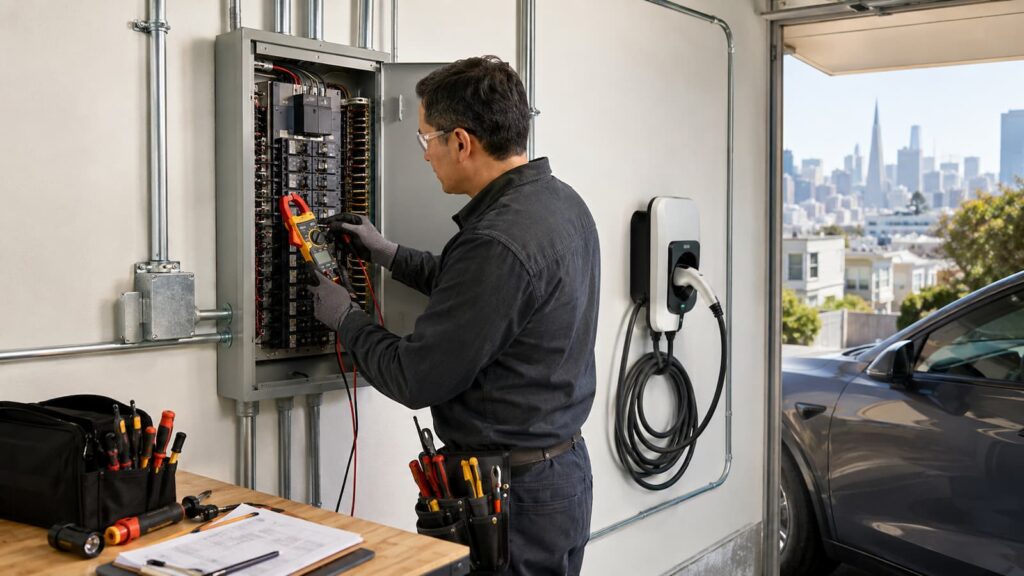
Do I Need an Electrical Panel Upgrade for an EV Charger?
If you’re planning to install a Level 2 EV charger at home, one of the first questions you’ll run into is simple but important: Do I need an electrical panel upgrade for an EV charger?
The honest answer is: not always. Some homes already have enough electrical capacity for a properly sized EV charger. Others can support charging with a lower-amperage setup or smart load management. But in many homes—especially older homes, homes with 100-amp service, homes with multiple electric appliances, or homes where the panel is already crowded—an electrical panel upgrade may be the safest and most reliable path.
This guide explains how electricians evaluate panel capacity for an EV charger, why a simple “empty breaker slot” is not enough, what 32A, 40A, and 48A charging really mean, when a service upgrade may be required, and what alternatives may help you avoid a full panel upgrade. The goal is to help you understand the decision before you spend money on equipment, permits, or installation work.
If you’re already planning a professional installation, MaxElectric can help with EV charger installation in San Francisco, including panel capacity review, dedicated circuit installation, charger mounting, wiring, and safe setup for daily home charging.
The short answer: when do you need a panel upgrade for an EV charger?
You may need an electrical panel upgrade for an EV charger if your existing panel or electrical service cannot safely support the additional continuous load. EV charging is not like plugging in a lamp or occasionally running a microwave. A Level 2 charger can pull a significant amount of power for several hours at a time, often overnight, and the electrical system must be designed for that kind of sustained demand.
You are more likely to need a panel upgrade if:
- Your home has a 100-amp electrical service and already runs many major appliances.
- Your panel is full or has no safe breaker space for a new dedicated EV circuit.
- The panel is outdated, damaged, overloaded, or from a known problematic brand.
- You want a higher-output charger, such as a 48-amp hardwired EV charger.
- You are also adding other large electric loads, such as an electric range, heat pump, hot tub, sauna, battery system, or ADU subpanel.
- A load calculation shows that the new EV charging circuit would push your system beyond safe capacity.
You may not need a panel upgrade if your existing service has enough calculated capacity, your panel is in good condition, and the charger is sized appropriately. In some cases, a 24A, 32A, or 40A charger can be a smart compromise that delivers practical daily charging without requiring a full service upgrade.
The key point: the answer is not based only on the number printed on your panel door. It depends on the full electrical picture of your home.
Why EV chargers are different from normal household loads
Most household appliances do not run at full power for many hours every day. A toaster may pull a lot of current, but only for a few minutes. A microwave may use significant power, but it cycles on and off in short bursts. Even an electric dryer usually runs for a limited period and then stops.
An EV charger is different because home charging is usually a continuous high-current load. If you plug in at night with a low battery, the charger may operate for several hours. That steady load is exactly why EV charger circuits must be designed carefully.
For example, a 40-amp EV charger does not belong on a 40-amp breaker. Because EV charging is treated as a continuous load, the circuit is typically sized so the charging current is no more than 80% of the circuit rating. That is why a 40-amp charging output usually requires a 50-amp circuit, and a 48-amp charging output usually requires a 60-amp circuit.
This is one of the most common misunderstandings homeowners have before installing a charger. The charger’s output amperage and the breaker size are related, but they are not the same thing.
Here is a simplified example:
| Charger Output | Typical Circuit Size | Approximate Power at 240V | Common Use Case |
|---|---|---|---|
| 16 amps | 20-amp circuit | 3.8 kW | Light daily driving, slower Level 2 charging |
| 24 amps | 30-amp circuit | 5.8 kW | Good compromise for limited panel capacity |
| 32 amps | 40-amp circuit | 7.7 kW | Common practical home charging speed |
| 40 amps | 50-amp circuit | 9.6 kW | Fast Level 2 home charging |
| 48 amps | 60-amp circuit | 11.5 kW | High-output hardwired charging |
These numbers are not a substitute for a real design, but they show why panel capacity matters. Adding a 50-amp or 60-amp EV circuit is not a small electrical change. It can be one of the largest loads in the home.
Panel size vs service size: what homeowners often confuse
When people ask whether they need a panel upgrade, they often use one phrase to describe several different things. In reality, an electrician may be looking at three separate issues:
- Panel capacity — the rating and condition of the breaker panel itself.
- Breaker space — whether the panel has physical and code-compliant room for a new breaker.
- Service capacity — whether the utility service feeding the home can handle the added load.
A home can have breaker space but not enough service capacity. Another home can have enough service capacity but a panel that is too old, too damaged, or too crowded to safely add a charger. A third home may need only a subpanel, not a full service upgrade. This is why a quick photo of the panel is helpful, but it is not always enough for a final answer.
What is an electrical panel upgrade?
An electrical panel upgrade usually means replacing the existing breaker panel with a newer, safer, larger, or better-configured panel. This may be done because the existing panel is outdated, full, damaged, unsafe, or too limited for modern electrical needs.
A panel upgrade may or may not include increasing the utility service size. For example, a homeowner may replace an old 100-amp panel with a new 100-amp panel for safety and reliability, or they may upgrade from 100 amps to 200 amps if the home needs more capacity.
What is a service upgrade?
A service upgrade means increasing the electrical capacity delivered to the property, such as moving from 100-amp service to 200-amp service. This can involve coordination with the utility, meter equipment, service conductors, grounding and bonding updates, permit work, and inspection.
If your home needs a higher service capacity to support EV charging and other modern loads, MaxElectric also provides electrical power increase services in San Francisco.
What is a subpanel?
A subpanel is a secondary electrical panel fed from the main panel. It can provide additional breaker space in a garage, basement, utility area, or other part of the home. A subpanel can be useful when the main panel has capacity but poor breaker space or inconvenient circuit routing.
However, a subpanel does not magically create more service capacity. If the home’s total electrical service is already maxed out, adding a subpanel alone does not solve the load problem. It only redistributes circuits.
The most important step: electrical load calculation
The right way to determine whether you need a panel upgrade for an EV charger is not guessing. It is a load calculation.
A load calculation estimates the electrical demand of the home based on its size, appliances, HVAC equipment, kitchen loads, laundry equipment, existing circuits, and proposed new loads. The EV charger is added to that calculation at its designed charging output. If the calculation shows that the existing service can safely handle the added EV load, a panel upgrade may not be necessary. If the calculation exceeds the safe capacity of the service, an upgrade or load management solution may be needed.
This is why two homes with the same 100-amp panel can get different answers. One may have gas appliances, no central electric heat, modest electrical demand, and enough capacity for a lower-amperage charger. Another may have electric heat, electric range, electric dryer, air conditioning, hot tub, and a future battery system. The second home is much more likely to need a major upgrade.
A useful panel review for an EV charger should look at:
- Main service rating: 100A, 125A, 150A, 200A, or another size.
- Existing major loads: HVAC, range, dryer, water heater, sauna, hot tub, heat pump, battery, solar, ADU, workshop equipment.
- Available breaker spaces and whether tandem breakers are permitted in that panel.
- Panel age, condition, labeling, signs of overheating, corrosion, or improper modifications.
- Distance from panel to charger location and voltage drop considerations.
- Grounding and bonding condition.
- Whether the charger will be hardwired or connected through a receptacle.
- Whether smart load management can be used safely and legally.
If a contractor tells you “you’re fine” based only on seeing one empty breaker space, that is not a complete evaluation. An EV charger is a long-term electrical load, and it deserves a real capacity review.
Is 100-amp service enough for an EV charger?
Sometimes, yes. Often, maybe. In some homes, no.
A 100-amp service is common in older homes, including many homes in dense urban areas. It may have been perfectly adequate when the home had gas heating, a gas range, a gas dryer, and no EV charger. But modern homes are adding more electrical demand: EV charging, heat pumps, induction ranges, electric water heaters, battery systems, home offices, and sometimes ADUs.
A 100-amp panel may support an EV charger if the home’s calculated load allows it and the charger is sized realistically. For example, a 24-amp or 32-amp charger may be enough for many daily drivers. If you drive 30 to 50 miles per day, you may not need the fastest possible charger. Overnight charging at a moderate amperage may fully meet your needs.
But if you want a 48-amp charger on a 60-amp circuit, and your home already has significant electric loads, a 100-amp service may not be enough. The issue is not whether the charger can physically be installed. The issue is whether the electrical system can support it safely without overload, nuisance tripping, overheating, or future limitations.
A practical way to think about 100-amp service
Ask these questions:
- Do you have gas or electric appliances?
- Do you have central air conditioning or electric heating?
- Are you planning to electrify more appliances soon?
- Do you need the EV to charge from nearly empty to full overnight, or just recover daily driving?
- Would a lower-amperage EV charger meet your actual routine?
- Is the panel old, crowded, or already showing problems?
If you are keeping mostly gas appliances and charging one EV overnight, a carefully designed lower-amp setup may work. If you are moving toward a fully electric home, a panel and service upgrade may be the smarter long-term investment.
Is 200-amp service enough for an EV charger?
In many homes, 200-amp service provides much more flexibility for EV charging. It often allows a Level 2 charger to be added without the same level of constraint found in many 100-amp homes. But 200 amps does not automatically mean “anything is possible.” The load calculation still matters.
A 200-amp home with electric heat, two EVs, a hot tub, induction cooking, electric dryer, heat pump water heater, battery system, and other large loads may still need careful planning. A 200-amp panel can also be physically full, poorly configured, outdated, or unable to accept the desired breaker arrangement.
For most single-EV households, however, a healthy 200-amp service is usually a strong starting point. It may support a 40A or 48A EV charger depending on the home’s existing loads and the charger location.
The advantage of a 200-amp upgrade is not just today’s EV charger. It can also prepare the home for future electrical demands: a second EV, solar and battery equipment, electric appliances, garage tools, outdoor equipment, or home additions.
How many amps do you actually need for home EV charging?
Many homeowners assume they need the highest available charger output. In reality, the best charger size depends on how you drive, how long the car is parked overnight, what your vehicle can accept, and what your electrical system can safely support.
Here is the practical reality: most EV owners do not arrive home at 0% battery every night. Many only need to replace the energy used during the day. A moderate Level 2 charger can be more than enough for daily use.
Approximate Level 2 charging expectations vary by vehicle efficiency, voltage, battery condition, and onboard charger limits, but the general pattern looks like this:
| Charging Output | Approximate Power | General Daily Use Fit |
|---|---|---|
| 16A | About 3.8 kW | Light driving, longer overnight sessions |
| 24A | About 5.8 kW | Good for many commuters with limited panel capacity |
| 32A | About 7.7 kW | Strong everyday Level 2 option |
| 40A | About 9.6 kW | Fast home charging for larger batteries or heavier driving |
| 48A | About 11.5 kW | High-output charging, usually hardwired |
If your panel is limited, stepping down from 48A to 32A may be a very reasonable choice. It can reduce the required circuit size and may avoid a larger project. The tradeoff is charging speed, but for many drivers that tradeoff is barely noticeable in daily life.
For example, if your car sits in the garage for 10 to 12 hours overnight, a 32A charger may add plenty of energy for the next day. If you drive unusually long distances every day, share one charger between multiple EVs, or need rapid recovery between trips, a higher-output charger may be worth the extra electrical work.
Hardwired charger vs NEMA 14-50 outlet: does it affect panel upgrade needs?
A hardwired charger and a NEMA 14-50 outlet both need a properly sized dedicated circuit. The panel capacity question does not disappear just because the charger plugs into an outlet. If you are adding a new 240V circuit for EV charging, the electrical system still must support that load.
That said, the installation type can affect the final design.
Hardwired EV charger
A hardwired charger is permanently connected to the circuit. It is often preferred for higher-output charging, outdoor installations, cleaner conduit routing, and long-term reliability. Many 48A chargers require hardwiring because the circuit size is typically above what a common NEMA 14-50 receptacle setup supports.
Hardwired installation can also reduce problems related to plug and receptacle wear. Since EV charging is a sustained high-current load, weak receptacle contacts, loose plugs, or low-quality outlets can become a heat risk over time.
NEMA 14-50 outlet
A NEMA 14-50 outlet is a common plug-in option for EV charging. It is flexible and may work well when installed correctly with the right receptacle, wiring, breaker, box, and location. But it should not be treated like a casual convenience outlet. EV charging through a receptacle can expose poor workmanship or low-quality components because the load continues for hours.
If your plan is to use a plug-in EV charger, make sure the outlet is installed specifically for EV charging conditions—not simply “whatever 240V outlet fits.” MaxElectric provides professional NEMA 14-50 outlet installation in San Francisco for homeowners who prefer a plug-in Level 2 setup.
From the panel capacity perspective, the key question is still the same: can your system safely support the circuit size required by the charger output?
Signs your panel may not be ready for an EV charger
Some warning signs are obvious. Others are easy to miss until charging begins and the system starts showing symptoms under load.
Your panel may need repair, replacement, reconfiguration, or upgrade before EV charging if you notice:
- Frequent breaker trips, especially when multiple appliances are running.
- Lights dimming when large loads turn on.
- Buzzing, crackling, or humming from the panel.
- Warm breakers or a warm panel cover.
- Rust, corrosion, water marks, or staining inside or around the panel.
- Scorch marks, melted insulation, or burning smell near the panel.
- Double-tapped breakers or messy, poorly labeled circuits.
- Old fuse box instead of a modern breaker panel.
- No available breaker space or questionable use of tandem breakers.
- Known problematic panels, such as Federal Pacific or Zinsco equipment.
If your panel already has safety concerns, an EV charger should not be added as “just one more circuit.” The charger may become the load that reveals existing weaknesses. In that case, the real project is not just EV charging—it is modernizing the electrical system so the home can safely support the way you use power today.
For older or unsafe equipment, MaxElectric can help with outdated electrical panel replacement before adding new high-demand circuits.
What if the panel has no empty breaker spaces?
A full panel does not automatically mean you need a service upgrade. It means the electrician needs to evaluate the safest way to add capacity or reorganize the system.
Possible solutions include:
- Installing a properly sized subpanel if the main service has enough capacity.
- Replacing the existing panel with a larger panelboard.
- Reconfiguring circuits if the current layout is inefficient or outdated.
- Using a smart load management system where appropriate.
- Upgrading service capacity if the load calculation requires it.
What you do not want is a shortcut solution that makes the panel look like it has room but does not solve the underlying load or safety issue. Tandem breakers, breaker swaps, and circuit rearrangements must be allowed by the panel’s listing and done correctly. The wrong “space-saving” approach can create inspection problems and safety risks.
Can load management help avoid a panel upgrade?
Yes, in some cases. Load management can be a smart solution when the home does not have enough spare capacity for a full-speed EV charger but can safely charge when other large loads are not running.
A load management device can monitor electrical demand and reduce or pause EV charging when the home’s load gets too high. For example, it may allow the EV charger to run at night when the dryer, oven, and HVAC load are lower, then reduce charging if the home approaches a set capacity limit.
This can be especially useful for:
- Homes with 100-amp service where a full service upgrade would be expensive or complicated.
- Condos or multi-family buildings where service upgrades are difficult.
- Homeowners who drive moderate daily mileage and do not need maximum charging speed every night.
- Properties where utility coordination would significantly delay the project.
However, load management is not a universal substitute for an upgrade. It must be selected, installed, configured, and permitted properly. It also does not fix an unsafe, damaged, obsolete, or poorly maintained panel. If the panel itself is the problem, load management will not make it healthy.
Can you just install a lower-amperage EV charger instead?
Often, yes. Reducing charger amperage is one of the most practical ways to fit EV charging into an existing home electrical system.
For example, if a 48A charger would require a 60A circuit and push the home beyond available capacity, a 32A charger on a properly sized circuit may still provide excellent daily charging. Even a 24A charger can be enough for many drivers if the vehicle is parked overnight for a long charging window.
This is where real-world driving behavior matters more than charger marketing. Ask yourself:
- How many miles do I usually drive per day?
- How many hours is the car parked at home overnight?
- Do I need to fully recharge from a very low battery every night?
- Do I have a second vehicle or public fast charging available for rare cases?
- Will I add a second EV soon?
A lower-amperage charger can be a smart, safe, cost-effective solution. But it still needs a dedicated circuit and proper installation. Lower amperage does not mean “DIY-friendly” or “no permit needed.” It simply reduces electrical demand.
Do permits matter for EV charger installation?
Yes. Permits matter because EV charger installation involves adding or modifying electrical circuits, and the installation should be reviewed for safety and code compliance. This is especially important in San Francisco, where older buildings, shared garages, meter locations, and tight utility spaces can make EV charger projects more complex than they first appear.
A permit process may require documentation such as equipment information, electrical plans, panel schedules, load calculations, site details, and installation specifications. The exact requirements depend on the project, charger type, location, building type, and local authority having jurisdiction.
For homeowners, the permit is not just paperwork. It helps confirm that the circuit is sized properly, the equipment is listed, the installation method is appropriate, and the work can be inspected. This can matter later for insurance, resale, warranty claims, and peace of mind.
Skipping permits may look faster at first, but it can create problems if the installation fails inspection later, causes damage, or needs to be disclosed during a sale. A properly permitted installation is usually the better long-term choice.
Special considerations for San Francisco homes
San Francisco homes often have electrical conditions that make EV charger planning more nuanced. Many properties are older, garages can be compact, panel locations are not always convenient, and multi-unit buildings may involve shared spaces or HOA considerations. Even when the charger location looks simple, the electrical route from the panel to the parking space can be complicated.
Common San Francisco EV charger challenges include:
- Older 100-amp services that were not designed for EV charging.
- Panels located far from the garage or parking area.
- Shared garages in condos or multi-family properties.
- Limited wall space for clean charger mounting and conduit routing.
- Older wiring, grounding issues, or outdated panels.
- Utility coordination for service upgrades.
- Permit documentation and inspection requirements.
This is why a local EV charger installation is not only about mounting the charger. It is about designing a system that fits the actual property: service size, panel condition, conduit route, parking layout, charger output, and future electrical needs.
When a panel upgrade is definitely worth considering
Even if there is a workaround, a panel upgrade may still be the better long-term investment in certain situations. The question is not only “Can we make this charger work?” The better question is “Will this electrical system support my home safely for the next 10 to 20 years?”
A panel upgrade is worth serious consideration if:
- You plan to keep the EV for years and charge at home daily.
- You expect to buy a second EV.
- You are moving toward electric appliances or home electrification.
- Your current panel is old, unsafe, full, or poorly configured.
- You want faster charging without load management limitations.
- You are planning solar, battery backup, a generator transfer setup, or an ADU.
- You want to improve the home’s electrical reliability and resale readiness.
For many homeowners, the EV charger is the trigger that reveals the bigger issue: the home’s electrical system was designed for an earlier era. A panel upgrade can turn a constrained installation into a clean, flexible, future-ready electrical setup.
When you may be able to avoid a panel upgrade
A panel upgrade is not always necessary. You may be able to avoid one if the electrical system is healthy and the charger is designed around real capacity instead of maximum output.
Possible ways to avoid a full panel upgrade include:
- Choosing a lower-amperage Level 2 charger.
- Using a charger with adjustable current settings.
- Installing smart load management.
- Adding a subpanel when service capacity is adequate but breaker space is limited.
- Scheduling charging during lower-demand hours.
- Designing for your actual daily mileage instead of rare worst-case charging needs.
The best solution is the one that is safe, permitted, reliable, and realistic for your driving habits. Sometimes that means a major upgrade. Sometimes it means a smarter charger choice.
What happens during a professional EV charger panel assessment?
A professional EV charger assessment is more than looking for an empty breaker slot. A qualified electrician should evaluate whether the existing electrical system can safely support the charger you want.
A typical assessment may include:
- Inspecting the main electrical panel and service rating.
- Checking panel condition, age, labeling, breaker compatibility, and signs of overheating.
- Reviewing existing major loads and future planned loads.
- Performing or preparing a load calculation.
- Determining the safest charger amperage for the home.
- Evaluating the route from the panel to the charger location.
- Checking grounding and bonding conditions.
- Recommending hardwired vs plug-in installation.
- Identifying permit and inspection requirements.
- Explaining whether a panel upgrade, subpanel, load management device, or service upgrade is needed.
A good assessment should leave you with a clear answer: what charging speed your home can support now, what upgrades would be required for faster charging, and what option makes the most sense for your budget and long-term plans.
Questions to ask before installing an EV charger
Before approving an EV charger installation quote, ask practical questions. These questions help you avoid underbuilt circuits, failed inspections, overheating problems, and expensive changes later.
- What amperage will the charger be configured for?
- What breaker size and wire size will be used?
- Is the charger hardwired or plug-in?
- If plug-in, what grade of receptacle will be used?
- Has a load calculation been reviewed?
- Does my existing panel have enough capacity, not just physical space?
- Will a permit be required?
- Is load management an option?
- Will this setup support a future second EV?
- What signs would indicate the charger circuit is overheating or overloaded?
If the answer to most questions is vague, the installation plan may not be complete enough. EV charging is too demanding for guesswork.
Common mistakes homeowners should avoid
Many EV charging problems are preventable. They usually happen when speed, convenience, or low upfront cost is prioritized over proper electrical design.
Mistake 1: assuming an empty breaker slot means capacity
An empty slot only means there may be physical space for a breaker. It does not prove that the panel or service can support a new EV charging load.
Mistake 2: choosing the fastest charger by default
A 48A charger may be attractive, but it may not be necessary for your driving habits. Oversizing the charger can increase installation cost and trigger upgrades that a lower-amperage charger could avoid.
Mistake 3: using a low-quality receptacle for plug-in EV charging
EV charging through a receptacle creates sustained heat and mechanical stress. A cheap or poorly installed outlet can become a failure point.
Mistake 4: increasing breaker size to stop tripping
A breaker that trips is warning you about a possible overload, fault, heat issue, or mismatch. Replacing it with a larger breaker without matching the wire and equipment is dangerous and should never be used as a shortcut.
Mistake 5: ignoring future electrical plans
If you are likely to add solar, battery backup, an electric range, heat pump, second EV, or ADU, it may be smarter to plan a broader electrical upgrade now rather than repeat work later.
FAQ: electrical panel upgrades for EV chargers
Do all EV chargers require a panel upgrade?
No. Many homes can support an EV charger without a panel upgrade, especially if the charger is properly sized and the existing service has enough calculated capacity. But the answer should be based on a load calculation and panel inspection, not guesswork.
Can I install a Level 2 charger on a 100-amp panel?
Sometimes. A 100-amp panel may support a lower-amperage Level 2 charger if the home’s existing loads are modest and the load calculation allows it. But many 100-amp homes are too limited for high-output charging unless load management or a service upgrade is used.
Is 200 amps enough for an EV charger?
In many homes, yes. A healthy 200-amp service usually provides much more flexibility for Level 2 charging. However, homes with multiple large electric loads or two EVs still need a proper load calculation.
What size breaker do I need for an EV charger?
It depends on the charger output. As a simplified rule, EV charging is typically designed so the charging output is 80% of the circuit rating. A 32A charger commonly uses a 40A circuit, a 40A charger commonly uses a 50A circuit, and a 48A charger commonly uses a 60A circuit. The final design must match the charger, wiring, breaker, installation method, and code requirements.
Can I avoid a panel upgrade by charging at lower amps?
Often, yes. Lower-amperage charging may be a practical solution if it meets your daily driving needs and the existing electrical system can support it. Many homeowners do not need the maximum available charging speed for everyday use.
Can a load management device avoid a service upgrade?
In some homes, yes. Load management can reduce or pause EV charging when the home’s electrical demand is high. This may allow safe EV charging on a limited service. But it must be installed correctly and does not fix an unsafe or outdated panel.
Do I need a permit for EV charger installation?
In most cases, adding a new EV charging circuit requires an electrical permit. Permit requirements vary by location and project type, but a permitted installation helps confirm that the charger circuit is safe, code-compliant, and properly inspected.
Is a hardwired charger better than a NEMA 14-50 outlet?
Hardwired chargers are often preferred for higher-output, permanent, outdoor, or cleaner installations. NEMA 14-50 outlets can work well when installed correctly with quality components. The better option depends on your charger, panel capacity, location, and long-term use.
Will an EV charger overload my home?
It can if the charger is added without proper planning. A correctly designed EV charger circuit should be matched to your home’s service capacity, panel condition, and calculated load. That is why panel review is so important before installation.
Should I upgrade my panel now if I plan to electrify more appliances later?
If you plan to add an EV charger, heat pump, electric range, electric dryer, battery system, or second EV, it may be smart to think beyond the immediate charger installation. A panel or service upgrade can make future projects easier and safer.
Final answer: do you need an electrical panel upgrade for an EV charger?
You need an electrical panel upgrade for an EV charger only if your current electrical system cannot safely support the charger you want. Some homes are ready with a properly sized dedicated circuit. Some homes need a lower-amperage charger or load management. Others need a new panel, subpanel, or full service upgrade.
The only reliable way to know is to evaluate the panel, calculate the home’s load, review the charger requirements, and design the circuit correctly. An EV charger is one of the most demanding electrical additions a homeowner can make, so it should be treated as a serious electrical project—not just a device mounted on the garage wall.
If your panel is modern, healthy, and has enough calculated capacity, you may be able to install a Level 2 charger without upgrading the panel. If your panel is old, crowded, overloaded, damaged, or limited to 100 amps with several major electric loads, an upgrade may be the safer and more future-ready choice.
The best solution is the one that gives you reliable daily charging without creating overload, heat, nuisance trips, failed inspections, or future electrical bottlenecks. For many homeowners, the right answer is not automatically “upgrade everything.” It is: design the charger around the home you actually have—and the home you are planning to create.