
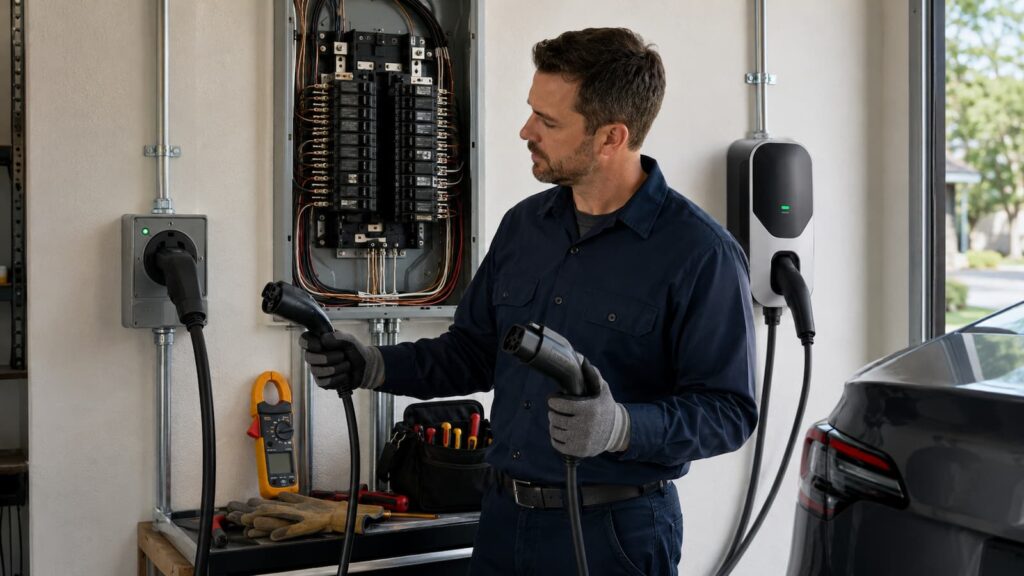
NEMA 14-50 vs Hardwired EV Charger: Which Is Safer for Home Charging?
If you are planning a Level 2 EV charger at home, one of the first decisions you will face is whether to install a NEMA 14-50 outlet for a plug-in charger or choose a hardwired EV charger mounted directly to the wall. Both options can work. Both can be safe when installed correctly. But they are not equal in long-term reliability, charging speed, code considerations, maintenance, overheating risk, or future flexibility.
The short answer is this: a hardwired EV charger is usually the safer and more reliable long-term option for daily home charging, especially if you want higher charging output, outdoor installation, cleaner conduit routing, fewer plug/receptacle failure points, or a permanent setup. A NEMA 14-50 outlet can still be a good choice when flexibility matters, the charger output is appropriate, the receptacle is high quality, and the circuit is installed specifically for EV charging.
The problem is that many homeowners compare these options too casually. They think, “A 240V outlet is cheaper, so why not just install that?” But EV charging is not like occasionally plugging in a dryer. A Level 2 EV charger may pull high current for several hours at a time, night after night. That means the circuit, breaker, wire, receptacle, charger, panel capacity, grounding, and installation method all matter.
This guide explains the real differences between NEMA 14-50 and hardwired EV chargers, which option is safer, when each one makes sense, and what homeowners should know before choosing. If you want a properly designed home charging setup, MaxElectric can help with EV charger installation in San Francisco, including panel capacity review, dedicated circuit installation, and safe charger setup.
Quick comparison: NEMA 14-50 vs hardwired EV charger
Before we get into the details, here is the practical homeowner-friendly comparison.
| Feature | NEMA 14-50 Plug-In Charger | Hardwired EV Charger |
|---|---|---|
| Connection type | Charger plugs into a 240V receptacle | Charger is directly wired to the circuit |
| Typical charging output | Often up to 40A charging on a 50A circuit, depending on EVSE | Often up to 48A charging on a 60A circuit, depending on charger and home capacity |
| Best for | Flexibility, portable EVSE use, easier charger replacement | Permanent daily charging, higher output, cleaner installation |
| Main safety concern | Outlet/plug heat, receptacle wear, loose contacts, GFCI nuisance trips | Must be installed and configured correctly; less plug-related risk |
| Outdoor use | Possible only with proper equipment and weatherproofing | Often preferred for outdoor or semi-outdoor locations |
| Long-term durability | Depends heavily on receptacle quality and plug usage | Generally stronger for permanent daily use |
| Flexibility | High — charger can be unplugged or replaced more easily | Lower — more permanent installation |
| Clean appearance | Can look good, but plug and outlet remain visible | Usually cleaner and more finished |
| Best safety choice | Safe when properly installed with quality components | Usually safer for high-use, high-output, permanent charging |
If you want the safest general recommendation for a homeowner who charges daily, choose a hardwired charger. If you want flexibility, travel with a mobile connector, or need a plug-in solution for a specific reason, a NEMA 14-50 outlet can be a safe option when installed correctly.
What is a NEMA 14-50 outlet for EV charging?
A NEMA 14-50 is a 240-volt receptacle commonly used for higher-power appliances, RVs, ranges, and plug-in EV charging. For EV owners, it is popular because many portable Level 2 chargers and mobile connectors can plug into it with the right adapter.
A typical EV charging setup with a NEMA 14-50 includes:
- A dedicated 240V circuit
- A 50-amp breaker in many common installations
- Properly sized conductors
- A high-quality NEMA 14-50 receptacle
- A suitable electrical box and cover
- GFCI protection where required
- A plug-in EV charging cable or mobile connector
The important detail is that a 50-amp circuit does not mean you should charge at 50 amps. EV charging is a continuous load, so a charger on a 50-amp circuit is commonly limited to 40 amps of charging output. Some mobile connectors are limited even lower, such as 32 amps, depending on the equipment.
A NEMA 14-50 outlet can be a convenient and flexible setup, but it must be installed for EV charging conditions. Using a cheap receptacle, loose terminations, an old dryer/range circuit, extension cords, adapters, or an unknown existing outlet can create overheating and breaker-tripping risks.
If your preferred setup is plug-in charging, MaxElectric offers professional NEMA 14-50 outlet installation in San Francisco designed for safe Level 2 EV charging.
What is a hardwired EV charger?
A hardwired EV charger is permanently connected to the electrical circuit. Instead of plugging into a receptacle, the charger is wired directly through conduit or approved cable to the electrical system. The charger is mounted to the wall, post, or approved surface, and the circuit is designed around the charger’s rated output and settings.
A hardwired setup usually includes:
- A dedicated 240V circuit
- Correct breaker size for the charger output
- Proper conductor sizing
- Clean conduit or approved wiring method
- Correct grounding and bonding
- Manufacturer-required commissioning/settings
- Permit and inspection where required
- A permanently mounted EVSE unit
Hardwired chargers are common for Tesla Wall Connector, Universal Wall Connector, ChargePoint Home Flex, Wallbox, Emporia, Ford Connected Charge Station, and many other wall-mounted EVSE units. They can be installed indoors or outdoors depending on equipment rating and site conditions.
The main safety advantage of hardwiring is that it removes the receptacle and plug connection as a failure point. There is no outlet contact pressure to weaken, no plug blades to heat, no receptacle face to loosen, and no repeated plugging/unplugging wear. For a daily-use charger, that matters.
Which is safer: NEMA 14-50 or hardwired?
For most permanent home charging installations, a hardwired EV charger is safer and more reliable. The reason is not that NEMA 14-50 is automatically unsafe. A properly installed NEMA 14-50 can be safe. The reason is that hardwiring eliminates one of the most common weak points in EV charging: the plug-and-receptacle connection.
EV charging is a sustained load. If a plug/receptacle connection has poor contact pressure, a loose terminal, corrosion, low-quality components, or heat damage, the problem may not appear instantly. It may show up after 30 minutes, two hours, or several months of nightly charging. That is why many plug-in EV charging failures involve heat at the receptacle, plug, or breaker.
Hardwired chargers still need correct installation. They are not magic. A hardwired charger can still be unsafe if the breaker is wrong, the wire is undersized, the charger is set too high, the panel is overloaded, grounding is poor, or the installation ignores manufacturer instructions. But when installed correctly, hardwired EVSE reduces mechanical connection points and is usually better for long-term high-current charging.
In simple terms:
- Safest for daily permanent charging: hardwired EV charger.
- Safe when installed correctly and used appropriately: NEMA 14-50 outlet.
- Risky: old outlet, cheap receptacle, loose plug, reused dryer/range circuit, adapters, extension cords, or unknown wiring.
The biggest safety issue with NEMA 14-50: heat at the outlet
The most common safety concern with plug-in EV charging is heat. Heat can develop when electrical resistance increases at a connection point. In a NEMA 14-50 setup, those connection points include the receptacle terminals, plug blades, internal receptacle contacts, wire terminations, breaker terminals, and any junction points in the circuit.
A small amount of warmth can happen under load, but a hot plug, hot outlet face, burning smell, discoloration, or softened plastic is not normal. If you notice any of those signs, stop charging and have the circuit inspected.
NEMA 14-50 outlet overheating can be caused by:
- Low-quality receptacle not built for repeated high-current EV charging
- Loose terminal screws
- Improper torque during installation
- Worn internal contacts
- Repeated unplugging and plugging
- Plug not fully inserted
- Damaged plug blades
- Corrosion or moisture exposure
- Undersized conductors
- Wrong breaker size
- Charging amperage set too high
This is why the cheapest outlet installation is rarely the best choice for EV charging. A NEMA 14-50 used for occasional RV or appliance use is not the same as a receptacle used for nightly continuous EV charging. The installation should be designed for the actual duty cycle.
GFCI issues: why plug-in EV chargers can be more complicated
One practical difference between a NEMA 14-50 setup and a hardwired charger is GFCI protection. In many modern installations, receptacles used for EV charging require GFCI protection. This often means a GFCI breaker for the NEMA 14-50 circuit.
GFCI protection is important because it helps protect people from shock hazards. However, it can also create nuisance trip issues in some EV charging setups. The EVSE itself may already include internal ground-fault protection, and adding an upstream GFCI breaker can sometimes create frustrating trips depending on equipment, leakage current, wiring, moisture, and compatibility.
This does not mean you should remove GFCI protection where it is required. It means the installation should be designed correctly from the start. If a NEMA 14-50 charger repeatedly trips a GFCI breaker, the cause could be:
- Moisture in the receptacle or box
- Improper wiring
- Neutral/ground issue
- Damaged charging cable
- EVSE internal fault
- Incompatible breaker/charger behavior
- Outdoor exposure problems
- Real ground fault that needs repair
A hardwired charger may avoid some receptacle-related GFCI complications, depending on local code, equipment instructions, and installation conditions. But hardwired equipment still needs proper ground-fault protection as required by the EVSE and applicable code. The answer is not “avoid protection”; the answer is “design the system correctly.”
Charging speed: can NEMA 14-50 charge as fast as hardwired?
Sometimes, but not always. A NEMA 14-50 setup is commonly installed on a 50-amp circuit, which usually supports up to 40 amps of continuous EV charging. Some mobile connectors are limited to 32 amps, even when plugged into a 14-50 outlet. That may still be plenty for most drivers, but it is not the fastest possible home charging setup.
A hardwired charger can often support higher output, such as 48 amps on a properly designed 60-amp circuit, depending on the charger, vehicle, electrical panel, wire size, and local requirements. This can provide faster charging for vehicles that can accept that rate.
Here is a simplified comparison:
| Setup | Typical Circuit | Common Charging Output | Approximate Power at 240V |
|---|---|---|---|
| NEMA 14-50 plug-in EVSE | 50A circuit | 32A–40A, depending on charger | 7.7–9.6 kW |
| Hardwired EV charger | 40A circuit | 32A | 7.7 kW |
| Hardwired EV charger | 50A circuit | 40A | 9.6 kW |
| Hardwired EV charger | 60A circuit | 48A | 11.5 kW |
The speed difference may or may not matter. If your car sits at home for 10 to 12 hours overnight and you drive a normal daily commute, a 32A or 40A plug-in setup may be more than enough. If you drive long distances, have a large battery EV, share one charger between multiple vehicles, or want maximum overnight recovery, a higher-output hardwired charger may be worth it.
The safest charger is not always the fastest charger. The charger output must match your panel capacity, wire size, breaker size, vehicle capability, and real charging needs.
Breaker sizing: why 50 amps does not mean 50 amps of charging
This is one of the most important safety points in the entire discussion. A 50-amp circuit does not mean your EV charger should draw 50 amps continuously. Because EV charging is a continuous load, the charging output is typically limited to 80% of the circuit rating.
That is why:
- A 40A circuit usually supports up to 32A charging.
- A 50A circuit usually supports up to 40A charging.
- A 60A circuit usually supports up to 48A charging.
This applies whether the charger is plug-in or hardwired. You cannot make a NEMA 14-50 outlet safer by simply installing a larger breaker. The breaker must match the wire, receptacle, charger, panel, and installation conditions.
One dangerous mistake is installing a 60-amp breaker for a NEMA 14-50 receptacle so a charger can run at 48 amps. That is not a proper fix. If you want 48-amp charging, a hardwired charger on a properly designed 60-amp circuit is usually the correct direction.
The breaker protects the wiring. If the breaker is too large for the conductors or equipment, the circuit can overheat before the breaker trips. That is why breaker sizing is not a homeowner guesswork item.
Panel capacity: both options need a real load calculation
Choosing between NEMA 14-50 and hardwired does not eliminate the need to check panel capacity. Both options add a substantial load to the home. A NEMA 14-50 outlet on a 50-amp circuit can be just as demanding on the panel as a hardwired 40-amp charger on a 50-amp circuit.
An electrician should evaluate:
- Main service size, such as 100A, 125A, 150A, or 200A
- Existing major loads
- Available breaker space
- Panel age and condition
- Whether the panel accepts the required breaker type
- Grounding and bonding
- Distance from panel to charger location
- Voltage drop considerations
- Future loads such as a second EV, heat pump, induction range, battery, or ADU
A common mistake is assuming that an empty breaker slot means the home is ready for EV charging. Physical space is not the same as electrical capacity. A proper load calculation is the right way to determine whether your home can support the charger output you want.
If your existing panel is outdated, overloaded, unsafe, or too limited for EV charging, a charger installation may need to be paired with electrical panel replacement or upgrade.
Cost comparison: is NEMA 14-50 cheaper than hardwired?
A NEMA 14-50 outlet can be cheaper than a hardwired EV charger installation, but not always by as much as homeowners expect. The real cost depends on the distance from the panel, wiring method, breaker type, permit requirements, outlet quality, wall construction, panel capacity, and whether a new charger must be purchased.
A plug-in setup may cost less when:
- The panel is close to the charger location.
- The panel has enough capacity and breaker space.
- The installation is indoors in a garage.
- A suitable high-quality receptacle can be installed cleanly.
- The homeowner already has a compatible mobile connector.
- No panel upgrade or load management is needed.
A hardwired setup may cost more when:
- The charger unit must be purchased separately.
- The charger requires a larger circuit.
- The conduit route is longer or more complex.
- The installation is outdoors.
- The panel needs upgrades or reconfiguration.
- Permits or inspections require additional documentation.
However, a cheap NEMA 14-50 installation can become expensive later if it causes overheating, breaker trips, GFCI nuisance trips, outlet replacement, or a failed inspection. For a daily-use EV charger, long-term reliability often matters more than the lowest upfront price.
The better question is not “Which one is cheapest?” The better question is “Which setup is safest, code-conscious, reliable, and appropriate for how I actually charge?”
When a NEMA 14-50 outlet makes sense
A NEMA 14-50 outlet can be a practical choice in the right situation. It is not automatically a “less safe” option if it is installed correctly, protected correctly, and used within its limits.
A NEMA 14-50 may make sense if:
- You want flexibility to unplug or replace the charger.
- You use a mobile connector that supports 14-50 charging.
- You do not need maximum charging speed.
- The outlet is indoors in a clean, dry garage.
- The charger will not be unplugged frequently.
- You are renting or may move soon, subject to owner approval and permits.
- Your electrical panel supports a 50A dedicated circuit.
- You prefer a lower upfront equipment cost.
For many drivers, a 32A or 40A plug-in charger can recover more than enough range overnight. If your daily driving is moderate and your car is parked for long periods, a properly installed NEMA 14-50 can be a reasonable solution.
But the phrase “properly installed” matters. The outlet should be high quality, the circuit should be dedicated, the breaker should be correct, the conductors should be properly sized, and the charger should be set to the correct output.
When a hardwired EV charger is the better choice
A hardwired EV charger is usually the better choice when the charger will be used daily, when the installation is permanent, or when safety and long-term reliability are the priority.
A hardwired charger makes sense if:
- You want the safest permanent home charging setup.
- You charge every night or nearly every night.
- You want 48A charging where your vehicle and electrical system support it.
- The charger will be outdoors or in a semi-exposed area.
- You want a clean finished installation with no plug/receptacle connection.
- You want fewer overheating concerns at the outlet.
- You plan to keep the charger long-term.
- You want smart charger features, load sharing, scheduling, or energy tracking.
- You may add a second EV later.
- You are installing a Tesla Wall Connector or Universal Wall Connector.
Hardwired installation is also often preferred for higher-output chargers because it avoids pushing a plug-in receptacle setup to its practical limit. If your EVSE can deliver 48A, hardwiring is generally the more appropriate installation method.
For Tesla owners, MaxElectric provides Tesla charger installation in San Francisco, including clean wall connector mounting, circuit planning, panel review, and code-conscious wiring.
Outdoor charging: hardwired is usually the stronger option
Outdoor EV charging introduces more variables: rain, fog, humidity, temperature changes, sunlight, dust, and physical exposure. In a city like San Francisco, garages and parking layouts vary widely. Some chargers are installed in enclosed garages, while others are mounted on exterior walls, carports, driveways, or shared parking areas.
A NEMA 14-50 outlet can be installed outdoors only when the full installation is designed for outdoor conditions. That means proper weather-rated covers, boxes, equipment, mounting, strain relief, and protection. But a plug and receptacle outdoors still introduce a connection point that can be affected by moisture, wear, and physical movement.
A hardwired charger is usually cleaner outdoors because the circuit enters the charger through a controlled wiring method rather than through a plug. The installation can be sealed and routed more neatly, reducing exposure at the connection point.
If the charger is outside or semi-exposed, hardwired installation is often the better safety and durability choice.
What about using an existing dryer outlet or range outlet?
Many homeowners ask whether they can use an existing dryer outlet or range outlet for EV charging. Sometimes the plug looks close enough. Sometimes an adapter is available online. But that does not mean the circuit is safe for EV charging.
Existing 240V outlets may be unsuitable because:
- The circuit may not be dedicated for EV charging.
- The breaker size may not match the charger output.
- The wire size may not be correct.
- The receptacle may be old or worn.
- The outlet may not have required GFCI protection.
- The neutral/ground configuration may not be appropriate.
- The outlet may have been installed for intermittent appliance use, not continuous EV charging.
- The circuit may be shared or modified.
- The panel label may be inaccurate.
Using adapters can make the situation even riskier. Adapters add connection points, and every connection point can heat if it is loose, undersized, damaged, or poorly made. For EV charging, extension cords and questionable adapters should be avoided.
The safer approach is to install a dedicated EV charging circuit designed for the charger you intend to use.
What about charger portability?
Portability is one of the main advantages of a NEMA 14-50 setup. A plug-in charger can be unplugged, taken on a trip, replaced more easily, or used in another compatible location. For some homeowners, that flexibility is valuable.
A hardwired charger is not portable. It is a permanent home charging appliance. If you move, you usually leave it behind or hire an electrician to remove it. If the unit fails, replacement may require electrical work rather than simply unplugging one device and plugging in another.
However, most EV owners do not need their main home charger to be portable. Many keep a mobile connector in the vehicle for travel or emergencies and use a wall-mounted hardwired charger at home. That combination gives daily reliability plus backup flexibility.
If portability is the top priority, NEMA 14-50 may be attractive. If reliable daily home charging is the top priority, hardwired usually wins.
Maintenance and long-term reliability
Hardwired chargers generally require less attention at the physical connection point because there is no plug and receptacle interface. Once installed correctly, the connection is fixed inside the charger’s wiring compartment or junction path, protected from routine movement.
NEMA 14-50 setups should be monitored more carefully. Over time, the outlet can loosen, contacts can wear, plugs can heat, and repeated unplugging can reduce connection quality. Homeowners using plug-in EV charging should periodically look for warning signs.
Stop charging and call an electrician if you notice:
- Outlet faceplate feels hot
- Plug feels hot
- Burning smell
- Discoloration around outlet slots
- Loose plug fit
- Breaker trips during charging
- Charging stops unexpectedly
- Crackling or buzzing sounds
- Melted plastic or scorch marks
With either setup, the panel and breaker should also be checked if there are repeated trips, heat, buzzing, or charging interruptions.
Permits and inspection: both options may require approval
Whether you choose NEMA 14-50 or hardwired, installing a new EV charging circuit is electrical work that may require permits and inspection. This is especially important for homeowners who want the installation to be safe, insurable, and acceptable during future resale or renovation work.
A permit-ready EV charger installation may require:
- EVSE equipment information
- Manufacturer installation instructions
- Panel schedule
- Load calculation
- Circuit details
- Breaker and conductor sizing
- Charger location
- Mounting details
- GFCI information where applicable
- Inspection access
In San Francisco, EV charger installations can involve specific local documentation and review. Older homes, multi-unit buildings, garages, exterior walls, and shared parking areas may add complexity. A professional installer should understand both the electrical design and the local permitting process.
Skipping permits may look faster, but it can create problems with inspection, insurance, resale, and future electrical upgrades. A safe EV charger installation should be designed to pass inspection, not just “work” when first plugged in.
Which option is better for Tesla owners?
For Tesla owners, a Tesla Wall Connector or Universal Wall Connector is often the best long-term home charging choice. It provides a clean wall-mounted setup, can support strong Level 2 charging output when installed on the correct circuit, and is designed as a permanent home EVSE solution.
A NEMA 14-50 outlet with a mobile connector can still work well for many Tesla drivers. It may be enough if you drive moderate daily mileage and prefer portability. But for daily home charging, higher output, outdoor installation, or a more finished setup, a hardwired Wall Connector is usually the better choice.
Tesla owners should avoid assuming that a mobile connector and a NEMA 14-50 outlet are always equivalent to a Wall Connector. The output may differ, the installation method differs, and the long-term connection reliability differs.
The best Tesla setup depends on:
- Your vehicle’s onboard charging capability
- Your electrical panel capacity
- Your daily driving needs
- Whether charging is indoor or outdoor
- Whether you plan to add another EV
- Your preference for portability vs permanent installation
- Permit and code requirements
If you want the strongest long-term home setup, hardwired is usually the right answer.
Which option is better for condos and multi-unit buildings?
Condos and multi-unit buildings add another layer of planning. The question is not only NEMA 14-50 vs hardwired. You may also need to consider HOA rules, shared garages, assigned parking, meter location, electrical capacity allocation, conduit routing, billing, fire separations, and building management approval.
In many condo or shared-garage situations, a hardwired charger is cleaner and more controlled. It can be mounted permanently, routed with conduit, labeled clearly, and integrated into a planned electrical design. A plug-in outlet may be less desirable in shared spaces because of tampering, unplugging, cord management, and receptacle exposure.
However, some buildings may prefer receptacle-based infrastructure for flexibility. The right answer depends on building rules, electrical capacity, meter arrangement, and permitting requirements.
Before choosing equipment in a condo, confirm:
- Who owns or controls the parking space
- Where the electrical panel or meter is located
- Whether the charger can be connected to your meter
- Whether HOA approval is required
- How conduit can be routed
- Whether load management is required
- Whether multiple future chargers are expected
For shared buildings, planning matters more than charger type alone.
Decision guide: which one should you choose?
Use this decision guide as a starting point.
Choose NEMA 14-50 if:
- You want a plug-in charger or mobile connector.
- You value portability.
- You do not need maximum charging speed.
- You have a clean indoor garage location.
- You plan to charge at 32A or 40A within a properly designed circuit.
- You want easier charger replacement later.
- You understand that the outlet must be high quality and properly installed.
Choose hardwired if:
- You want the safest permanent daily charging setup.
- You want fewer plug/receptacle overheating risks.
- You want 48A charging where supported.
- The charger will be outdoors or semi-outdoors.
- You want a cleaner finished installation.
- You plan to keep the charger long-term.
- You may add a second EV or smart load sharing later.
- You are installing a Tesla Wall Connector or similar wall-mounted charger.
Do not choose either option until the panel is reviewed if:
- Your panel is old or full.
- Your home has 100A service and several large loads.
- Breakers already trip frequently.
- You see rust, heat marks, or buzzing at the panel.
- You are adding an EV charger plus other electric appliances.
- You are unsure whether the circuit can support the charger.
- The charger location is far from the electrical panel.
In those cases, the real first step is an electrical assessment, not buying a charger.
Common mistakes to avoid
Many EV charging problems come from preventable installation mistakes. Avoid these shortcuts:
- Using an old dryer or range outlet without inspection. The outlet may not be dedicated, properly sized, or safe for continuous EV charging.
- Buying the cheapest NEMA 14-50 receptacle. EV charging places sustained demand on the outlet, so quality matters.
- Assuming a 50A breaker means 50A charging. Continuous load rules usually limit charging output to 40A on a 50A circuit.
- Installing a larger breaker to get faster charging. The wire, breaker, panel, and charger must all match.
- Ignoring panel capacity. A new charger circuit can overload an already constrained electrical system.
- Skipping permits. Unpermitted work can create inspection, insurance, and resale problems.
- Using extension cords or adapters. Extra connection points increase heat and failure risk.
- Ignoring heat at the outlet. A hot plug or receptacle is a warning sign, not a normal feature.
- Installing outdoors without weather planning. Moisture and exposure make proper equipment selection critical.
EV charging should feel boring. Plug in, charge, unplug, drive. If you are dealing with heat, breaker trips, error messages, or unreliable charging, something in the setup needs attention.
FAQ: NEMA 14-50 vs hardwired EV charger
Is a hardwired EV charger safer than NEMA 14-50?
Generally, yes. A hardwired charger removes the plug and receptacle connection, which is one of the common heat and wear points in plug-in EV charging. A NEMA 14-50 can still be safe when installed correctly with quality components and proper protection.
Is NEMA 14-50 safe for EV charging?
Yes, a NEMA 14-50 can be safe for EV charging if it is on a dedicated correctly sized circuit, installed with a quality receptacle, properly protected, and used within its charging limits. It becomes risky when homeowners reuse old outlets, use cheap receptacles, rely on adapters, or ignore heat and breaker trips.
Can NEMA 14-50 support 48 amp charging?
No, not in a typical safe residential EV charging design. A NEMA 14-50 is commonly associated with a 50A circuit, which usually supports up to 40A continuous charging. For 48A charging, a hardwired charger on a properly designed 60A circuit is usually the correct approach.
Does a hardwired EV charger need a GFCI breaker?
It depends on the charger, installation location, manufacturer instructions, local code, and the adopted electrical code in your area. Plug-in receptacle-based EV charging often has GFCI requirements. Hardwired chargers may handle ground-fault protection differently, but they still must be installed according to code and manufacturer instructions.
Why does my NEMA 14-50 outlet get hot when charging?
Heat may come from loose terminals, worn contacts, a low-quality receptacle, high charging current, poor plug fit, damaged wiring, or improper installation. Stop charging if the outlet or plug feels hot, smells burnt, or shows discoloration.
Is hardwired better for outdoor EV charging?
Usually, yes. A hardwired charger often provides a cleaner and more durable outdoor installation because it reduces exposure at the plug/receptacle connection. Outdoor plug-in setups require careful weather-rated equipment and protection.
Is NEMA 14-50 cheaper than hardwired?
Often, a NEMA 14-50 outlet can be cheaper upfront, especially if the panel is nearby and the homeowner already has a compatible mobile connector. But a high-quality EV-ready outlet installation is not the same as a cheap generic outlet. Long-term reliability and safety should be part of the cost comparison.
Can I install a NEMA 14-50 outlet myself?
No. Installing a 240V EV charging circuit is not a DIY job. It requires proper breaker sizing, conductor sizing, grounding, GFCI protection where required, load calculation, permit compliance, and safe panel work.
Should I unplug my NEMA 14-50 charger when not in use?
Frequent unplugging can add mechanical wear to the receptacle. If the outlet and plug are properly installed and stay cool, many homeowners leave the EVSE plugged in. If there is heat, looseness, discoloration, or damage, stop using it and call an electrician.
Will a hardwired charger increase home value?
A professionally installed hardwired charger can be attractive to future EV owners because it looks permanent, clean, and ready for daily charging. The value depends on the home, market, permit status, and quality of installation.
Do I need a panel upgrade for either option?
Possibly. Both NEMA 14-50 and hardwired chargers require enough panel and service capacity. If your panel is old, full, overloaded, or limited to 100A service with several large loads, you may need a panel upgrade, service upgrade, subpanel, or load management system.
Final answer: which is safer for home charging?
For most homeowners who want a permanent, daily-use Level 2 charging setup, a hardwired EV charger is the safer and more reliable choice. It eliminates the plug/receptacle connection, supports cleaner installation, is often better for outdoor use, and can allow higher charging output when the circuit and panel are designed for it.
A NEMA 14-50 outlet is still a valid option when flexibility matters, the charger output is appropriate, the outlet is high quality, the circuit is dedicated, and the installation is done professionally. It can be a good solution for homeowners who use a mobile connector, do not need maximum speed, and want a plug-in setup.
The unsafe option is not NEMA 14-50 by itself. The unsafe option is a poorly installed outlet, reused appliance circuit, cheap receptacle, wrong breaker, undersized wire, overloaded panel, missing protection, or charger set beyond the circuit’s safe rating.
If you want the best long-term answer, start with a panel capacity review and choose the installation method around your home, your EV, your driving habits, and your future electrical plans. For many homes, that answer will be a hardwired charger. For others, a professionally installed NEMA 14-50 outlet will be enough. The safest setup is the one designed correctly from panel to plug—or from panel to charger.