
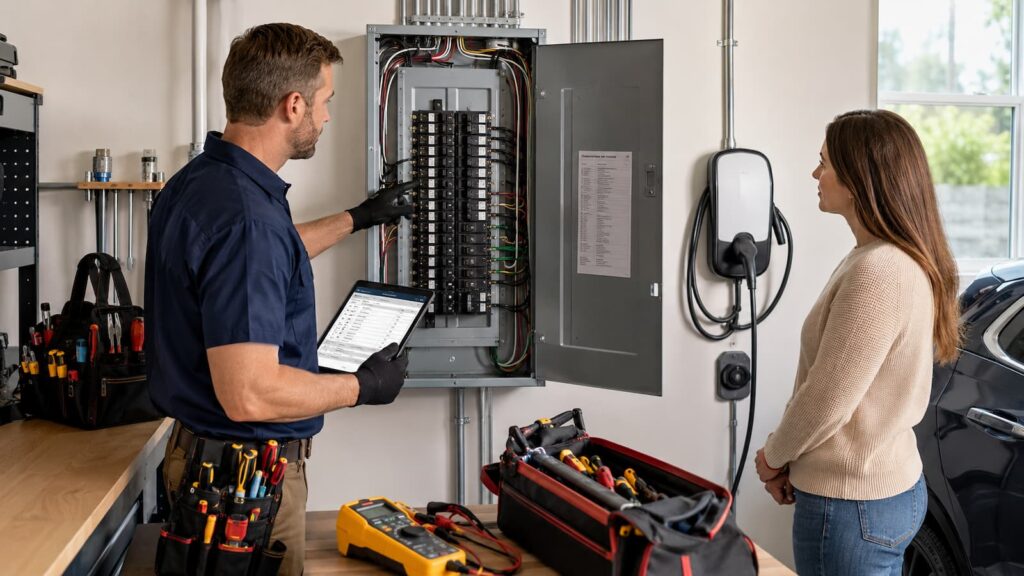
100 Amp vs 200 Amp Electrical Panel: Is 100 Amps Enough for a Modern Home?
If your home has a 100 amp electrical panel, you may be wondering whether it is still enough for modern life. Maybe you are planning to install an EV charger. Maybe you are replacing gas appliances with electric ones. Maybe your breakers trip more often than they used to. Or maybe an inspector, electrician, insurance company, or buyer mentioned that your home would be better with a 200 amp panel.
The short answer is this: 100 amps can still be enough for some homes, but 200 amps is usually the better long-term standard for homes with modern electrical demands. A small home with gas heating, gas cooking, gas dryer, no EV charger, and modest electrical use may operate safely on 100 amps. But a home with a Level 2 EV charger, electric range, electric dryer, heat pump, central air conditioning, hot tub, sauna, battery system, ADU, or future electrification plans may quickly outgrow 100 amp service.
The important detail is that the answer is not based only on the number printed on the panel. A 100 amp panel is not automatically unsafe. A 200 amp panel is not automatically unlimited. The real question is whether your home’s calculated electrical load, panel condition, breaker space, service capacity, and future plans match the electrical system you have.
This guide explains the difference between 100 amp and 200 amp electrical panels, when 100 amps may still be enough, when upgrading to 200 amps makes sense, and how EV chargers and modern appliances affect the decision. If your existing panel is outdated, overloaded, or no longer supports your home’s needs, MaxElectric can help with outdated electrical panel replacement and safe upgrade planning.
Quick answer: is 100 amps enough for a modern home?
A 100 amp electrical panel may be enough for a smaller or moderately powered home if most major appliances are gas, the home does not have an EV charger, and the electrical system is in good condition. However, 100 amps may not be enough if the home has multiple large electric loads or if you plan to add modern upgrades such as Level 2 EV charging, heat pumps, induction cooking, electric water heating, hot tubs, saunas, or an ADU.
A 200 amp panel is often better for:
- Level 2 EV charger installation
- Homes with electric ranges or induction cooktops
- Electric dryers and electric water heaters
- Heat pumps and central air conditioning
- Solar and battery backup systems
- Hot tubs, saunas, workshops, or garage equipment
- Future electrification projects
- Home additions or accessory dwelling units
- Older homes with crowded or outdated panels
- Homeowners who want more long-term electrical flexibility
Still, upgrading is not always automatic. A real load calculation may show that a lower-amperage EV charger, smart load management, or a subpanel can solve a specific issue without a full 200 amp service upgrade. The best answer depends on the home.
What does “100 amp” or “200 amp” actually mean?
When people say a home has “100 amps” or “200 amps,” they are usually talking about the main electrical service capacity. This is the amount of current the service equipment is designed to handle. The main breaker or service disconnect may be rated for 100 amps, 125 amps, 150 amps, 200 amps, or another size.
A 100 amp electrical service can deliver less total power than a 200 amp service. At 240 volts, the rough theoretical comparison looks like this:
| Service Size | Approximate Maximum Power at 240V | What It Means in Practice |
|---|---|---|
| 100 amps | 24,000 watts / 24 kW | Can work for smaller or gas-appliance homes, but limited for modern electric loads |
| 125 amps | 30,000 watts / 30 kW | A little more capacity, but still may be tight for EV + electrification |
| 150 amps | 36,000 watts / 36 kW | Middle-ground capacity for some homes |
| 200 amps | 48,000 watts / 48 kW | Common modern target for larger loads and future flexibility |
These numbers are simplified. A home does not usually run every electrical load at maximum power at the same time. Electrical load calculations account for demand factors, appliance loads, continuous loads, and service rules. But the comparison helps explain why 200 amps gives a home much more room for modern electrical use.
It is also important to separate three concepts:
- Electrical panel rating — the panel’s maximum amp rating.
- Electrical service size — the capacity delivered to the home by the service equipment and utility connection.
- Available capacity — how much room remains after existing loads are considered.
A home can have a 200 amp panel that is already heavily loaded. A home can have a 100 amp panel that still works fine because the major appliances are gas and electrical demand is modest. That is why load calculation matters more than guessing.
100 amp panel: when it may still be enough
A 100 amp panel is not automatically outdated or dangerous. Many homes have operated safely on 100 amps for decades. If the panel is in good condition and the home’s electrical demand is modest, 100 amps may still be adequate.
A 100 amp panel may be enough if:
- The home is relatively small.
- Heating is gas, not electric resistance heat.
- The water heater is gas.
- The range or cooktop is gas.
- The dryer is gas.
- There is no Level 2 EV charger.
- There is no hot tub, sauna, large workshop, or major garage equipment.
- The home does not have multiple HVAC systems.
- The panel has enough safe breaker space.
- The panel is modern, clean, labeled, and in good condition.
- There are no repeated breaker trips or signs of overheating.
For example, a smaller home with gas appliances, LED lighting, standard kitchen circuits, normal electronics, and no EV charger may not need a 200 amp upgrade right away. If the home’s calculated load is within the 100 amp service capacity, and the panel is safe, a replacement or upgrade may not be necessary.
However, “enough for now” is not the same as “ready for the future.” If you plan to add an EV charger, convert appliances from gas to electric, add a heat pump, build an ADU, or install a battery system, 100 amps may quickly become limiting.
100 amp panel: when it is probably not enough
A 100 amp panel becomes questionable when the home has several major electric loads or when the homeowner wants to add new high-demand equipment. Modern homes use electricity differently than older homes did. The same service that worked well for gas appliances and basic lighting may struggle when the home starts supporting EV charging, heat pumps, induction cooking, and electric water heating.
A 100 amp panel may not be enough if you have or plan to add:
- Level 2 EV charger
- 48 amp hardwired EV charger
- Electric range or induction cooktop
- Electric dryer
- Electric water heater or heat pump water heater
- Heat pump or central air conditioning
- Electric resistance heating
- Hot tub
- Sauna
- Large workshop equipment
- Solar and battery backup system
- Generator transfer equipment
- Accessory dwelling unit
- Major remodel or home addition
- Second EV charger
The issue is not that any single appliance is impossible on 100 amps. The issue is the combination. A 40 amp EV charger, electric dryer, air conditioner, and electric range may not all run at full power at the same time every day, but the electrical system still needs to be evaluated properly. A 100 amp service has less room for overlap and future growth.
Warning signs that your 100 amp service may be overloaded or outdated include:
- Breakers trip frequently.
- Lights dim when appliances start.
- The main breaker trips.
- The panel is full with no safe room for new circuits.
- Breakers feel warm or show discoloration.
- The panel makes buzzing or crackling sounds.
- You smell burning near the panel.
- There are double-tapped breakers or messy modifications.
- The panel is old, corroded, or poorly labeled.
- You cannot add modern circuits without major rearrangement.
If these symptoms are present, the question is not only whether 100 amps is enough. The panel itself may need professional inspection, repair, replacement, or upgrade.
200 amp panel: why it is common for modern homes
A 200 amp panel is a common modern residential standard because it gives homeowners more flexibility. It does not mean you can add unlimited equipment, but it provides more capacity for everyday electrical life and future upgrades.
A 200 amp service can make sense if you want to support:
- Level 2 EV charging
- Multiple 240V circuits
- Electric cooking
- Electric laundry
- Heat pump systems
- Air conditioning
- Electric water heating
- Solar and battery systems
- Garage equipment
- Home offices and electronics
- Future additions
- Potential second EV charging
For many homeowners, the value of 200 amps is not only today’s usage. It is future flexibility. If you are already replacing an old panel, planning a remodel, or adding an EV charger, upgrading to 200 amps may prevent repeated electrical work later.
That said, 200 amps is not automatically required for every home. A load calculation may show that your current service is adequate. In some cases, a lower-amperage EV charger or smart load management can be more cost-effective than a full service upgrade.
The best reason to upgrade to 200 amps is not fear. It is a clear plan: your home has current or future electrical demand that 100 amps cannot reasonably support.
100 amp vs 200 amp panel: side-by-side comparison
Here is a practical homeowner comparison:
| Category | 100 Amp Panel | 200 Amp Panel |
|---|---|---|
| Best fit | Smaller homes, gas appliances, modest electrical use | Modern homes, EV chargers, electric appliances, future upgrades |
| EV charger readiness | May support lower-amperage charging depending on load calculation | More likely to support 40A or 48A charging, depending on existing loads |
| Electric appliances | Can become limited with multiple large loads | Better suited for induction range, dryer, heat pump, electric water heater |
| Breaker space | Often limited in older panels | Usually more flexible if panel is properly sized and configured |
| Future expansion | Limited | Stronger long-term flexibility |
| Upgrade cost | Lower if kept as-is | Higher upfront cost if service upgrade is needed |
| Resale perception | May raise questions in older or electrified homes | Often viewed as more modern and future-ready |
| Best decision basis | Load calculation and panel condition | Load calculation and future plans |
The main takeaway: a 100 amp panel can be acceptable when the home’s electrical demand is modest. A 200 amp panel is usually better when the home is being modernized, electrified, expanded, or prepared for EV charging.
The real answer comes from a load calculation
The only reliable way to know whether 100 amps is enough is to perform a load calculation. This is how electricians evaluate the demand of the home and determine whether the existing service can safely support current and planned loads.
A proper load calculation may consider:
- Home square footage
- Required lighting and general-use loads
- Kitchen small appliance circuits
- Laundry circuit
- Electric range or cooktop
- Electric dryer
- Water heater
- Heating and cooling equipment
- EV charger load
- Hot tub, sauna, or pool equipment
- Battery, solar, or generator equipment
- ADU or subpanel loads
- Other fixed appliances
This is why two homes with 100 amp panels can get different answers. A small home with gas appliances may pass comfortably. A similar-sized home with electric heating, EV charging, electric cooking, and a hot tub may not.
Do not rely on breaker count alone. Adding up the numbers on all the breakers is not a load calculation. Many breakers are not drawing full current at the same time. But some large loads, especially EV charging, can run continuously and must be planned carefully.
A good panel assessment should answer three questions:
- Is the existing panel safe and in good condition?
- Does the home’s service have enough calculated capacity?
- Will the system support planned future loads?
If the answer to any of these is no, a panel replacement, service upgrade, subpanel, or load management solution may be needed.
EV chargers: the load that often triggers the 100A vs 200A question
EV chargers are one of the most common reasons homeowners start comparing 100 amp vs 200 amp panels. A Level 2 EV charger can be one of the largest loads in the home. More importantly, it can run for hours at a time.
Common Level 2 charger configurations include:
| EV Charger Output | Typical Circuit Size | Approximate Power at 240V | Panel Impact |
|---|---|---|---|
| 24A | 30A circuit | 5.8 kW | Lower impact, useful for limited panels |
| 32A | 40A circuit | 7.7 kW | Practical Level 2 option for many homes |
| 40A | 50A circuit | 9.6 kW | Stronger charging, more panel demand |
| 48A | 60A circuit | 11.5 kW | High-output charging, usually requires more capacity |
A 100 amp service may support a lower-amperage charger if the home’s other loads are modest. But a 40A or 48A charger can be challenging for a 100 amp home, especially if the home also has electric appliances or HVAC equipment.
This does not mean every EV owner needs a 200 amp upgrade. Some homeowners can install a lower-amperage Level 2 charger, use smart load management, or charge during lower-demand hours. But if you want fast charging, future flexibility, or multiple electric upgrades, a 200 amp service may be the better foundation.
If you are planning home charging, MaxElectric can help with EV charger installation and evaluate whether your current panel can support the charger you want.
Can you install a Level 2 EV charger on a 100 amp panel?
Sometimes. A Level 2 EV charger can sometimes be installed on a 100 amp service if the load calculation supports it and the charger is sized appropriately. A 24A or 32A charger may be realistic for some homes. A 40A or 48A charger may be more difficult unless the home has low existing demand or uses load management.
Examples where 100 amps may support EV charging:
- Small home with gas appliances
- No central electric heat
- No hot tub or sauna
- No major electric appliance conversions planned
- Moderate daily driving needs
- Lower-amperage charger selected intentionally
- Smart load management used where appropriate
Examples where 100 amps may not be enough:
- Home has electric range, electric dryer, and central air
- Home has heat pump plus electric water heater
- Homeowner wants 48A charging
- Two EVs will charge at home
- Panel is already full or outdated
- Main breaker trips under heavy load
- Future electrification is planned
The safe answer comes from evaluating the panel, service capacity, existing loads, charger amperage, and future plans. Installing an EV charger on a 100 amp panel without this review can lead to nuisance trips, overheating, failed inspection, or a charger that must be derated below expectations.
Electric appliances and home electrification: why 100 amps gets tight
Many homeowners are moving toward electrification. That may mean replacing gas appliances with electric versions, adding heat pump HVAC, installing an induction range, using a heat pump water heater, or adding battery backup. Each project can be manageable by itself. Together, they can push a 100 amp service beyond its practical limit.
Common electrification loads include:
| Equipment | Why It Matters |
|---|---|
| Induction range or electric range | Can require a large 240V circuit |
| Electric dryer | Adds another major appliance load |
| Heat pump HVAC | May require dedicated circuits and service capacity |
| Heat pump water heater | Usually lower demand than older electric water heaters, but still needs planning |
| EV charger | Large continuous load that can run for hours |
| Battery system | May require service equipment and panel planning |
| Hot tub or sauna | Large dedicated 240V loads |
If your home is still mostly gas, a 100 amp panel may feel adequate. If you are gradually converting to electric, a 200 amp upgrade may become part of the bigger plan. The best time to think about it is before installing multiple new systems, not after your panel is already crowded and overloaded.
For homeowners converting appliances from gas to electric, panel capacity should be reviewed before installation. MaxElectric also provides gas-to-electric appliance conversion electrical services when new circuits or panel planning are required.
Breaker space vs service capacity: why a full panel is not the only issue
Homeowners often look at the panel and ask, “Do I have room for another breaker?” That is a good question, but it is only one part of the answer.
There are two different issues:
- Breaker space: Is there physical and code-compliant room for another breaker?
- Service capacity: Can the electrical service safely support the added load?
A panel may have an empty slot but not enough load capacity. Another panel may be physically full but still have enough service capacity, making a subpanel or panel reconfiguration possible. These are different solutions.
Common options include:
- Replacing a full panel with a larger panelboard
- Installing a subpanel when service capacity is adequate
- Using smart load management
- Upgrading from 100A to 200A service
- Reducing the planned load, such as choosing a lower-amperage EV charger
- Correcting unsafe existing wiring before adding circuits
Do not confuse “more breaker spaces” with “more power.” A subpanel can create more circuit distribution, but it does not increase the total service capacity feeding the home.
When a subpanel may solve the problem
A subpanel can be useful when the main electrical service has enough capacity but the main panel lacks breaker space or is far from the area where new circuits are needed. For example, a garage subpanel may make sense if you are adding an EV charger, workshop circuits, lighting, outlets, or future equipment in the same area.
A subpanel may be helpful if:
- The main service has enough calculated capacity.
- The main panel is safe and in good condition.
- You need multiple circuits in a garage, workshop, ADU, or addition.
- The existing panel has limited breaker space but not limited service capacity.
- You want cleaner circuit organization.
- The feeder route is practical.
A subpanel may not solve the problem if:
- The 100 amp service is already overloaded.
- The main panel is unsafe or obsolete.
- The load calculation does not allow new major loads.
- The main panel cannot support the subpanel feeder.
- You need a full service capacity increase.
If a subpanel is the right solution, MaxElectric can help with sub-panel installation and upgrades in San Francisco.
When upgrading from 100 amps to 200 amps makes sense
Upgrading from 100 amps to 200 amps makes sense when your current electrical service no longer supports your home’s actual or planned electrical use. It can also be a smart long-term move when you are already replacing an old panel and expect future electrical growth.
A 200 amp upgrade is worth considering if:
- You are installing a Level 2 EV charger and want faster charging.
- You plan to buy a second EV.
- You are converting gas appliances to electric.
- You are installing a heat pump or central air conditioning.
- You are remodeling a kitchen or adding an electric range.
- You are adding a hot tub, sauna, or workshop equipment.
- You are building an ADU or major addition.
- Your current panel is old, full, or unsafe.
- Your home has frequent breaker trips or power issues.
- You want better resale readiness and future flexibility.
Upgrading to 200 amps can be more than a capacity increase. It can also modernize the service equipment, improve panel organization, create room for future circuits, and correct outdated grounding or unsafe panel conditions.
If your home needs more available power, MaxElectric provides electrical power increase services in San Francisco for homeowners planning larger electrical upgrades.
How much does it cost to upgrade from 100 amps to 200 amps?
The cost to upgrade from 100 amp to 200 amp service varies widely because the scope can be simple or complex. A straightforward panel and service upgrade may cost a few thousand dollars, while a difficult project involving utility coordination, meter work, grounding updates, panel relocation, older wiring corrections, underground service, or exterior repairs can cost significantly more.
Factors that affect cost include:
- Current service size and condition
- New service size
- Panel location and accessibility
- Whether the panel must be relocated
- Meter and service entrance requirements
- Grounding and bonding updates
- Utility coordination
- Permit and inspection requirements
- Condition of existing wiring
- Number of circuits being reconnected
- Whether new circuits are added at the same time
- Exterior wall, stucco, or finish repairs
If the project is being done only because you want an EV charger, it is worth asking whether a lower-amperage charger or load management system can meet your needs. If the home needs broader modernization anyway, a 200 amp upgrade may be the better long-term investment.
San Francisco homes: why 100 amp service is common but often limiting
Many San Francisco homes were built before today’s electrical demands were normal. Older homes may have 100 amp service, limited panel space, older wiring methods, compact garages, shared electrical areas, or panels located far from where a new EV charger or appliance circuit is needed.
San Francisco homes may face additional planning issues such as:
- Older electrical panels
- 100 amp services that were adequate before EV charging
- Limited garage or utility room space
- Long conduit routes to parking areas
- Shared garages in multi-unit buildings
- Permit and inspection requirements
- Utility coordination for service increases
- Older grounding and bonding systems
- Previous unpermitted electrical modifications
This is why a local electrical assessment is important. A generic answer like “100 amps is enough” or “you always need 200 amps” can be misleading. The right answer depends on the building, the panel, the service equipment, the planned loads, and the permitting path.
For San Francisco homeowners, the 100A vs 200A decision often comes up during EV charger installation, appliance conversion, panel replacement, home remodels, or preparation for solar and battery systems. Planning all of these together can reduce repeated electrical work later.
Older or unsafe panels: amperage is not the only concern
Sometimes homeowners focus on amperage when the more urgent issue is panel safety. A 100 amp panel may be too old, damaged, obsolete, corroded, or unsafe even if the home’s load is modest. A 200 amp panel can also be problematic if it is poorly installed or damaged.
Panel replacement may be needed if you have:
- Federal Pacific panel
- Zinsco panel
- Old fuse box
- Rust or corrosion
- Scorch marks or melted insulation
- Breakers that will not reset
- Frequent overheating
- Buzzing or crackling sounds
- Improper breaker types
- Double-tapped breakers
- Missing panel cover screws or damaged dead front
- Poor labeling and messy circuit modifications
If the panel is unsafe, the question is not only 100 amps vs 200 amps. The equipment may need replacement because it is unreliable or hazardous. In that case, upgrading capacity at the same time may be worth considering, especially if you plan to add modern loads.
MaxElectric provides dedicated services for Federal Pacific electrical panel replacement and Zinsco electrical panel replacement when outdated panel equipment needs professional replacement.
Insurance, resale, and inspection considerations
Electrical capacity and panel condition can affect more than daily convenience. They can also come up during insurance reviews, home inspections, appraisals, buyer negotiations, and remodel planning.
A 100 amp service may raise questions if the home is large, heavily electrified, or marketed as EV-ready. An old or problematic panel may raise concerns even if the service size is technically adequate. Buyers may also view 200 amp service as a sign that the home is better prepared for modern electrical needs.
Common inspection concerns include:
- Undersized service for current loads
- Old fuse boxes
- Federal Pacific or Zinsco equipment
- Improper breaker use
- Double-tapped breakers
- Missing grounding
- Unpermitted panel work
- Overcrowded panels
- No capacity for EV charging or future appliances
A 200 amp upgrade is not guaranteed to increase resale value dollar-for-dollar, but it can remove a major objection. It can make the home more attractive to buyers who own EVs, want electric appliances, or plan future renovations.
Can load management help you avoid upgrading to 200 amps?
Yes, in some cases. Load management can help a home with limited service capacity safely operate an EV charger or other controllable load without upgrading the entire electrical service.
A load management system monitors the home’s electrical usage and reduces or pauses certain loads when the total demand approaches a set limit. For EV charging, this can mean the charger runs at full output when the home has capacity and automatically reduces output when other large appliances are running.
Load management may make sense if:
- You have 100 amp service but want Level 2 EV charging.
- You drive moderate daily mileage.
- Your charger can be controlled intelligently.
- A full service upgrade is expensive or difficult.
- You have limited utility upgrade options.
- You are not adding many other large electric loads.
However, load management is not a magic solution. It does not repair an unsafe panel, replace damaged wiring, or create unlimited capacity. It also must be installed correctly and accepted by the applicable code and permitting authority.
For some homes, load management is a smart alternative. For others, a 200 amp upgrade is the better long-term path.
Common mistakes homeowners make when comparing 100A and 200A panels
Choosing whether to keep 100 amps or upgrade to 200 amps is not always simple. Avoid these common mistakes:
- Assuming 100 amps is unsafe by default. It may be adequate for some homes if the load calculation supports it.
- Assuming 200 amps is unlimited. Large homes with many electric loads still need planning.
- Looking only at empty breaker spaces. Physical room is not the same as service capacity.
- Adding a large EV charger without load calculation. EV charging can be a major continuous load.
- Installing a bigger breaker to “create more power.” Breaker size must match wiring and equipment.
- Ignoring panel condition. An unsafe old panel may need replacement regardless of amperage.
- Forgetting future appliances. Heat pumps, induction ranges, and second EVs can change the decision.
- Skipping permits. Panel and service upgrades usually require permits and inspection.
- Choosing the cheapest quote without comparing scope. One quote may include utility coordination and grounding; another may not.
The best decision is based on safety, capacity, code compliance, and future use—not on one number alone.
How an electrician determines whether you need 200 amps
A professional assessment should look at the complete electrical system. The electrician should not simply glance at the panel and say “upgrade” or “you’re fine” without understanding your loads and plans.
A proper assessment may include:
- Checking the main service rating
- Inspecting panel brand, condition, and age
- Looking for heat, corrosion, damage, or unsafe modifications
- Reviewing major existing appliances
- Performing or preparing a load calculation
- Checking available breaker space
- Verifying grounding and bonding
- Considering EV charger requirements
- Reviewing future appliance or remodel plans
- Checking whether a subpanel or load management is possible
- Determining whether utility coordination is needed
- Explaining permit and inspection requirements
After that assessment, you should know whether your 100 amp service is acceptable, whether a 200 amp upgrade is recommended, or whether another solution would be more practical.
Decision guide: keep 100 amps, upgrade to 200 amps, or consider another solution?
Use this as a practical starting point.
Keeping 100 amps may be reasonable if:
- Your home is small or moderate in size.
- Most major appliances are gas.
- You do not plan to add Level 2 EV charging.
- You do not plan major electrification.
- Your panel is modern, safe, and not full.
- There are no frequent breaker trips.
- A load calculation confirms adequate capacity.
Upgrading to 200 amps may be best if:
- You are adding a Level 2 EV charger.
- You want 40A or 48A EV charging.
- You are switching from gas to electric appliances.
- You have or plan to install heat pumps.
- You are adding a hot tub, sauna, ADU, or workshop.
- Your current panel is old, unsafe, or full.
- You want future flexibility and fewer electrical limitations.
- A load calculation shows 100 amps is not enough.
Another solution may make sense if:
- You only need more breaker space, not more service capacity.
- A subpanel can solve the layout issue.
- Smart load management can safely support an EV charger.
- A lower-amperage charger meets your real driving needs.
- You want to phase upgrades over time.
The right answer is not always the biggest upgrade. It is the most appropriate upgrade for your home’s actual electrical demand.
FAQ: 100 amp vs 200 amp electrical panels
Is 100 amps enough for a house?
100 amps can be enough for some smaller or moderate homes, especially if major appliances are gas and the home does not have EV charging or multiple large electric loads. A load calculation is the best way to know for sure.
Is 100 amps enough for a modern home?
Sometimes, but it depends on the home. A modern home with EV charging, electric appliances, heat pumps, hot tub, or future electrification plans may outgrow 100 amps quickly. A gas-appliance home with modest electrical use may still be fine.
Is 200 amps enough for a modern home?
For many single-family homes, 200 amps provides a strong modern electrical foundation. It is usually much better suited for EV charging, electric appliances, remodeling, and future upgrades than 100 amps. Very large or heavily electrified homes may need additional planning beyond 200 amps.
How do I know if I have 100 amp or 200 amp service?
The main breaker may be labeled 100, 125, 150, or 200 amps. However, the safest way to confirm service size is to have an electrician inspect the service equipment, panel label, meter equipment, conductors, and installation. Do not rely on guesswork or panel appearance alone.
Can I upgrade from 100 amps to 200 amps?
In many homes, yes. The project may require a new panel, service equipment, grounding and bonding updates, permits, inspection, and utility coordination. The exact scope depends on the property and existing service.
Do I need 200 amp service for an EV charger?
Not always. Some 100 amp homes can support lower-amperage Level 2 charging or smart load management. However, 200 amp service often provides more flexibility for faster charging and future electrical upgrades.
Can a 100 amp panel support a 50 amp EV charger circuit?
Possibly, but only if the load calculation supports it and the existing panel/service are suitable. A 50 amp circuit for EV charging is a major load on a 100 amp service, so it should not be added without professional review.
Can I add a subpanel instead of upgrading to 200 amps?
Sometimes. A subpanel can add breaker space and improve circuit distribution if the main service has enough capacity. It does not increase the total power available to the home. If the service is undersized, a subpanel alone will not solve the problem.
Will upgrading to 200 amps lower my electric bill?
No, not by itself. A 200 amp service gives your home more capacity, but your electric bill depends on how much energy you use. However, upgrading may allow you to use electric appliances, EV charging, or efficient heat pumps that change overall energy costs.
Does a 200 amp panel increase home value?
It can improve buyer confidence and make the home more attractive to buyers who want EV charging, electric appliances, or future upgrades. The value depends on the home, market, permit status, and quality of the installation.
Should I upgrade to 200 amps before installing solar or battery backup?
Not always, but panel capacity should be reviewed before solar or battery installation. Some homes need panel upgrades, service equipment changes, or load-side planning. Others can support solar and batteries with the existing service depending on system design.
Is a 100 amp panel unsafe?
A 100 amp panel is not unsafe simply because it is 100 amps. It may be unsafe if it is overloaded, damaged, outdated, corroded, improperly modified, or from a problematic panel type. Safety depends on condition and load, not only amperage.
Final answer: is 100 amps enough, or should you upgrade to 200 amps?
100 amps can be enough for some homes, especially smaller homes with gas appliances and modest electrical demand. If your panel is safe, your breakers are not tripping, you are not adding major electric loads, and a load calculation confirms adequate capacity, there may be no immediate need to upgrade.
But for many modern homes, 200 amps is the better long-term choice. It gives you more flexibility for EV charging, electric appliances, heat pumps, home additions, battery systems, and future electrical upgrades. If your current 100 amp panel is full, outdated, unsafe, or limiting your plans, upgrading to 200 amps may be a smart investment in safety, reliability, and future readiness.
The best decision starts with a professional panel assessment and load calculation. Do not upgrade just because of a guess, and do not avoid upgrading if your home clearly needs more capacity. A properly planned electrical system should support how you live now and where your home is headed next.