
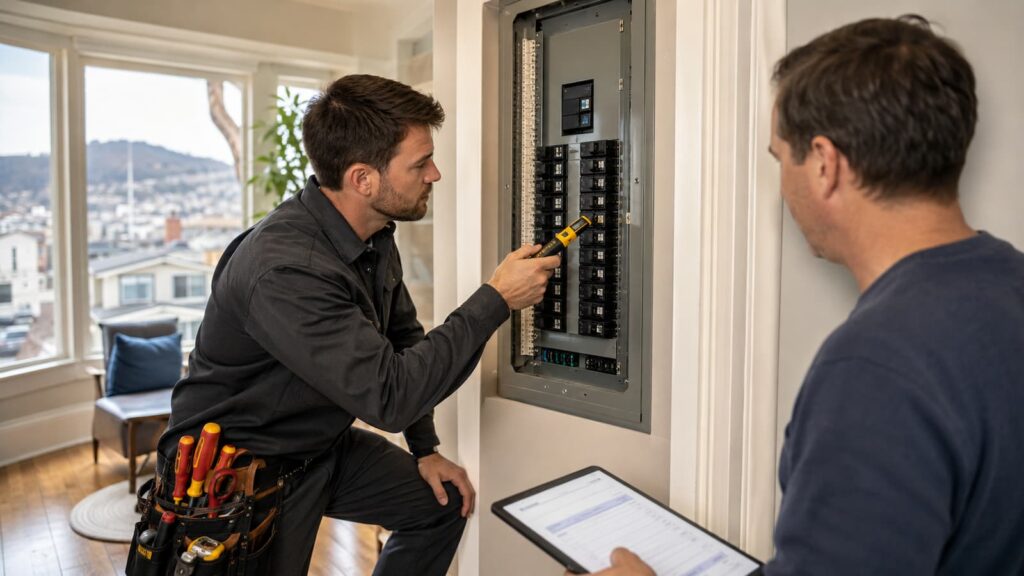
How Much Does an Electrician Cost in San Francisco?
Electrical work in San Francisco can cost anywhere from a modest service call for a small outlet issue to several thousand dollars for a panel upgrade, EV charger circuit, rewiring project, or major electrical modernization. The short answer is simple: many residential electrical jobs in San Francisco fall somewhere between $200 and $600 for small repairs, while larger projects can range from $1,000 to $10,000+, depending on the scope, access, materials, permits, inspection requirements, and the condition of the existing electrical system.
But that short answer is not enough to make a smart decision.
If you are trying to understand how much an electrician costs in San Francisco, the real question is not only “What is the hourly rate?” It is also what type of electrical work you need, whether the issue is simple or hidden behind walls, whether your home has older wiring, whether a permit is required, and whether your electrical panel has enough capacity for the work you want done.
San Francisco homes are not always straightforward. A simple-looking outlet problem can turn into a wiring issue. A new appliance circuit may require a panel load check. An EV charger installation may be easy in one garage and complicated in another because of distance, conduit routing, condo rules, or panel capacity. Older homes may have knob-and-tube wiring, ungrounded outlets, outdated panels, or previous DIY electrical work that needs to be corrected before anything new can be safely added.
This guide explains what electricians typically cost in San Francisco, what affects the price, how different jobs are usually priced, when permits matter, and how to avoid overpaying without cutting corners on safety. If you need a licensed electrician in San Francisco, MaxElectric can help you understand the right scope before work begins.
Quick answer: how much does an electrician cost in San Francisco?
For most homeowners, a basic electrician visit in San Francisco often starts with a service call or diagnostic fee. Small repairs may cost a few hundred dollars, while larger installations or panel-related work can cost several thousand dollars. The exact price depends on the work involved, the age of the home, the condition of the existing electrical system, and whether new wiring, permits, or inspections are required.
Here is a practical overview:
| Type of electrical work | Typical San Francisco cost range |
|---|---|
| Service call or basic troubleshooting visit | $150–$350+ |
| Small outlet, switch, or fixture repair | $175–$500+ |
| Replace standard outlet or switch | $150–$350+ |
| Install GFCI outlet | $200–$450+ |
| Install new outlet where wiring already exists nearby | $250–$600+ |
| Add a new circuit | $600–$1,800+ |
| Dedicated 240V appliance circuit | $900–$2,500+ |
| EV charger installation | $900–$3,500+ |
| NEMA 14-50 outlet installation | $700–$2,500+ |
| Electrical panel repair | $300–$1,500+ |
| Electrical panel replacement or upgrade | $2,500–$8,000+ |
| Whole-home rewiring | $10,000–$30,000+ |
| Knob-and-tube wiring replacement | Often $12,000–$40,000+ depending on home size and access |
| Emergency electrical service | Usually higher than standard scheduled service |
These are planning ranges, not fixed prices. A licensed electrician can only give a reliable estimate after understanding the scope, seeing the panel, checking access, reviewing the wiring route, and identifying any safety or code issues.
For example, replacing one outlet in a modern home may be straightforward. Replacing one outlet in a 1920s San Francisco home with old wiring, no grounding, a damaged box, or an overloaded circuit may require a completely different approach.
Why electrical work costs more in San Francisco than in many other areas
San Francisco is not the cheapest place to hire skilled trades. Electrical pricing is affected by labor costs, insurance, business overhead, parking, access, permitting, inspection coordination, and the city’s older building stock.
A fair electrical estimate in San Francisco should account for more than the minutes spent with a screwdriver in hand. Professional electrical work includes diagnosis, planning, safe shutdown, protection of the work area, code-compliant installation, materials, testing, cleanup, and sometimes permit documentation.
Several local factors can raise the cost:
Older homes and outdated systems
Many San Francisco homes were built long before modern electrical demand existed. Homes originally designed for basic lighting and small appliances may now need to support computers, HVAC equipment, induction cooking, EV charging, laundry appliances, hot tubs, saunas, smart home devices, and high-demand kitchen equipment.
Older homes may have:
- Knob-and-tube wiring
- Cloth-insulated wiring
- Ungrounded outlets
- Fuse boxes
- Outdated panels
- Federal Pacific or Zinsco panels
- Overloaded circuits
- Poorly labeled breakers
- Old DIY modifications
- Junction boxes hidden behind walls
- Mixed wiring from several remodels
If you suspect older wiring, it is worth scheduling a professional evaluation before adding new loads. MaxElectric provides knob-and-tube wiring replacement in San Francisco for homes where outdated wiring needs to be corrected or replaced safely.
Limited access and difficult routing
San Francisco properties can be beautiful but challenging. Narrow garages, finished walls, steep lots, shared walls, crawl spaces, multi-unit buildings, and tight utility areas can all affect labor time.
Running a new circuit across an open unfinished basement is very different from routing a circuit through finished plaster walls in a multi-story home with limited access. The more difficult the path, the more time and planning the job requires.
Permit and inspection requirements
Many electrical projects require permits, especially when new wiring, new circuits, service upgrades, panel work, or major alterations are involved. Permit requirements are not just paperwork. They can affect project timing, inspection scheduling, and the level of documentation needed.
For homeowners, this matters because an unpermitted electrical job may create problems later during a sale, remodel, insurance claim, or inspection. More importantly, permits and inspections help confirm that work is done safely and to code.
Parking, scheduling, and job logistics
In many San Francisco neighborhoods, even getting tools and materials from the vehicle to the work area takes planning. Parking difficulty, building access, elevator use, HOA rules, tenant coordination, and noise restrictions can all add time.
For small jobs, this is one reason a service call fee exists. The electrician is not only charging for time on the device itself but also for travel, setup, tools, diagnosis, and the responsibility of performing safe electrical work.
High demand for electrification
San Francisco homeowners are increasingly adding electric appliances, EV chargers, heat pumps, induction ranges, electric dryers, hot tubs, saunas, and backup power systems. That demand often requires dedicated circuits, load calculations, panel checks, or service upgrades.
If you are switching appliances from gas to electric, MaxElectric can help with gas-to-electric appliance conversion services, including the electrical planning needed to support new loads safely.
Electrician hourly rate vs flat-rate pricing
Many homeowners ask, “What is the electrician hourly rate in San Francisco?” It is a fair question, but hourly pricing does not always tell the whole story.
Some electricians charge hourly. Some charge a service call plus hourly labor. Some use flat-rate pricing for common tasks. Many larger jobs are priced as a project after inspection.
Hourly pricing
Hourly pricing may be used for troubleshooting, repairs, investigation, or uncertain work where the final scope is not obvious at the beginning.
Hourly billing can make sense for:
- Diagnosing intermittent power issues
- Finding the cause of tripping breakers
- Locating hidden wiring problems
- Investigating flickering lights
- Inspecting older electrical systems
- Repairing unknown issues behind walls or panels
The downside is that homeowners may feel uncertain about the final cost if the problem takes longer to locate.
Flat-rate pricing
Flat-rate pricing is common for clearly defined work, such as replacing a device, installing a standard fixture, adding a known circuit route, or installing a specific EV charger setup.
Flat-rate pricing can be helpful because you know the expected price before the work begins. However, the quote must be based on accurate information. If the existing wiring is unsafe, the panel is full, or the wall access is more difficult than expected, the scope may need to change.
Project pricing
Project pricing is common for panel upgrades, rewiring, remodel electrical work, dedicated appliance circuits, EV chargers, hot tub wiring, sauna circuits, commercial work, and large safety corrections.
This is usually the best approach when materials, labor, permits, inspections, and planning all need to be included.
What is included in a professional electrician’s price?
A professional electrical estimate is not just labor. Depending on the job, the price may include:
- Initial review or consultation
- Troubleshooting and diagnosis
- Panel inspection
- Load calculation or load review
- Circuit planning
- Materials and devices
- Breakers, wiring, boxes, conduit, fittings, and connectors
- GFCI or AFCI protection where required
- Permit support when needed
- Safe shutdown and lockout practices
- Installation labor
- Testing and verification
- Cleanup
- Labeling
- Final walkthrough
- Inspection readiness
A cheaper quote may look attractive, but it is important to ask what is actually included. Does it include the right breaker? Does it include proper grounding? Does it include permit support? Does it include patching? Does it include troubleshooting if the circuit does not behave as expected? Does it include code-compliant materials?
Electrical work is not the place to compare quotes only by the lowest number.
Cost by common electrical service in San Francisco
Below are the most common electrical jobs homeowners ask about, with practical price expectations and the factors that can move the price up or down.
Electrical troubleshooting cost
Typical range: $150–$600+
Troubleshooting is often needed when something is not working and the cause is not obvious. You may have an outlet that stopped working, a breaker that keeps tripping, lights that flicker, a buzzing sound, a partial power loss, or an appliance that causes electrical issues.
The final cost depends on how quickly the issue can be found.
A simple troubleshooting visit may involve:
- Testing outlets and switches
- Checking GFCI devices
- Inspecting breakers
- Looking for loose connections
- Identifying overloaded circuits
- Testing voltage
- Reviewing recent electrical changes
More complex troubleshooting may involve tracing wiring, opening devices, checking multiple circuits, inspecting the panel, or finding hidden junctions.
Call a licensed electrician if the issue involves heat, burning smells, sparks, repeated breaker trips, buzzing, water exposure, or partial power loss. For urgent problems, MaxElectric provides 24/7 emergency electrical services in San Francisco.
Outlet and switch replacement cost
Typical range: $150–$350+ per device, often less per device when grouped together
Replacing a basic outlet or switch can be one of the more affordable electrical jobs, but the price depends on the condition of the wiring and box.
The job may cost more if:
- The existing box is damaged
- The outlet is ungrounded
- The wiring is old or brittle
- The circuit needs GFCI or AFCI protection
- There are signs of overheating
- The device is in a difficult location
- The outlet is outdoors or in a wet area
- Multiple circuits are present in the same box
If you need several outlets or switches replaced, it is usually more cost-effective to group them into one visit instead of scheduling separate appointments. MaxElectric offers switch and outlet installation and replacement for homes and businesses in San Francisco.
GFCI outlet installation cost
Typical range: $200–$450+
GFCI protection is important in areas where electrical shock risk is higher, such as kitchens, bathrooms, garages, laundry rooms, basements, outdoor locations, and other moisture-prone areas.
The cost depends on whether the electrician is replacing an existing outlet, adding protection at the breaker, correcting old wiring, or installing a new outlet location.
A GFCI outlet installation may cost more if:
- The existing box is too small
- The wiring is ungrounded
- The location is outdoors
- The circuit serves multiple downstream outlets
- The panel needs a compatible breaker
- Previous work was done incorrectly
Light fixture installation cost
Typical range: $150–$750+
Installing a light fixture can be simple if wiring, box support, and switch control already exist. The cost increases when new wiring, ceiling access, fixture support, dimmer compatibility, or multiple fixture locations are involved.
Recessed lighting, pendant lights, under-cabinet lighting, exterior lighting, and smart lighting usually require more planning than a basic fixture replacement.
The price may increase if:
- A new switch leg is needed
- Ceiling access is limited
- The fixture is heavy
- The electrical box is not rated for the fixture
- New wiring must be run
- Dimmer compatibility needs to be checked
- Multiple fixtures must be laid out evenly
For lighting projects, MaxElectric provides lighting and recessed lighting upgrade / installation in San Francisco.
Ceiling fan installation cost
Typical range: $250–$750+
Ceiling fans need proper electrical wiring and secure support. A fan should not be mounted to a standard light fixture box unless the box is fan-rated.
The cost depends on whether there is already an approved fan box, whether the fan includes a light, whether wall controls are needed, and whether new wiring must be installed.
A ceiling fan installation may cost more if:
- There is no existing ceiling box
- The existing box is not fan-rated
- The ceiling is high or sloped
- New switch wiring is needed
- The fan is large or heavy
- The wiring is outdated
New outlet installation cost
Typical range: $250–$900+
Installing a new outlet is different from replacing an existing outlet. A new outlet may require routing wiring from another location, adding a box, cutting the wall, protecting the cable, and confirming the circuit can support the additional load.
The price depends on distance, access, wall material, and whether a new circuit is required.
A new outlet may be needed for:
- Home office equipment
- Wall-mounted TV
- Kitchen appliance
- Garage tools
- Outdoor use
- Laundry area
- Bathroom remodel
- Dedicated appliance use
- Smart home equipment
The price goes up when the outlet needs a dedicated circuit, GFCI protection, outdoor weatherproof equipment, or a long wiring route.
Dedicated circuit installation cost
Typical range: $600–$1,800+
A dedicated circuit serves one specific appliance or piece of equipment. This is common for high-demand loads and equipment that should not share power with general outlets.
Dedicated circuits are often needed for:
- Electric dryers
- Electric ranges
- Ovens
- Microwaves
- Dishwashers
- Garbage disposals
- Heat pumps
- Mini-splits
- EV chargers
- Hot tubs
- Saunas
- Workshop tools
- Sump pumps
- Commercial equipment
The cost depends on amperage, voltage, distance from the panel, routing difficulty, breaker type, panel capacity, and permit requirements.
If you are adding a high-demand appliance, the first step is not just “run a wire.” The first step is confirming that the panel and service can safely handle the load.
240V circuit installation cost
Typical range: $900–$2,500+
A 240V circuit is commonly needed for electric ranges, dryers, EV chargers, saunas, hot tubs, HVAC equipment, and some workshop equipment.
The cost depends on:
- Required amperage
- Wire size
- Breaker type
- Distance from panel
- Indoor vs. outdoor routing
- Conduit requirements
- GFCI protection requirements
- Disconnect requirements
- Panel space
- Load capacity
- Permit and inspection requirements
For spa and sauna projects, MaxElectric provides 240V installation for saunas and hot tubs in San Francisco.
EV charger installation cost
Typical range: $900–$3,500+
EV charger installation costs vary widely because every property is different. A simple installation near the panel may be relatively straightforward. A long conduit run from the panel to a detached garage, driveway, or shared parking space can cost more.
The price depends on:
- Charger type
- Hardwired vs. plug-in setup
- Circuit amperage
- Panel capacity
- Distance from panel to charger
- Garage or driveway access
- Conduit routing
- Wall type
- Indoor or outdoor installation
- HOA or condo requirements
- Permit and inspection needs
- Load management requirements
Not every EV charger requires a panel upgrade. A licensed electrician should check available capacity first. In some cases, load management can solve the problem without a full service upgrade. In other cases, the panel or service may need to be upgraded for safe long-term use.
MaxElectric provides EV charger installation in San Francisco with panel load checks, dedicated 240V circuits, and permit-aware workmanship.
NEMA 14-50 outlet installation cost
Typical range: $700–$2,500+
A NEMA 14-50 outlet is often used for EV charging and some high-powered appliances. It is a 240V outlet, and installation must be done carefully because the load can be significant.
The cost depends on distance, wire size, breaker type, GFCI requirements, outlet location, panel capacity, and whether the installation is indoors or outdoors.
A NEMA 14-50 installation may cost more if:
- The panel is far from the parking area
- Conduit must be run outdoors
- Trenching is needed
- The panel is full
- Load calculation shows limited capacity
- A subpanel or panel upgrade is needed
- The installation is in a condo or shared garage
For this type of work, see MaxElectric’s NEMA 14-50 outlet installation service.
Electrical panel repair cost
Typical range: $300–$1,500+
Panel repair may be needed when breakers are failing, circuits are mislabeled, connections are loose, corrosion is present, or the panel shows signs of overheating.
Panel problems should not be ignored. A breaker that trips repeatedly is not just an inconvenience. It may be warning you about overload, short circuit, ground fault, damaged wiring, or failing equipment.
Common panel repair work includes:
- Breaker replacement
- Circuit labeling
- Correcting loose connections
- Replacing damaged components
- Troubleshooting tripping circuits
- Inspecting heat damage
- Addressing corrosion
- Repairing unsafe wiring inside the panel
If breakers keep tripping, MaxElectric provides circuit breaker panel and fuse box repair in San Francisco.
Electrical panel upgrade cost
Typical range: $2,500–$8,000+
Electrical panel upgrades are one of the larger common residential electrical projects. The cost depends on the existing panel, amperage, service equipment, utility coordination, grounding, permits, inspection requirements, and whether additional corrections are needed.
A panel upgrade may be needed if:
- Your panel is outdated
- Your home still has fuses
- The panel is overloaded
- You are adding EV charging
- You are adding electric appliances
- You are adding a heat pump or mini-split
- You are converting from gas to electric
- You need more breaker spaces
- The panel is unsafe or damaged
- You have a Federal Pacific or Zinsco panel
- Your insurance company requires replacement
A panel upgrade is not always required for every new appliance or EV charger. A good electrician should evaluate the actual load, not automatically recommend the most expensive option.
MaxElectric provides electrical panel replacement and updates in San Francisco for homes that need safer, more modern capacity.
Electrical power increase cost
Typical range: $3,000–$10,000+
An electrical power increase is more involved than replacing a panel. It may include upgrading service capacity, coordinating with the utility, improving grounding and bonding, replacing service equipment, and ensuring the home can support higher electrical demand.
This may be needed when a home is adding multiple major loads, such as:
- EV charger
- Electric dryer
- Electric range
- Heat pump
- Heat pump water heater
- Hot tub
- Sauna
- ADU electrical loads
- Large remodel loads
- Workshop equipment
MaxElectric provides electrical power increase services in San Francisco when a home needs more capacity for modern electrical demand.
Whole-home rewiring cost
Typical range: $10,000–$30,000+
Whole-home rewiring is one of the most variable electrical projects. The price depends on the home size, number of circuits, wall access, attic or crawlspace access, plaster vs. drywall, finished surfaces, panel condition, grounding needs, permits, and how much of the existing wiring must be removed or abandoned.
A smaller home with good access may cost less. A larger older San Francisco home with finished walls, multiple floors, limited access, plaster walls, and outdated wiring can cost significantly more.
Rewiring may be needed when:
- Wiring insulation is deteriorating
- Outlets are ungrounded
- Circuits are overloaded
- Knob-and-tube wiring is present
- Previous DIY work is unsafe
- Insurance requires correction
- A major remodel is planned
- The home cannot support modern appliances safely
- Lights flicker or breakers trip frequently
- There are signs of overheating
For wiring repairs, additions, and larger wiring projects, see MaxElectric’s electrical wiring installation and repair services.
Knob-and-tube wiring replacement cost
Typical range: often $12,000–$40,000+, depending on scope
Knob-and-tube wiring is common in many older San Francisco homes. It is not always immediately visible, and it may be mixed with newer wiring from previous remodels.
The replacement cost depends on:
- Home size
- Number of circuits
- Accessibility
- Whether walls must be opened
- Attic and basement access
- Condition of existing wiring
- Whether a panel upgrade is needed
- Number of outlets and switches
- Whether grounding is being added
- Permit and inspection requirements
- Desired finish quality after access work
Knob-and-tube replacement is usually not a one-size-fits-all project. The electrician must map the existing system, identify active wiring, plan safe replacement routes, and minimize damage where possible.
If you own an older home and are planning electrical upgrades, EV charging, appliance circuits, or a remodel, it is smart to inspect the wiring before starting.
Emergency electrician cost in San Francisco
Emergency electrical service usually costs more than scheduled service. This is normal because emergency work may require immediate dispatch, after-hours availability, urgent troubleshooting, and faster safety decisions.
Emergency service may be needed for:
- Burning smell
- Smoke
- Sparks
- Hot outlet or switch
- Hot electrical panel
- Partial power loss
- Repeated breaker trips
- Buzzing panel
- Water-damaged electrical equipment
- Storm-related electrical damage
- Exposed or damaged wiring
- Electrical issue affecting business operations
Do not repeatedly reset a breaker that keeps tripping. Do not ignore burning smells. Do not use an outlet or switch that feels hot. If you see smoke or active fire, call 911 first.
Residential vs commercial electrician cost
Commercial electrical work often costs more than basic residential work because it may involve stricter requirements, more complex equipment, higher loads, business-hour limitations, emergency lighting, dedicated equipment circuits, tenant improvement coordination, and additional inspection needs.
Commercial work may include:
- Retail electrical repairs
- Office lighting
- Dedicated equipment circuits
- Panel work
- Emergency troubleshooting
- Breaker issues
- Tenant improvement wiring
- Exterior lighting
- Code corrections
- Power for commercial appliances
- Safety inspections
MaxElectric provides commercial electrical services in San Francisco for businesses that need safe, reliable electrical support.
What factors affect the final electrician price?
Two electrical jobs that sound identical over the phone can have very different prices once an electrician sees the home. Here are the biggest cost factors.
1. Scope of work
Replacing one existing switch is very different from adding a new switch location. Installing a fixture is very different from adding wiring for multiple recessed lights. Adding an outlet near an existing circuit is very different from running a new dedicated circuit from the panel.
The clearer the scope, the more accurate the quote.
2. Diagnosis time
Electrical problems are not always visible. A breaker may trip because of overload, short circuit, ground fault, damaged wiring, moisture, failing equipment, loose connection, or a bad breaker.
Good troubleshooting takes time because the electrician must find the real cause, not just replace parts and hope the problem disappears.
3. Age of the electrical system
Older wiring, ungrounded outlets, damaged boxes, old panels, and previous DIY work can all increase cost. The electrician may need to correct unsafe conditions before new work can be added.
4. Panel condition and capacity
Many modern upgrades begin at the panel. Before adding EV charging, a heat pump, electric range, sauna, hot tub, or dedicated appliance circuit, the electrician should check whether the panel has enough space and capacity.
A full panel does not always mean the entire service must be upgraded, but it does mean planning is required.
5. Distance from panel to work area
The longer the wiring route, the higher the cost. Long runs require more wire, more labor, more conduit, more supports, and more time.
Distance matters especially for EV chargers, outdoor circuits, detached garages, hot tubs, and appliance circuits.
6. Wall, ceiling, attic, basement, or crawlspace access
Open access reduces labor. Finished walls increase labor. Plaster, tile, concrete, exterior stucco, and multi-story routing can all increase complexity.
7. Permit and inspection requirements
Permit-ready work requires proper planning, correct materials, code-compliant installation, and inspection coordination. This adds value and protects the homeowner, but it can also affect cost.
8. Materials
Electrical materials vary. Breakers, GFCI/AFCI protection, copper wire, conduit, weatherproof boxes, disconnects, EV charger components, surge protection, and panel equipment all affect the final price.
9. Urgency
Scheduled work is usually less expensive than after-hours emergency work. If the issue is not dangerous, scheduling during normal hours can help control cost.
10. Finish work
Some electrical work requires opening walls or ceilings. Electricians may make access openings, but drywall repair, painting, or finish carpentry may not be included unless clearly stated in the estimate.
Always ask what is included.
Do you need a permit for electrical work in San Francisco?
Many electrical projects in San Francisco require a permit, especially when installing new wiring, adding circuits, modifying existing electrical systems, upgrading panels, or performing major electrical work.
Permit requirements may apply to:
- New circuits
- Panel replacement
- Service upgrades
- EV charger circuits
- Dedicated appliance circuits
- Major rewiring
- Subpanel installation
- Electrical work for remodels
- Electrical work in multi-unit buildings
- Certain commercial electrical projects
Some small like-for-like replacements may not require the same level of permitting, but homeowners should not assume. The safest approach is to ask a licensed local electrician whether the work requires a permit.
Permits matter because they help protect:
- Home safety
- Code compliance
- Insurance documentation
- Future resale
- Inspection records
- Long-term reliability
In a city like San Francisco, where many properties have older electrical systems and remodel history, permit-aware work is especially important.
How to get a more accurate electrical quote
The fastest way to get a realistic estimate is to provide useful details upfront.
Before contacting an electrician, gather:
- Your address or neighborhood
- Type of property: single-family home, condo, apartment, multi-unit, commercial
- Description of the problem or project
- Photos of the electrical panel
- Photos of the work area
- Distance from panel to work area, if relevant
- Appliance or equipment specifications
- Whether the work is urgent
- Whether there is smoke, heat, sparks, burning smell, or water exposure
- Any recent electrical work or remodel history
- Whether your home has old wiring or ungrounded outlets
- HOA or property manager requirements, if applicable
For EV chargers, 240V circuits, hot tubs, saunas, and appliance circuits, panel photos are especially helpful. A clear photo of the breaker panel, panel label, main breaker, and proposed installation location can save time and improve estimate accuracy.
Why the cheapest electrician quote can become expensive
Electrical work is safety work. A low quote may not be a good deal if it excludes important parts of the job.
Be cautious if a quote:
- Is much lower than every other estimate
- Does not mention permit requirements
- Does not include materials clearly
- Avoids discussing panel capacity
- Ignores grounding issues
- Promises a major job without seeing photos or visiting
- Does not explain what is included
- Does not provide license or insurance information
- Recommends shortcuts
- Suggests ignoring code requirements
- Does not test the work after installation
Poor electrical work can lead to tripping breakers, damaged equipment, failed inspections, insurance issues, shock hazards, or fire risks. It can also cost more later when a licensed electrician has to remove and correct the unsafe work.
How to save money on electrical work without cutting corners
You do not need to choose unsafe shortcuts to control cost. A good electrician can often help you find a practical approach.
Here are smart ways to save money:
Group small tasks together
If you need several outlets, switches, fixtures, or minor repairs, combine them into one visit. This helps you get more value from the service call and setup time.
Send photos before scheduling
Clear photos can help the electrician understand the job before arriving. For some projects, photos allow a faster and more accurate estimate.
Choose the right solution, not the biggest solution
Not every EV charger needs the highest amperage. Not every appliance addition requires a full service upgrade. Not every panel issue requires replacement. A proper load review can help identify the safest and most cost-effective path.
Schedule non-urgent work during normal hours
Emergency and after-hours work costs more. If the issue is not dangerous, scheduled service can be more affordable.
Plan electrical work before remodeling
Electrical work is often cheaper when walls are already open. If you are remodeling a kitchen, bathroom, garage, or ADU, plan wiring before finishes are installed.
Avoid DIY electrical changes
DIY electrical work may seem cheaper at first but can create unsafe conditions, failed inspections, and higher correction costs later.
Ask for a clear scope
A good quote should explain what is included, what is not included, and what could change the price.
When should you call an electrician immediately?
Some electrical issues should not wait.
Call a licensed electrician right away if you notice:
- Burning smell near outlets, switches, appliances, or panel
- Smoke or sparks
- Hot outlet, switch, or breaker
- Breaker that keeps tripping
- Buzzing from the panel
- Flickering lights with heat or burning smell
- Partial power loss
- Water near electrical equipment
- Melted outlet or plug
- Exposed wiring
- Electrical shock from a device or appliance
- Damaged panel
- Storm-related electrical damage
If there is active fire, visible smoke, or immediate danger, call 911 first.
Questions to ask before hiring an electrician in San Francisco
Before hiring an electrician, ask:
- Are you licensed and insured?
- Do you handle this type of electrical work regularly?
- Is the estimate hourly, flat-rate, or project-based?
- What is included in the price?
- Are materials included?
- Is a permit needed?
- Who handles permit coordination?
- Will the work be inspection-ready?
- Does my panel have enough capacity?
- Will you check grounding and circuit protection?
- Could the price change after diagnosis?
- What conditions would increase the cost?
- Will drywall repair or painting be included?
- How long will the work take?
- What safety testing is performed after installation?
A professional electrician should be able to explain the work in plain language.
Why hiring a licensed electrician matters
Electrical work affects fire safety, shock protection, equipment reliability, code compliance, insurance documentation, and long-term home value. A licensed electrician understands how to plan and complete work safely, especially in older San Francisco homes where electrical systems may have been changed many times over the years.
A licensed electrician understands:
- Safe wiring methods
- Load calculations
- Grounding and bonding
- Breaker sizing
- GFCI and AFCI protection
- Panel requirements
- Circuit planning
- Permit requirements
- Inspection expectations
- Local code considerations
- Safe troubleshooting procedures
Electrical work is not only about making something turn on. It is about making sure it operates safely under real load, over time, and under the actual conditions of the property.
So, how much should you budget?
Here is a practical way to think about your budget:
- For small electrical repairs, plan for $200–$600.
- For new outlets, GFCI protection, fixture work, or simple device replacement, plan for $200–$900, depending on scope.
- For new dedicated circuits, plan for $600–$2,500+.
- For EV chargers, 240V appliance circuits, saunas, hot tubs, or higher-load installations, plan for $900–$3,500+.
- For panel upgrades, plan for $2,500–$8,000+.
- For rewiring, knob-and-tube replacement, or major modernization, plan for $10,000–$40,000+, depending on home size and access.
The best way to avoid surprises is to get a clear estimate from a licensed local electrician who understands San Francisco homes.
FAQ: electrician cost in San Francisco
How much does an electrician charge per hour in San Francisco?
Many electricians in San Francisco charge by the hour for troubleshooting and repair work, while defined projects may be priced as a flat rate. Hourly rates vary based on the electrician’s experience, company overhead, urgency, and job type. For planning purposes, many homeowners should expect professional electrical labor to fall roughly in the low hundreds per hour once service call, travel, setup, diagnosis, and business costs are considered.
Why does the first hour often cost more?
The first hour often includes travel, parking, setup, tools, diagnosis, and the responsibility of inspecting the issue safely. Even a quick repair requires the electrician to arrive with the right equipment, evaluate the circuit, shut off power safely, complete the work, and test the result.
Do electricians charge for estimates?
It depends on the company and project. Some simple estimates may be free if enough photos and details are provided. Diagnostic visits, troubleshooting, complex project planning, panel evaluations, and detailed written scopes may involve a service fee.
How much does it cost to replace an outlet in San Francisco?
Replacing a standard outlet may cost around $150–$350+ depending on the wiring condition, grounding, box condition, and whether GFCI protection is needed. Multiple outlets are often more cost-effective when done during the same visit.
How much does it cost to install a new outlet?
A new outlet may cost $250–$900+ depending on whether wiring already exists nearby, whether a new circuit is needed, and how difficult the wire route is.
How much does it cost to install a 240V outlet?
A 240V outlet may cost $700–$2,500+ depending on amperage, wire size, distance from the panel, breaker type, GFCI requirements, panel capacity, and permit needs.
How much does EV charger installation cost in San Francisco?
EV charger installation often ranges from $900–$3,500+ depending on charger type, circuit size, distance from the panel, indoor or outdoor routing, panel capacity, HOA requirements, and permit needs.
Does every EV charger need a panel upgrade?
No. Some homes have enough capacity for a properly sized charger circuit. Others may need load management, a lower-amperage setup, a subpanel, or a panel upgrade. A licensed electrician should check the panel before recommending the best option.
How much does an electrical panel upgrade cost?
Electrical panel upgrades in San Francisco often range from $2,500–$8,000+ depending on service size, existing equipment, grounding, utility coordination, permits, inspection requirements, and whether additional corrections are needed.
How much does whole-home rewiring cost?
Whole-home rewiring often starts around $10,000 and can exceed $30,000 depending on the size of the home, access, wall materials, number of circuits, panel condition, and whether outdated wiring such as knob-and-tube must be replaced.
Is emergency electrical service more expensive?
Yes. Emergency service usually costs more than scheduled work because it may require urgent dispatch, after-hours availability, immediate troubleshooting, and faster safety response.
Can I do small electrical work myself?
Some homeowners consider DIY for simple replacements, but electrical work can be dangerous if wiring conditions are unknown. Older San Francisco homes often have surprises behind outlets and switches. If you see old wiring, ungrounded outlets, heat damage, repeated breaker trips, or anything unusual, hire a licensed electrician.
What is the cheapest way to hire an electrician?
The safest way to reduce cost is to group small jobs together, provide photos upfront, schedule non-urgent work during regular hours, and ask for a clear scope. Avoid unsafe shortcuts or unlicensed work.
Why are electrical quotes so different?
Quotes may differ because companies include different levels of labor, materials, permits, troubleshooting, warranty, testing, and cleanup. One quote may include code-compliant corrections while another only covers a basic device swap.
What should be included in an electrical estimate?
A good estimate should explain the scope, labor, materials, permit assumptions, exclusions, payment terms, expected timeline, and what conditions could change the price.
Should I hire the lowest bidder?
Not automatically. The lowest quote may exclude permits, materials, inspection readiness, troubleshooting, grounding corrections, or required safety upgrades. Electrical work should be judged by safety, clarity, licensing, and quality, not price alone.
Get a clear electrical estimate in San Francisco
Electrical pricing should not feel mysterious. A good electrician will explain what needs to be done, why it matters, what affects the price, and which options are available.
MaxElectric provides electrical repairs, troubleshooting, wiring, panel upgrades, EV charger installation, dedicated circuits, 240V installations, emergency electrical service, and electrical modernization for homes and businesses in San Francisco and the Bay Area.
If you need a licensed electrician in San Francisco, contact MaxElectric for a clear quote and practical next steps.
Call (415) 867-7006 or request an estimate online.