
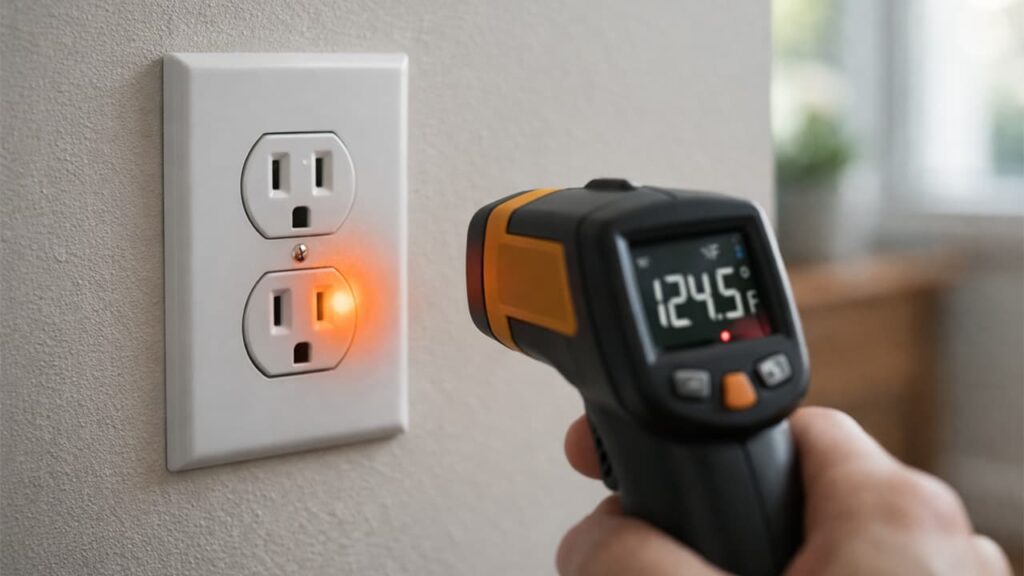
Warm or Hot Outlet: Is It Dangerous and What Should You Do? (2026 Guide)
A wall outlet should not be noticeably warm—especially not hot. If your receptacle faceplate feels warmer than the surrounding wall, electricity is encountering resistance somewhere in the outlet, the wiring, or the plug connection. That resistance turns electrical energy into heat. In the best case, it’s a minor issue (like a warm power adapter). In the worst case, it’s a developing fire hazard hidden behind drywall.
The U.S. Consumer Product Safety Commission (CPSC) is very direct about this: when outlet or switch faceplates feel hot/uncomfortable to touch, you should discontinue use immediately and get help from a qualified electrician.
This 2026 guide explains:
One sentence with anchor idea: Jump to “What to Do Immediately”.
Another sentence with anchor idea: Jump to “Most Common Causes”.
Another sentence with anchor idea: Jump to “When to Call an Electrician”.
We’ll cover what “warm” vs “hot” means, why it happens, which appliances and adapters are the usual suspects, what you can safely check without opening anything, what a licensed electrician will diagnose and fix, and how to prevent repeat problems—especially in older San Francisco homes with mixed-era electrical work.
Quick Safety Rule (Read This First)
If the outlet is hot to the touch, smells like burning, is discolored, makes buzzing/crackling noises, sparks, or the cover plate looks warped or melted:
- Unplug the device (if safe).
- Stop using that outlet.
- Turn off the breaker feeding that outlet.
- Call a qualified electrician.
This isn’t alarmist. A hot faceplate can signal a potential fire hazard in the receptacle, switch, or wiring.
Warm vs Hot: How to Interpret What You’re Feeling
“Warm” and “hot” are subjective, so here’s a practical way to judge it.
Slightly warm (often “watch it, don’t ignore it”)
- You can keep your fingers on the faceplate comfortably.
- The warmth is mild and may correspond to a warm power brick or a high-draw device.
This can still be a warning if it repeats—especially under normal loads.
Warm enough to be uncomfortable (investigate soon)
- You notice it without searching.
- It feels uncomfortable after a few seconds.
- It’s localized near one outlet slot, one screw, or one side.
That pattern often points to a connection problem.
Hot / painful (treat as urgent)
- You reflexively pull your hand away.
- You smell hot plastic or see any discoloration.
- You hear buzzing/crackling or see flickering lights when using the outlet.
CPSC guidance treats “hot/uncomfortable” faceplates as a stop-using-now situation.
Why Heat at an Outlet Can Be Dangerous
An outlet heats up when current flows through an area with higher-than-normal resistance—often at a terminal connection or contact point. Heat is not just “extra warmth”; it’s a symptom of stress that accelerates failure:
- Heat can soften plastic bodies and loosen spring contacts further.
- Heat can degrade insulation on conductors inside the box.
- Heat can create carbonization (a conductive path) that promotes arcing.
- Arcing can cause rapid damage, and in some cases ignition.
Fire safety research discussing receptacle failures highlights overheating at loose terminal connections as a prominent cause of receptacle-related fires, driven by resistive (ohmic) heating that worsens as oxide layers and high-resistance contact forms.
And the risk is higher than many homeowners realize because the problem may be inside a concealed space. NFPA research notes that faulty wiring in concealed spaces (behind walls, attics, etc.) is particularly dangerous because it can burn for a prolonged period before detection.
The Physics in Plain English: Resistance, Heat, and “Loose Equals Hot”
Every electrical connection—plug blades meeting receptacle contacts, copper wire under a terminal screw, wire splice under a connector—has some resistance. In a healthy connection, resistance is low and the contact area is large.
When a connection is loose or degraded:
- Contact area becomes small.
- Resistance rises.
- Heat rises (and rises fast as load increases).
That’s why the same outlet might feel normal when charging a phone but warm when running a toaster oven or space heater.
What to Do Immediately (Safe Steps You Can Take)
These steps avoid risky DIY while still giving you meaningful control.
1) Unplug the device and stop using the outlet
If the faceplate is warm/hot, unplug the device and leave the outlet unused. CPSC explicitly recommends discontinuing use of a hot receptacle or switch and obtaining help from a qualified electrician.
2) Reduce the load and observe what changes (without “testing” dangerously)
If nothing looks melted and there’s no odor:
- If the outlet was powering a high-wattage device (heater, air fryer, hair dryer), assume load stress revealed a weakness.
- If the warmth happened with a small device, suspect connection failure or worn receptacle contacts.
3) Turn off the breaker if it’s hot, smells, or makes noise
Heat + odor/noise = stop using + breaker off. If you can’t identify the breaker confidently, don’t guess repeatedly; shutting off the main is safer than leaving a suspected overheating connection energized.
4) Look for visible warning signs
Without removing the plate:
- Brown/yellow discoloration around slots or screws
- Warped plate, softened plastic
- Soot marks
- A “hot electronics” or burning plastic smell
If any are present, keep the breaker off and call an electrician.
5) If you’re a renter: report it as a safety issue
Document the outlet condition (photos), what was plugged in, and when it happened. Warm/hot outlet complaints should be treated as urgent maintenance.
The Most Common Causes of a Warm or Hot Outlet
This section is intentionally broad—because “hot outlet” can be caused by the outlet itself, the wiring feeding it, the plug, or the circuit design.
1) Loose termination inside the outlet box (very common)
A conductor under a terminal screw (or clamp plate) that isn’t tight enough becomes a heater under load. With time, vibration and thermal cycling can worsen it.
Modern code language emphasizes tightening torque according to manufacturer instructions and using an approved means to achieve that torque.
Why that matters: a termination that’s “kind of tight” can still run hot at 12–15 amps.
2) Backstab (“push-in”) connections loosening over time
Many 15A receptacles allow push-in wiring. The CPSC guide specifically calls out that back wire push-in connections “may tend to loosen and overheat.”
This is especially common on outlets that experience:
- frequent plugging/unplugging,
- high intermittent loads,
- downstream “pass-through” current feeding additional outlets.
3) Worn internal contacts (loose plug fit)
If the plug slides in/out too easily, the connection may be loose and likely to overheat. CPSC warns that loose plug fit can lead to overheating and notes the receptacle may need replacement by a qualified electrician.
Loose contact tension causes micro-movement and sometimes micro-arcing at the blades, which creates localized heat.
4) Overloaded outlet or circuit (or high continuous draw)
Overload doesn’t always mean “breaker trips.” You can have heat at the outlet long before the breaker sees an overcurrent event—especially if the problem is a high-resistance connection.
Common heat-producing loads:
- portable space heaters
- hair dryers
- microwaves
- air fryers / toaster ovens
- portable AC units
- vacuum cleaners (inrush current)
- multiple chargers on a power strip (less common alone, but can stack with other loads)
5) Daisy-chain pass-through heating
Many receptacles are wired to feed other receptacles. CPSC notes that even unused receptacles may feel hot because power delivered to one receptacle often passes through the connections of one or more others—indicating a potential fire hazard.
So the “hot outlet” might not be the one under heavy load—sometimes it’s an upstream device carrying current to the downstream branch.
6) Damaged plug blades, adapters, or cords
A worn cord cap, oxidized blades, bent prongs, or a plug that doesn’t fully seat can create resistance at the plug-to-outlet interface.
A classic scenario:
- The outlet is “fine” with most devices.
- One specific appliance makes it warm/hot.
That appliance’s plug or cord may be failing.
7) Aluminum wiring or mixed-metal terminations (in some properties)
NFPA research notes aluminum wire connections can deteriorate and increase resistance, producing hazardous overheating, and references CPSC’s recommendation for qualified electrician repair/replacement approaches.
Not every SF home has aluminum branch wiring—but mixed-era remodels can introduce mixed-metal terminations or questionable splicing practices.
8) GFCI receptacle heating or failure
GFCI outlets contain electronics; mild warmth can occur, but “hot” is not normal. A failing GFCI can overheat and should be replaced by a qualified electrician.
NFPA home electrical safety guidance also stresses that AFCIs/GFCIs should be installed by qualified electricians and defective devices replaced promptly.
9) USB or “smart” receptacles with internal power supplies
Outlets with integral USB charging or smart functionality include internal power conversion components. They may run slightly warm during heavy use, but should still not become hot. UL standards and updates continue to add safety requirements for receptacles with integral power supplies.
10) Loose neutral or upstream electrical issues (less common, more serious)
In some cases, heat at an outlet is a symptom of:
- loose neutral connection at the receptacle,
- loose neutral splice in a junction box,
- loose termination at the panel.
Loose neutrals can cause unstable voltage, flickering lights, and unusual device behavior. This is electrician territory.
“Is It Dangerous?” A Practical Risk Ladder
If you want a simple decision model:
Low-ish risk (still worth attention)
- Slight warmth only with one known warm adapter
- No discoloration, smell, noise, or loose plug fit
- The adapter itself is hot and the outlet just feels slightly warmer near where it touches the plate
What to do: Try a different outlet for that adapter. If warmth follows the adapter, replace the adapter. If the same outlet warms with multiple devices, suspect the outlet/wiring.
Medium risk (schedule a professional evaluation)
- Outlet warms with multiple devices
- Plug fit feels loose
- Warmth is localized to one side or one slot
- Minor discoloration starts to appear
What to do: Stop using it for high-wattage loads; schedule inspection.
High risk (urgent)
- Hot to touch
- Smell of burning plastic or “electrical” odor
- Buzzing/crackling
- Visible discoloration, melted plastic, smoke
- Breaker trips repeatedly when using that outlet
What to do: Stop using immediately, breaker off, call electrician.
CPSC’s language aligns with this: hot/uncomfortable faceplates indicate a potential fire hazard and usage should be discontinued until a qualified electrician evaluates it.
The “Hidden” Causes Competitors Often Miss
Many articles stop at “loose wire” or “overload.” Here are deeper, real-world contributors electricians see:
Back-to-back high-load appliances on the same general-use circuit
Kitchens and living rooms often share circuits in older homes. You might not realize the outlet is feeding:
- a microwave + air fryer,
- a toaster + kettle,
- a portable heater + entertainment center.
Even if you’re not over breaker rating continuously, repeated heat cycles accelerate wear.
Poor-quality receptacles installed in high-use locations
Residential-grade devices are not all equal. High-use areas (kitchen counter, laundry, garage) often benefit from better contact design and stronger terminals. If a builder-grade receptacle is used for years with heavy loads, it can loosen internally.
Overfilled or shallow electrical boxes
If a box is crowded, conductors may be sharply bent, stressing terminations and reducing contact quality over time. Also, tight packing reduces heat dissipation.
“Backwired” vs “side-wired” confusion
Some devices use clamp-plate backwiring (good), while others use push-in backstab (more prone to loosening). Homeowners often lump them together. CPSC specifically refers to push-in back connections as a type that may loosen and overheat.
Pigtails vs pass-through on device screws
A professional-quality repair often uses a splice and pigtail so the receptacle isn’t carrying downstream current through its device terminals. That reduces the receptacle as a failure point.
Thermal imaging reveals the real hotspot
The outlet faceplate might feel warm, but the hottest point could be:
- the neutral terminal,
- a splice in the back,
- an upstream receptacle feeding multiple loads.
Fire safety research describes how overheating at poor connections can persist and intensify over time, which is why finding the exact hot spot matters.
Common Scenarios (With the Likeliest Root Cause)
“Outlet is warm when the space heater runs”
Space heaters pull high current. They expose weak connections quickly.
- Likely causes: worn receptacle contacts, loose termination, backstab loosening, marginal circuit capacity.
“Outlet is hot but breaker didn’t trip”
Breakers respond to current, not always to a high-resistance hotspot. A loose connection can heat dramatically without exceeding breaker trip curves.
“Only one outlet in the chain is warm, others are fine”
That one outlet may be:
- upstream feeding others,
- poorly terminated,
- worn internally.
CPSC notes upstream pass-through connections can make even unused receptacles feel hot.
“GFCI outlet feels warm”
Electronics inside can run warm, but it should never be hot. Failing electronics are replaced, not ignored.
“My phone charger makes the outlet warm”
Some compact chargers run warm/hot normally, especially under fast-charging. If the charger is hot and the outlet only mildly warm, replace the charger if it seems abnormal. If the outlet warms with other chargers too, suspect the receptacle.
What a Licensed Electrician Will Typically Do (Beyond “Replace the Outlet”)
A real diagnostic process usually includes:
1) Confirm circuit type and breaker rating
- 15A vs 20A branch circuit
- Dedicated circuit vs shared general lighting circuit
- Multi-wire branch circuit considerations (shared neutrals)
- Panel condition and breaker seating
2) Inspect receptacle condition and wiring method
- Signs of overheating: darkened insulation, brittle jacket, melted device body
- Whether conductors are backstabbed, side-wired, or clamped
- Whether the device is carrying downstream load
- Grounding integrity and correct polarity
3) Re-terminate connections correctly (including torque awareness)
Industry code updates highlight the importance of correct termination tightening, aligned with manufacturer instructions and approved means for achieving torque.
4) Evaluate upstream/downstream outlets on the same circuit
Because the “hot outlet” can be a symptom of a different failure point.
5) Consider protective devices (GFCI/AFCI) and location requirements
Bathrooms, kitchens, garages, laundry areas and exterior outlets often require specific protection. NFPA guidance emphasizes qualified installation and replacement of defective AFCIs/GFCIs.
6) Load assessment and recommendations
If your lifestyle now includes heavy plug-in loads (portable AC, multiple kitchen appliances, work-from-home equipment), the electrician may recommend:
- redistributing loads to different circuits,
- adding a dedicated circuit,
- upgrading certain outlets to better-grade devices.
San Francisco-Specific Considerations (Permits and 2026 Updates)
Electrical permits in San Francisco
San Francisco’s DBI indicates that you need an electrical permit before installing new wiring or making alterations/extensions/additions to existing electrical installations, with exemptions noted in code.
This matters because “simple outlet work” can turn into “alteration work” quickly once overheated wiring, box issues, or circuit modifications are involved—especially in older buildings.
California code baseline in 2026
The 2025 California Building Standards Code (Title 24) has an effective date of January 1, 2026.
The 2025 California Electrical Code (Title 24, Part 3) is an integrated code based on the 2023 NEC, effective January 1, 2026.
Practically: repairs and upgrades in 2026 are expected to align with the current adopted framework and local amendments.
Prevention: How to Avoid Hot Outlets in the First Place
Replace outlets that don’t hold plugs tightly
Loose fit is not “normal wear.” It’s a heat and arcing risk. CPSC recommends replacement by a qualified electrician when plugs fit loosely.
Don’t run high-wattage appliances through power strips
Power strips add contact points that can heat. Use wall outlets for high-load devices and ensure the circuit is appropriate.
Treat repeated warmth as a symptom, not a quirk
If the same outlet warms repeatedly—even mildly—under normal use, the connection is telling you something.
Upgrade high-use locations to better devices
Kitchens, laundry, garage, and home office setups benefit from robust receptacles, correct wiring practices (pigtails, solid terminations), and correct protection.
Be cautious with “outlet extenders” and cheap adapters
Poor-quality accessories can create poor contact and heating at the plug interface.
FAQ (Detailed, Real-World Answers)
Can a warm outlet start a fire?
It can. Heat is a sign of energy being dissipated at a point of resistance. Fire safety research explains how loose terminal connections can form a high-resistance connection that can heat and worsen over time.
NFPA research also emphasizes the danger of wiring problems in concealed spaces behind walls.
If the breaker didn’t trip, am I safe?
Not necessarily. A high-resistance hotspot may not exceed the breaker’s current threshold.
Should I just replace the faceplate?
A faceplate doesn’t fix heat. If the plate is warm, something behind it is heating.
What if only one appliance causes the outlet to warm?
That often points to a worn plug, damaged cord, or a load that’s stressing a marginal outlet. It still deserves attention—especially if that appliance is high-wattage.
Is it okay if a USB outlet is slightly warm?
Mild warmth can be normal, but “hot” isn’t. Internal power supply outlets are governed by safety standards and requirements continue to evolve for devices with integral power supplies.
A Simple Checklist You Can Use (No Tools Needed)
- ☐ Outlet faceplate feels warmer than nearby wall
- ☐ Plug fit is loose or falls out
- ☐ You smell hot plastic / “electrical” odor
- ☐ You see discoloration around slots/screws
- ☐ You hear buzzing/crackling
- ☐ Outlet warms with multiple devices
- ☐ Breaker trips with that outlet under load
If you checked any of the last four, treat it as urgent. If you checked any of the first three repeatedly, schedule an electrician.
CPSC’s guidance supports discontinuing use and getting qualified help when outlets/switches feel hot or plugs fit loosely and overheating is likely.
Key Takeaway (2026)
A warm outlet is not something to “monitor forever.” It’s usually a sign of:
- loose or degrading connections,
- worn receptacle contacts,
- backstab connections loosening,
- overloaded usage,
- or a broader circuit issue.
Because the problem can exist behind the wall, and because concealed-space wiring faults are especially dangerous, the safest strategy is: stop using the outlet, reduce risk immediately, and have a qualified electrician diagnose the real cause.