
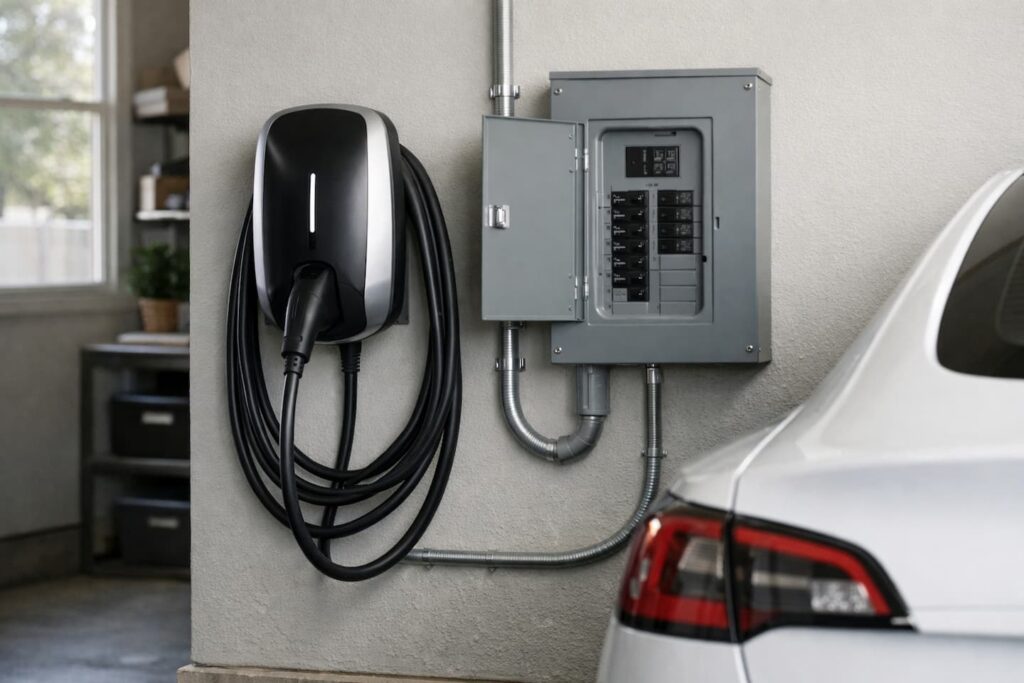
EV Charger Not Working at Home? A Complete Troubleshooting Guide for San Francisco Homeowners
If your EV charger is not working, charging stops randomly, or the speed suddenly drops, you’re not alone. Home charging problems are common—and the cause is often not the charger itself, but the power supply, circuit design, outlet condition, panel capacity, or a protection device doing its job.
If you’d like a licensed electrician to diagnose the circuit, confirm code compliance, and install a safe long-term solution, our team can help with EV charger installation in San Francisco.
A reliable home charging setup usually starts with verifying the electrical fundamentals (power, breaker, wire size, grounding, and connection quality), then matching them to your charger’s requirements.
This guide is written to answer the real search intent behind queries like “EV charger not working,” “home EV charger not working,” “EV charger not charging,” “EV charger troubleshooting,” and “EV charger problems.” It’s also built to be practical: what you can check safely, what different symptoms often mean, and when it’s time to call a professional.
Safety first (read this before troubleshooting)
EV charging is continuous, high-current electrical load. That means minor issues—like a loose connection or a worn receptacle—can turn into overheating and real risk.
Stop charging and call a licensed electrician if you notice any of the following:
- A burning smell, smoke, or visible scorching near an outlet, plug, or charger
- The plug, connector, or outlet feels hot (not “slightly warm”—actually hot)
- Crackling, buzzing, or arcing sounds from an outlet, breaker, or panel
- A breaker that trips repeatedly and won’t stay on
- Melted plastic, discoloration, or a charger that shows repeated faults
What you can safely do:
- Check the charger’s basic power status (lights, app status)
- Confirm the car is set to charge (schedule, charge limit)
- Reset the charger only using the manufacturer’s normal reset process
- Inspect the visible parts (cord, plug, outlet face) for heat or damage
What you should not do:
- Do not open the electrical panel or attempt to tighten/replace wiring
- Do not “upgrade” breaker size to stop tripping
- Do not use extension cords or questionable adapters for Level 2 charging
Start here: a quick “what’s happening?” checklist
Most EV charger issues fall into one of these symptom buckets:
- EV charger not working (no lights, no response, dead unit)
- EV charger not charging (charger has power but car won’t charge)
- Charging starts then stops (charging interrupted / keeps stopping)
- Charging is too slow (not charging at full speed)
- Charger is offline / won’t connect to Wi-Fi
- Outlet/plug issues (warm/hot, discoloration, intermittent connection)
- Breaker/GFCI/AFCI issues (tripping, won’t reset)
- “Should I unplug/turn off when not in use?” and idle power questions
Work through the section that matches your symptom. If more than one symptom applies (e.g., “slow charging” plus “hot plug”), treat the safety symptom as the priority.
EV charger not working (no power / dead unit)
This is the classic “EV charger not working” or “home EV charger not working” search intent: the unit appears dead—no lights, no app connection, no response when plugged in.
Common causes
A. Loss of power to the charger (most common)
- Breaker tripped or switched off
- GFCI outlet tripped (if the charger is plug-in)
- A disconnect or upstream protection device tripped
- A failed or loose outlet connection causing intermittent power
B. Charger internal fault or failure
- Internal components fail (rare on newer units, but it happens)
- Moisture intrusion (outdoor installs or poor sealing)
- Heat stress over time (especially if charging at high amperage on marginal wiring)
C. Supply voltage issue
- If the circuit is under-voltage, some chargers won’t boot normally
- Long wire runs with undersized conductors can contribute to voltage drop
What you can check safely
- Confirm the charger’s status lights and app state.
- If it’s plug-in, check whether the outlet is powered by testing a different known-working device (only if it’s safe and appropriate).
- If you have a home charging schedule, temporarily disable the schedule to test immediate charging.
When to call an electrician
If the unit is consistently dead at home but works elsewhere (or a different EVSE behaves similarly on the same outlet/circuit), the issue is usually the circuit—breaker, outlet, wiring, or panel conditions. A professional diagnosis is the fastest way to avoid repeated faults and prevent overheating.
EV charger not charging (powered on, but the car won’t charge)
This is the next most common pattern behind “EV charger not charging” and “why is my EV charger not working.”
The key concept: EV charging is a handshake
Your car and charger communicate before power flows. If the handshake fails, charging won’t start even if the charger is “on.”
Common causes
A. Charging is blocked by settings
- The car has a schedule enabled (charge window not active)
- A charge limit is set (vehicle already at limit)
- The charger is set to “restricted” or needs authorization (some smart chargers)
- Utility demand response settings or smart features may delay charging
B. Connector/port issue
- Dirty or wet connector pins
- Connector not fully seated/latched
- Vehicle charge port issue (less common, but possible)
C. Fault detection doing its job
Modern EVSEs can stop charging due to:
- Ground fault detection
- Overtemperature detection
- Voltage irregularities
- Internal fault codes
What you can check safely
- Remove schedules temporarily and try “charge now.”
- Re-seat the connector firmly.
- If possible, test on a different known-good charger (public or a friend’s) to isolate whether it’s the car or the home setup.
When it’s likely a home electrical issue
If the charger “looks fine” but charging consistently fails at home, it may be:
- A marginal connection at the outlet (plug-in EVSE)
- A circuit that can’t support the set amperage
- A protection device nuisance-tripping (sometimes it trips so fast you don’t notice)
Charging starts then stops (EV charger keeps stopping / charging interrupted)
Search phrases in this category include “EV charger keeps stopping,” “charging interrupted,” and “starts then stops.”
This symptom often points to heat, protection devices, or instability in the supply.
The most common reasons charging stops after starting
A. Overheating at the plug/outlet (plug-in chargers especially)
High current + imperfect connection = heat. If the EVSE detects abnormal heat (or if the car detects it), it may reduce power or stop charging.
B. Breaker/GFCI/AFCI nuisance trips
Some protective devices trip due to certain waveform characteristics or leakage current patterns—even when nothing is “wrong” with the car. It’s not uncommon to see EV charging expose borderline circuits.
C. Voltage drop under load
A circuit can look “fine” at idle, then sag under continuous charging load. Some EVSEs and vehicles respond by throttling down or stopping.
D. Smart charging logic
- Scheduling toggles
- Utility events
- Cloud connectivity interruptions (some chargers depend on app authentication)
- Load management systems limiting power
What you can check safely
- Note how long it charges before stopping (immediate vs 10 minutes vs 1–2 hours). That timing pattern matters.
- Feel the plug/outlet face carefully (if it’s warm/hot, stop charging).
- Try a reduced amperage setting if your charger supports it (this is often a safe test to identify overload/heat issues). Don’t “force” higher current to “make it work.”
When to stop troubleshooting and get help
Repeated interruptions aren’t just inconvenient—they often indicate:
- A connection that’s heating up
- A circuit that’s not designed for continuous high load
- A protection device mismatch or failing hardware
That’s exactly the scenario where a properly designed Level 2 install (correct breaker, wire, termination, and equipment choice) becomes the real fix—not repeated resets.
EV charger not charging at full speed (slow charging / reduced amps)
Queries like “why is my EV charger not charging at full speed” typically come from people who expect a certain miles-per-hour rate and suddenly see much less.
First: know what “full speed” actually means
Your max charging rate depends on:
- Charger output capability (e.g., 32A, 40A, 48A)
- Circuit size (breaker and wire sizing)
- Vehicle onboard charger limit (the car may cap it)
- Battery state/temperature (cars reduce rate when cold/hot or near full)
- Voltage (208V vs 240V changes kW)
Common causes of slow charging
A. Charger is set to a lower amperage
This can happen after a reset, firmware update, or when “share power” modes are enabled.
B. The car is limiting the rate
- Battery too cold/hot
- Battery near a high state of charge
- The car detects heat at the connector/port
C. Voltage drop
Long wire runs, undersized conductors, or a heavily loaded panel can cause enough drop to reduce kW.
D. Smart load management
Some homes intentionally throttle EV charging to avoid a service upgrade. This is normal when configured that way.
What you can check safely
- Confirm the charger’s configured amperage matches your circuit.
- Check the car’s charging screen for “limited” messages (temperature, schedule, etc.).
- Compare behavior at different times (if other home loads change the outcome).
When slow charging is a signal of a bigger problem
If slow charging is paired with:
- Warm/hot outlet
- Repeated interruptions
- Frequent breaker trips
…then “slow” may actually be a protective reaction to heat or instability.
EV charger not connecting to Wi-Fi / charger offline
This category includes “EV charger not connecting to Wi-Fi,” “EV charger offline,” and app-related issues.
Why Wi-Fi matters (and when it doesn’t)
Many chargers will still charge without Wi-Fi, but Wi-Fi enables:
- Firmware updates
- Scheduling and energy tracking
- Load sharing features
- Remote diagnostics
Some units, however, may behave oddly if they require authentication or cloud services for certain modes.
Common causes
- Only 2.4 GHz supported (many chargers don’t support 5 GHz)
- Weak signal in garage
- Router security settings blocking onboarding
- Firmware stuck mid-update
- App account/authorization issues
Practical steps (safe and reasonable)
- Ensure 2.4 GHz is available.
- Improve signal (mesh node closer to garage).
- Restart the charger using the manufacturer’s supported method.
If connectivity issues accompany charging faults, the electrical side still needs evaluation—Wi-Fi problems shouldn’t cause overheated plugs or tripping breakers.
Should you unplug or turn off an EV charger when not in use?
People search this because they want to be safe, reduce risk, or lower power costs.
Do EV chargers use electricity when not charging?
Most modern EVSEs use a small standby amount to keep electronics alive, maintain network connectivity, or power indicator lights. The cost is usually minor compared to actual charging.
Should you unplug it?
- Hardwired chargers: You don’t “unplug” these, and you generally don’t need to turn them off routinely.
- Plug-in chargers: If the outlet and plug are high quality and properly installed, leaving it plugged in is typically fine. Frequent unplugging can add mechanical wear over time.
When it does make sense to turn off or unplug
- If the outlet/plug shows any heat, discoloration, looseness, or arcing signs
- If the charger is outdoors and exposed (weatherproofing concerns)
- If you’re leaving for an extended period and prefer to de-energize nonessential loads
If you have any concern about outlet quality, the long-term fix is a properly installed, EV-rated receptacle—or switching to a hardwired charger.
Plug-in charging problems and NEMA 14-50 outlet issues (warm/hot plug, discoloration, intermittent power)
Even when search tools show low volumes, these issues produce real long-tail traffic and high conversion because they’re safety-driven.
If you use a NEMA 14-50 outlet for charging, outlet quality and installation quality matter a lot. A loose termination, worn contacts, or a non-EV-rated receptacle can overheat under sustained load.
If your setup relies on a plug-in configuration, consider a professional evaluation or a dedicated outlet install designed for continuous EV load. We offer professional NEMA 14-50 outlet installation in San Francisco.
A properly selected receptacle, correct wiring method, and secure terminations can eliminate many “mystery” interruptions and heat symptoms.
Common signs the outlet/plug is the real problem
- Plug is warm/hot
- Outlet faceplate is warm
- Discoloration on outlet slots
- Plug feels loose or doesn’t “seat” firmly
- Charging stops after 20–60 minutes (heat buildup)
Why it happens
EV charging is a continuous load. Any weakness in:
- contact pressure inside the receptacle,
- termination tightness,
- conductor sizing,
- or the outlet’s component quality
will show up as heat over time.
What to do immediately if you suspect overheating
Stop charging and have it assessed. Do not try to “make it work” by reducing vigilance—heat is a warning sign, not a minor inconvenience.
Breaker trips, GFCI trips, AFCI trips—why protection devices can interrupt EV charging
Some of the most frustrating EV charger problems are related to protection devices:
- “It charges for a while, then trips.”
- “It trips only at higher amps.”
- “It trips randomly.”
Even if these phrases don’t show huge volumes in your keyword tool, they often appear in Search Console later as long-tail queries.
Common reasons breakers trip during EV charging
A. Circuit overload or wrong circuit design
EV charging should be on a dedicated circuit sized for the charger’s configured output.
B. Weak/aging breaker
Breakers can wear out or become sensitive over time.
C. Loose connections causing heat
Heat near the breaker or in the panel can lead to nuisance trips or real trips.
D. GFCI/AFCI compatibility issues
Some combinations of chargers and protection devices can produce nuisance trips. The solution depends on the wiring method, equipment, and code requirements—not on “disabling protection.”
The right way to fix repeated trips
Repeated trips are a message: the system is either protecting you from a real issue or revealing a mismatch.
The correct fix is typically one of:
- Dedicated correctly sized circuit
- Correct breaker type selection for the application
- Hardwired installation where appropriate
- Load management configuration if service capacity is tight
- Addressing any loose/overheated terminations
This is also where many homeowners realize their “temporary plug-in solution” needs to become a proper permanent installation.
Tesla Wall Connector and Tesla-specific charging issues (when the electrical system is the root cause)
Tesla setups are extremely common in San Francisco. Many “Tesla charger problems” still trace back to the home electrical circuit, not the unit itself.
If you’re installing or troubleshooting a Tesla Wall Connector, you may also find it helpful to review Tesla charger installation services.
A Tesla Wall Connector can be very reliable, but only when it’s paired with a circuit that’s designed for its continuous output and configured correctly.
Common Tesla-related symptoms that often point to the electrical side
- Charging starts then stops after a period
- The charger limits amps unexpectedly
- Repeated faults that coincide with other home loads
- Heat at the connection point (especially with plug-in alternatives)
A note on “fault lights” and error indicators
It’s fine to consult the manufacturer’s guidance for basic interpretation. But if the symptom is accompanied by heat, repeated trips, or voltage issues, treat it as an electrical diagnosis problem—not an app problem.
San Francisco-specific factors that cause EV charging problems
SF homes often have a few patterns that directly affect EV charging reliability:
Older electrical infrastructure
- Older panels and limited service size (100A is common)
- Older wiring methods in certain neighborhoods/housing stock
- Space limitations and long runs to garages
Condos, multi-family buildings, and shared electrical systems
- Shared garages, meter rooms, HOA rules
- Load calculations and allocation for multiple units
- Complex routing for conduit and dedicated circuits
Permits and inspections
For compliant and insurable installations, permits and inspections matter. A well-planned install typically avoids “surprises” like failed inspections, required changes late in the project, or unsafe stopgap wiring.
When the best “fix” is actually a proper installation or upgrade
If you keep troubleshooting and the problem returns, it often means the system was never designed for EV charging as a continuous load.
A professional approach typically includes:
- Confirming panel capacity and breaker availability
- Verifying wire sizing, voltage stability, and grounding
- Choosing the best connection method (hardwired vs receptacle)
- Setting safe current limits based on real circuit capability
- Addressing any overheating risk at outlets/terminations
- Handling permitting when required
If your goal is to stop fighting intermittent issues and get a reliable daily charging routine, start with a proper evaluation and install plan.
FAQ (covers the main traffic questions)
Need a reliable long-term fix in San Francisco?
Troubleshooting is useful, but if your EV charger not working problem repeats—or if you notice heat, interruptions, or nuisance trips—the safest and fastest path is a professional evaluation and correctly designed installation.
Explore EV charger installation in San Francisco. A properly designed Level 2 setup—whether hardwired or paired with an EV-ready outlet—doesn’t just fix today’s charging headaches. It delivers reliable daily charging, reduces nuisance trips and overheating risk, and keeps your home charging circuit safe and code-compliant for the long run.